What is Orkas?
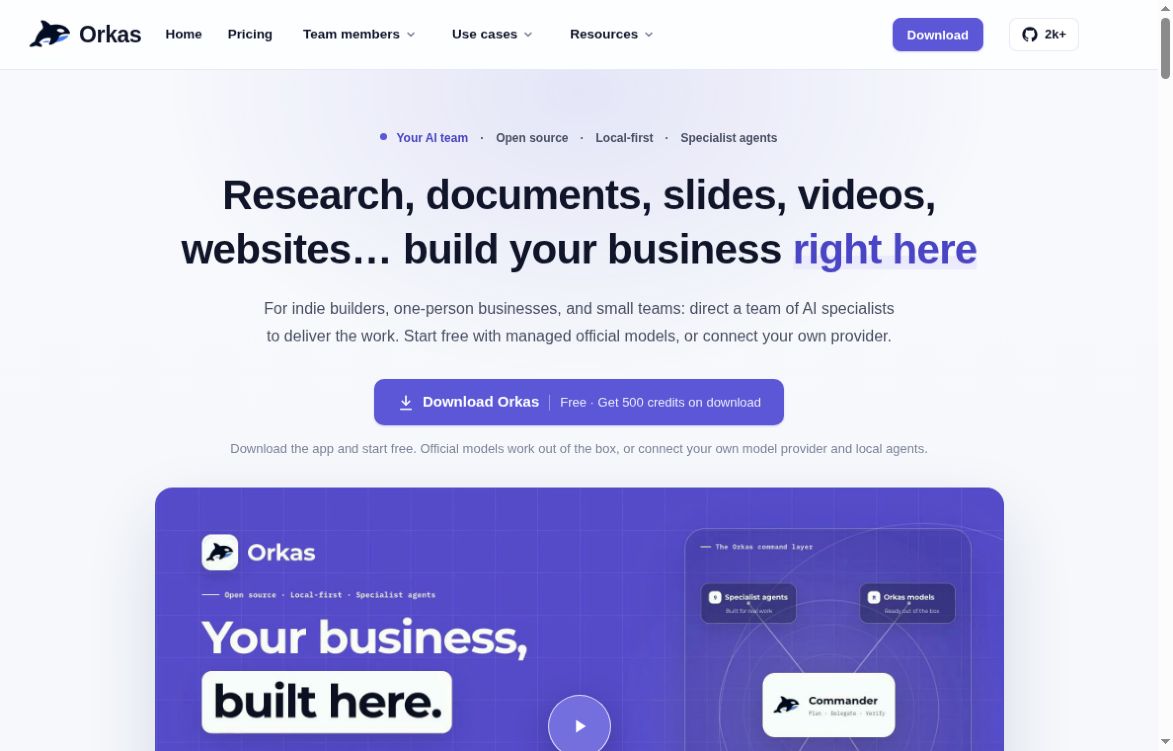
Orkas is an open-source, local-first desktop application that coordinates specialist AI agents through a Commander interface. Its official website presents workflows spanning research, documents, slides, websites and development, with packaged downloads for macOS and Windows. The idea is useful for people whose work crosses several formats: instead of treating a report, presentation and supporting files as unrelated chats, they can evaluate a coordinated task workflow. Whether that is worthwhile depends on the quality of the finished files and the effort needed to review them.
What is new in the October release?
The official October 17, 2026 release improves the Commander home for returning to unfinished tasks and unread results. It also describes clearer project actions and task boards, plus cleanup controls with recoverable removal. These changes are relevant to recurring work where finding the next unfinished item matters as much as starting a new prompt. They are release-note claims, not results from our own test. Orkas existed before this update; an October directory listing should not be presented as proof that the entire product launched that day.
How the task workflow is organized
The user guide starts with a requested outcome, relevant source material and constraints, then lets users choose models or connect external coding agents. Projects, skills and connectors provide additional structure. Outputs can be opened and revised within the task context. For a first evaluation, the important principle is to define a deliverable clearly: specify its audience, format, evidence requirements and actions that need approval. A broad instruction such as “help my business” makes it much harder to judge whether the result is useful.
Local-first does not mean entirely local processing
According to the security documentation, work is stored on the machine by default. Requests using your own model-provider credentials go directly to that provider, while managed models use Orkas’s service. Optional cloud sync stores synced data on Orkas servers. These are different data routes, not different labels for fully offline processing.
Before attaching sensitive material, identify which provider and connectors the task will use. Local storage alone does not answer where an inference request is processed. The security page also explains that its local credential encryption is not protection against an attacker who possesses both the disk and application. Treat the documentation as a description of the vendor’s design, rather than an independent security certification.
Free access and an important pricing caveat
The pricing page lists a free download and 500 welcome credits claimed through desktop login. It also displays Lite, Pro and Max plans, but the same page visibly identifies a Stripe sandbox/dev mode with test cards and no real charge. For that reason, this profile does not present the listed paid offers as verified live purchasing options. Confirm production billing availability with the provider before planning a paid deployment. Model-provider charges may also apply when bringing your own account. Pricing and the sandbox notice were checked on October 21, 2026.
A concrete first project to try
Consider a hypothetical comparison brief for a small team choosing between three publicly documented software tools. Use only public product links initially. Ask for a short document separating verified features, listed prices, unresolved questions and the sources supporting each point. Specify that no account creation, outreach or purchase should occur. This follows the outcome-and-context approach in the official guide, without assuming that every task will succeed automatically.
Review the source links before asking for a slide version. Check whether annual prices have been mistaken for monthly billing, whether missing information has been acknowledged, and whether the recommendation follows your stated criteria. Only then request another format. Keeping the first project bounded makes it easier to distinguish a genuinely useful workflow from attractive but unsupported output.
Measure the time required to verify and repair the final deliverable, not just the time until a completion message appears. Save an original copy of any important input file and inspect changes before reusing them. This is a suggested trial, not hands-on evidence of accuracy or a promise of autonomous completion.
Who should evaluate Orkas?
Orkas is a reasonable candidate to investigate if you want a desktop-centered way to coordinate several kinds of AI work and are comfortable checking data routes and outputs. Someone seeking a single quick answer may not need the added structure. Its repository uses the MIT license, which covers software and associated documentation subject to its notice requirements; that does not automatically grant rights to unrelated third-party assets.
For related agent-focused reading, see our Manus profile and Genspark AI profile. Compare actual deliverables, review effort and information handling rather than assuming that a larger set of agents means a better result.