OpenRouter said on November 22 that it has off-boarded three providers from its platform and removed 125 endpoints from Zero Data Retention (ZDR) eligibility, after canary-token research caught inference providers copying or mishandling customer prompts. The same weekend, Together AI disclosed its own breach: the Together AI prompt leak began when an AI coding agent committed a credential to a public GitHub repository, letting an unauthorized party download stored samples of customer prompts.
The two disclosures are the latest developments in the prompt-theft saga that began when Dragos published its canary-token study on November 19. GPTOnline covered that study in an earlier article on the three provider breaches, and covered OpenRouter’s November 21 email warning that MiniMax prompts may have been read in a follow-up on the MiniMax warning.
What OpenRouter did
In a post published November 22, OpenRouter said it had worked with the Dragos researchers and providers to understand the findings. Its actions were: off-boarding three providers based on the results of its investigations; removing 125 endpoints from ZDR eligibility, including providers flagged by the researchers plus additional endpoints removed as a precaution; and notifying all potentially affected customers. The company stressed that the findings did not show any breach or unauthorized access of OpenRouter itself.
OpenRouter said it is adapting the researchers’ tests to run them on an ongoing basis, is verifying network paths for cases where requests may be forwarded to third parties, and will require assurances and validation before restoring ZDR eligibility to any removed endpoint. “As we integrate similar testing techniques into OpenRouter, we will keep raising the bar, and providers that want to be on OpenRouter will need to meet it,” the company wrote.
The post links public security notices from three providers: Novita, Phala and Together AI. OpenRouter noted that not all affected providers have posted publicly, and said it has notified affected users regardless.
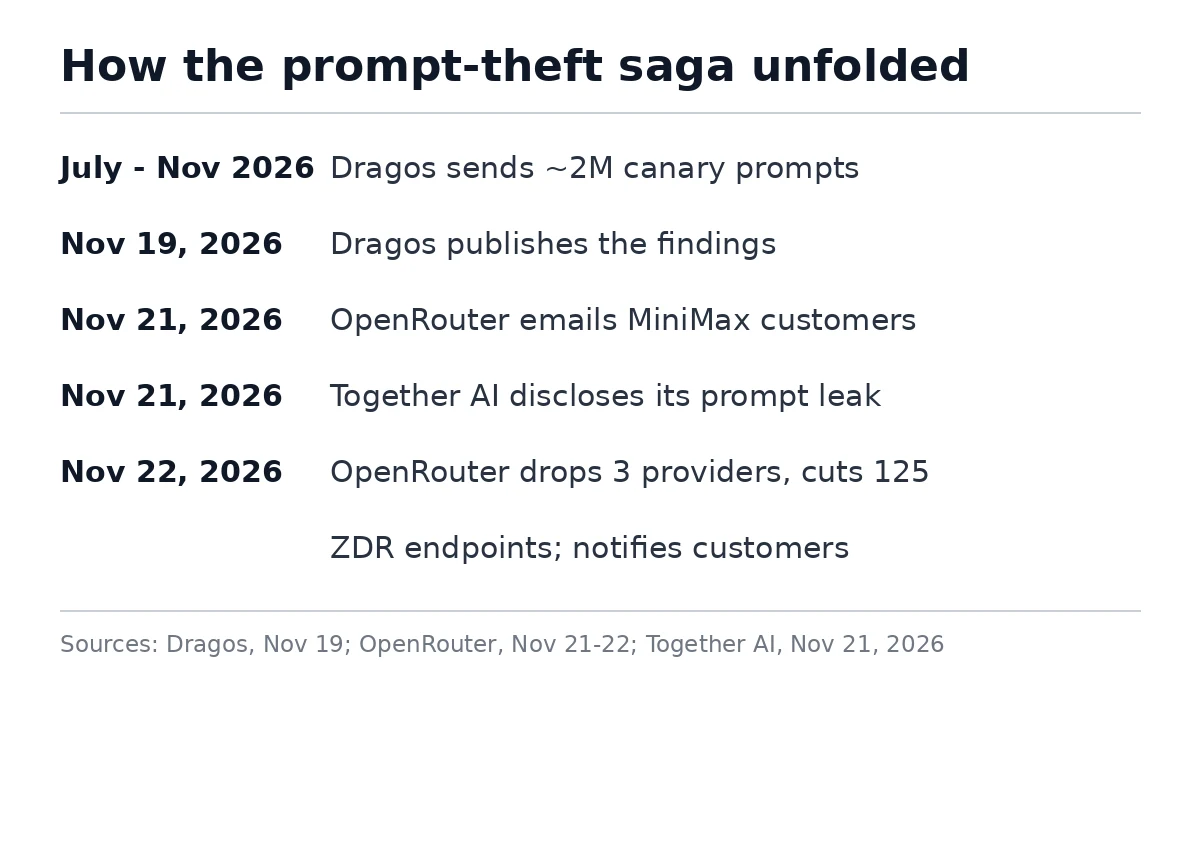
Timeline: GPTOnline, based on Dragos, OpenRouter and Together AI disclosures, Nov 19-22, 2026
What the Together AI prompt leak exposed
Together AI chief executive Vipul Ved Prakash published the disclosure on November 21. As part of routine software testing, the company had collected prompt samples that customers had authorized for that use, and stored them in a private Hugging Face repository. The samples came from requests to the MiniMax M3, GLM-5.2 and Kimi K2.6 models, mainly on June 24, July 4, July 8 and July 14, 2026.
During development of its public GitHub repository, xorl, an AI coding agent committed a credential that provided access to that private repository. Together AI said its automated scanning detected the exposed credential and reverted the commit. But during the exposure window, an unauthorized party obtained the credential and used it to download the stored prompt samples. The party then searched those samples for credentials to other services and tested whether those credentials were valid. Five of the credentials tested were canary credentials planted as part of the Dragos security experiment, which is how the leak surfaced.
“We apologize for this incident,” Prakash wrote. The company said it is working with an external forensic investigation firm and law enforcement, has found no evidence of additional prompt leakage beyond this incident, and understands the downloaded data has now been deleted. Its review of the affected contents is still ongoing, to determine whether sensitive personal information or other customer data was exposed; it will contact affected customers directly.
Together AI listed four changes it has made since the incident: using scoped or short-lived credentials, and keyless access where supported; checking all pull requests for credentials; making zero data retention the default setting for new accounts; and updating its development processes governing the use of AI coding agents. Customers handling sensitive prompt data should enable ZDR in their account settings, the company said.
What the other providers disclosed
At Phala, an attacker took control of an inference server and could view request data while it was being processed, according to the provider’s preliminary incident report. The incident was contained on November 8, and requests to the DeepSeek V4 Flash 0731 model that reached Phala through the gateway between October 21 and November 8 should be treated as exposed, with every key, token, password or other secret in them rotated. At Novita, a routing configuration issue caused some MiniMax requests to be sent on to MiniMax’s official API, beyond what was intended for those customers.
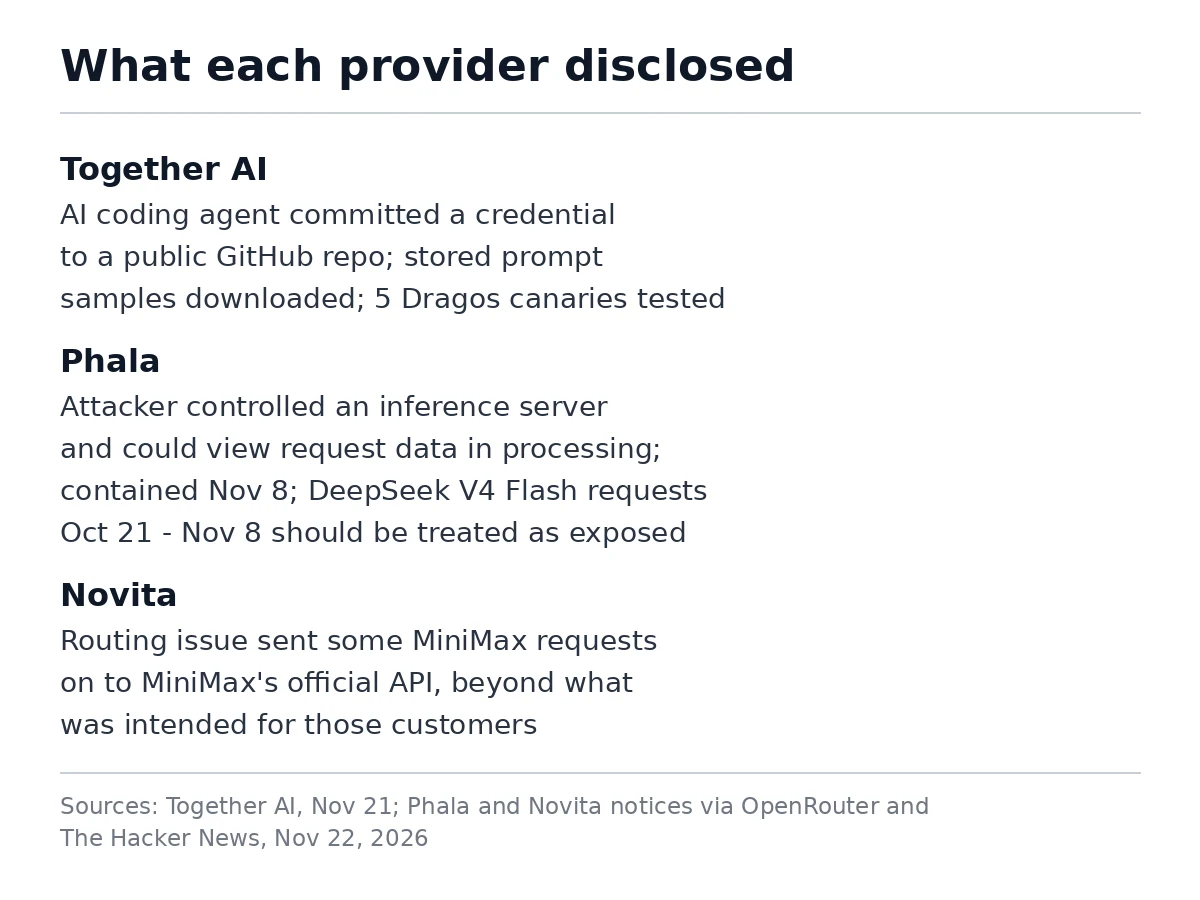
Chart: GPTOnline, based on Together AI, Phala and Novita disclosures, Nov 21-22, 2026
What is still not known
One detail remains unconfirmed: Dragos has not named the three breached providers, OpenRouter has not named the three it removed, and neither has said publicly whether they are the same three. The Together AI leak is also a separate event from the three provider breaches described in the Dragos study, not one of them. Readers should not assume the three off-boarded providers are Novita, Phala and Together AI simply because those three posted public notices.
Why it matters
The weekend’s disclosures show that a “Zero Data Retention” label is only as reliable as the provider behind it. The Dragos study found providers kept or copied prompts even under ZDR policies, and the Together AI case shows a second failure mode: data stored for legitimate testing, then exposed by an AI coding agent’s mistake in a public repository. For anyone sending sensitive prompts through third-party providers, the advice is now the same: enable ZDR where offered, rotate any credentials that appeared in prompts sent through affected providers, and treat a provider’s data policy as a claim to verify, not a guarantee.
Sources
- OpenRouter: Data Processing Incidents on Inference Providers (Nov 22, 2026)
- Together AI: Security event, prompt leakage for requests in June and July of 2026 (Nov 21, 2026)
- The Hacker News: OpenRouter Drops 3 Providers After Researchers Catch Months of Prompt Theft at AI Hosting Firms (Nov 22, 2026)