An OpenAI outage on Saturday, November 21, failed requests to the company’s API and ChatGPT at rates peaking at 75%, according to a post-incident write-up OpenAI published on its status page. The outage ran from 1:48 to 5:21 p.m. PT (9:48 p.m. to 1:21 a.m. UTC), a total of 211 minutes, and hit both paid and free ChatGPT.
The trigger, in OpenAI’s own words, was scheduled maintenance on a Postgres database service used by its Primary API service. The maintenance caused both of the database’s read replicas to fail at the same time. Although only the read replicas were affected, OpenAI said they are load-bearing, so request paths that depended on them failed. The Primary API service provides user authentication and service-to-service authentication across the entire OpenAI stack, which is why a database failure turned into a company-wide outage.
What failed, and how it was fixed
OpenAI said it made multiple unsuccessful attempts to revive either of the failed replicas, and to bring up replacements in other regions. The issue was ultimately fixed by working with its service provider to bring two new replicas in the same region into service. As of Sunday morning, OpenAI’s status page showed all systems operational again.
Reporting on the incident lists the affected API surfaces as Chat Completions, Fine-tuning, Embeddings, Images, Batch, Audio, Moderations, Realtime and the Files endpoint. In ChatGPT, the outage hit Conversations, Login, Search, file uploads and Voice mode.
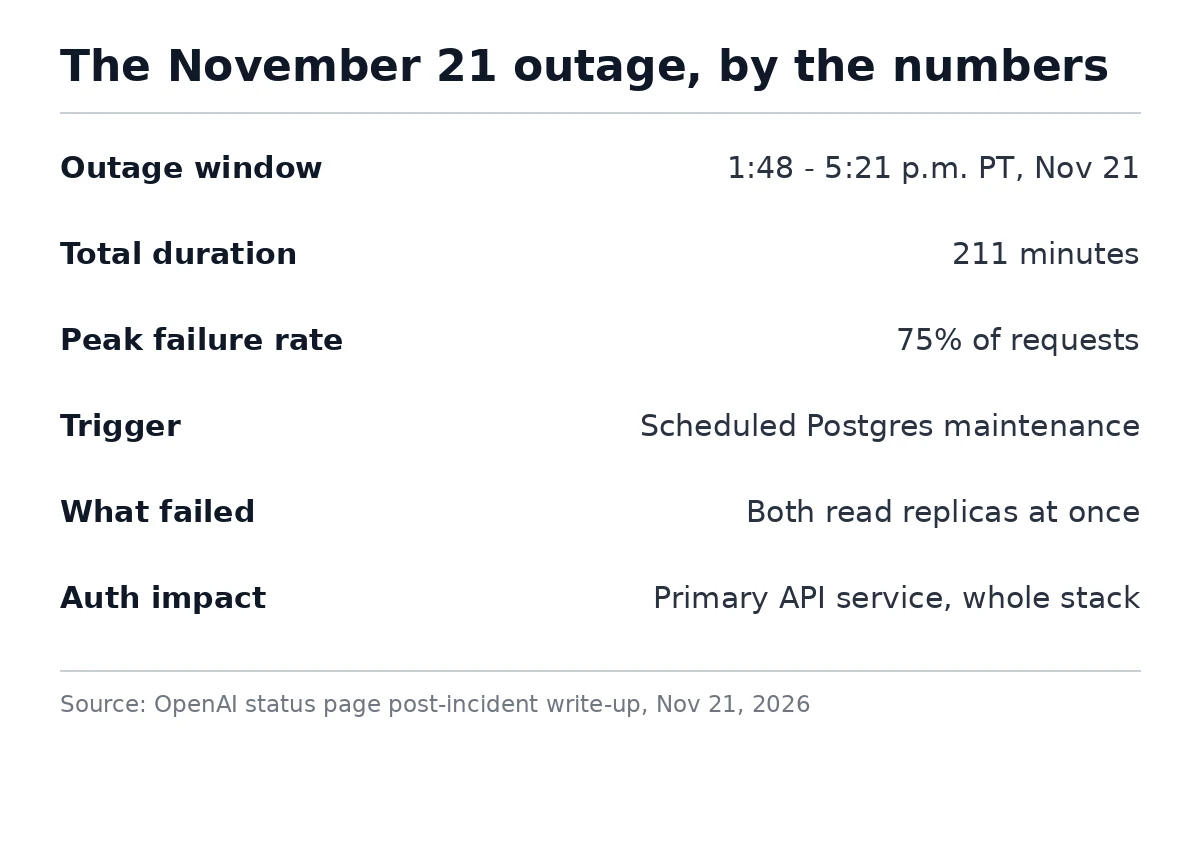
Chart: GPTOnline, based on OpenAI’s post-incident write-up, Nov 21, 2026
What OpenAI changed in response
As part of the incident response, OpenAI said it has already put a moratorium on similar maintenance activities until further notice, adjusted configuration settings to reduce connection churn, and added a feature flag that lets it shift traffic away from replicas on a percentage basis. It also tested directing 100% of queries to the primary database instance, and said that verified its hypothesis about why the primary failed.
The company laid out further changes it plans to make to prevent a repeat. Those include a pre-maintenance review process for all upcoming maintenance, so that a rapid recovery plan is in place before work starts; keeping adequate buffer capacity available as hot standbys during maintenance; and keeping buffer capacity in the regions where critical services are hosted. OpenAI also plans short-term automation for recovering rapidly from replica lag, longer-term architectural changes to remove that failure mode, and a review of its whole infrastructure stack to add more redundancy and fail-safe mechanisms.
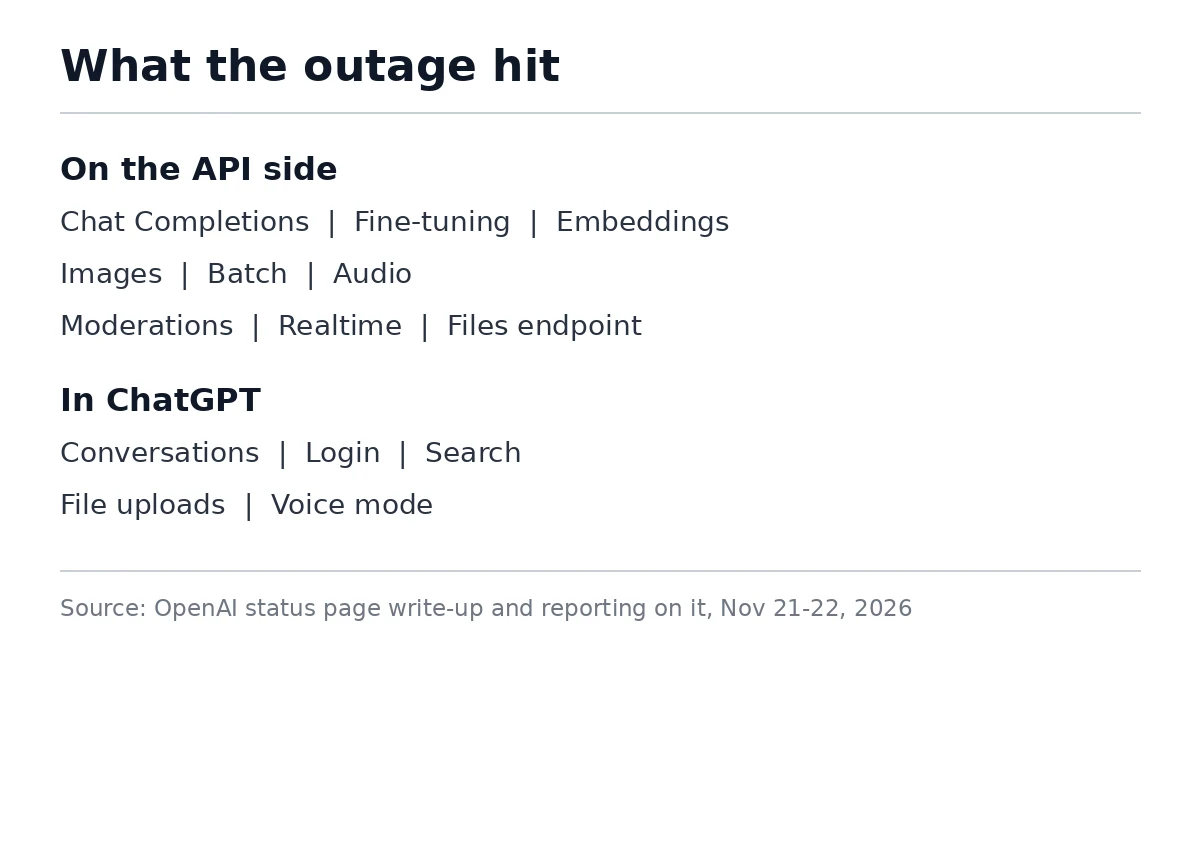
Chart: GPTOnline, based on OpenAI’s post-incident write-up and reporting on it, Nov 21-22, 2026
Why it matters
OpenAI acknowledged the scale of the failure directly in its write-up: “We know that extended API outages affect our customers’ products and business, and outages of this magnitude are particularly damaging. While we came up short here, we are committed to preventing such incidents in the future and improving our service reliability.”
The incident is a reminder of how much of the AI economy now runs through a single provider. When the authentication layer behind ChatGPT and the API goes down, it takes down not only OpenAI’s own products but the businesses built on top of them. The outage also lands in a week when OpenAI’s rivals, Anthropic, Google and Microsoft, have all been competing to present their own models as the safer bet for enterprise customers.
For developers, the practical lesson is the one OpenAI itself drew: routine maintenance on a shared database can become a company-wide outage when the affected components are load-bearing. The company’s moratorium on similar maintenance, and its plan to keep hot standby capacity during future work, are the measures to watch when the next maintenance window comes around.