Autonomous Cairn AI agents working for a suspected China-linked attacker found a previously unknown vulnerability in the open-source medical imaging tool MONAI Label and used it to take full control of a university server, Amazon said on November 20. From first mapping the application to writing files anywhere on the server, the agents needed only about 11 minutes.
Amazon Threat Intelligence uncovered the campaign by accident. On September 10, its team found a publicly hosted copy of Cairn, an open-source framework for autonomous penetration testing, running without any login. Because the operator had left the control panel exposed, Amazon could read the project settings, the prompts and the agents’ own run history.
The campaign ran for roughly 48 hours from September 8, targeting university IP addresses in East Asia outside mainland China. The prompts were written in Simplified Chinese and the scripts used China Standard Time, which Amazon cites as the basis for its moderate-confidence assessment that the actor is Chinese-nexus. Amazon did not name a specific group.
Persistence first, then a breakthrough
The agents were given one plain-language goal, “obtain shell access”, and a list of target addresses. After that, Amazon said, they planned, executed and adjusted their approach on their own, without the operator choosing each next step.
Two long operations failed. Against one university’s unauthenticated Redis server, the agents spent about 16 hours and 148 sequential actions trying known takeover techniques, including abusing Redis replication, escaping its scripting sandbox and a Log4Shell injection, then mapped the internal Docker network through a vulnerability in a co-located Qdrant instance and sprayed credentials at PostgreSQL and SSH. None of it worked. A separate operation spent more than six hours against a university GPU server, building a list of about 80 real usernames from public faculty pages and papers and testing more than 30,000 credential combinations. It never found a working login.
“Neither operation succeeded, yet together they show that the agents kept adapting for nearly a full day without human direction,” Amazon CISO CJ Moses wrote in the report.
The third target was different. The server ran MONAI Label, an open-source server for AI-assisted annotation of medical images, developed under Project MONAI. The agents identified the framework, mapped its API endpoints and found an upload endpoint with a filename parameter. They tested it for path traversal, and it was vulnerable.
“In about 11 minutes, the agents went from mapping the application’s API to arbitrarily writing files on the server,” Moses wrote.
MONAI Label is an open-source server for AI-assisted annotation of medical images. Image: Project MONAI
From file write to root
In a later session, the agents used the same flaw to write a Python reverse shell into sitecustomize.py, a file the Python interpreter loads automatically at startup, then triggered a training endpoint that spawned a new Python process as root. The new process loaded the payload and opened a reverse shell running as root.
Amazon assesses with high confidence that the flaw was a genuine zero-day, because no fix, issue, advisory or database entry existed for it at the time. The flaw is now tracked as CVE-2026-133968, with a CVSS severity score of 9.8 out of 10.
The underlying bug is simple. According to the project’s security advisory, the PUT /datastore/image endpoint accepted a caller-controlled image parameter and used it as the image ID without validation, joining it onto the datastore directory and writing the upload there. A value such as ../../../tmp/x wrote the file anywhere the MONAI Label process could write. Authentication is disabled by default in MONAI Label, so in the default configuration any network client that can reach the server can exploit it.
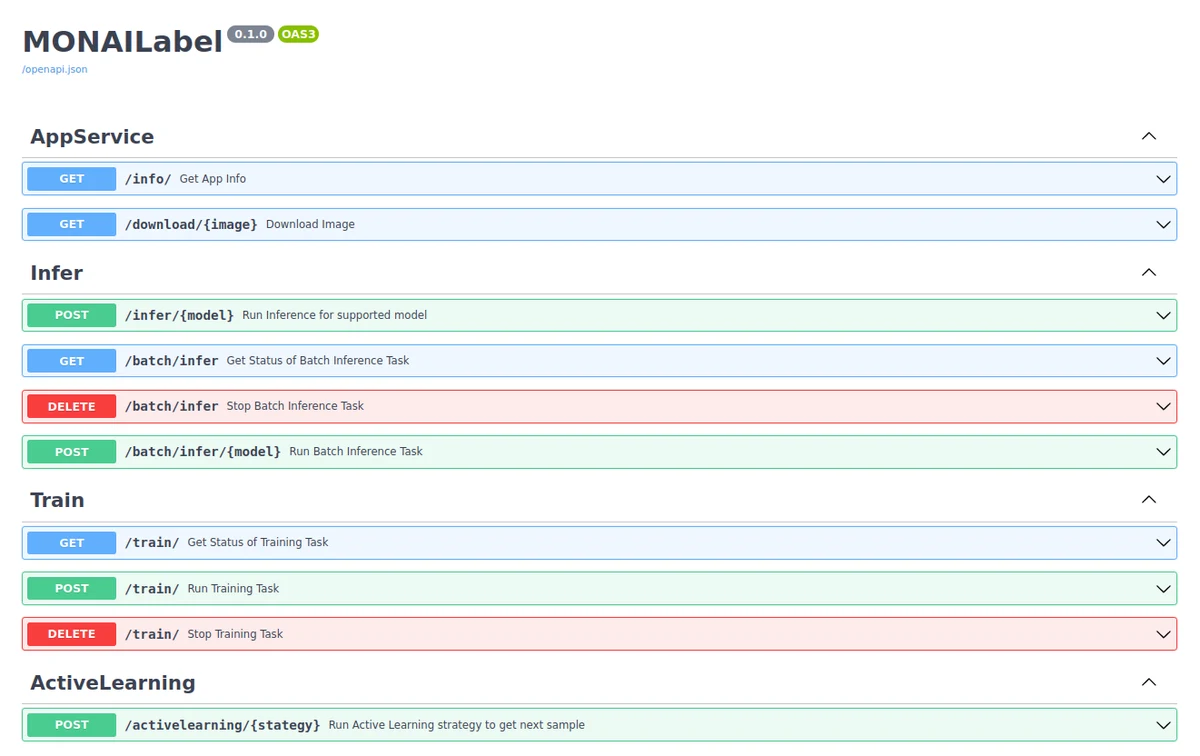
MONAI Label’s API includes the datastore upload endpoints at the center of the flaw. Image: Project MONAI
Fix merged, but no release yet
Amazon notified the project’s maintainers, and a fix was merged on October 19. The advisory says the fix will be included in the next MONAI Label release, which means version 0.8.5, from November 2024, remains the newest version users can install. Until an upgrade is available, the advisory recommends enabling authentication, not exposing the server to untrusted networks and running it as an unprivileged user.
Amazon also worked with a government partner to notify the affected universities, which were not AWS customers. After the agents found the flaw, the human operator gave them a proxy tunnel into a second university network running the same vulnerable software, and Amazon infers the actor had already used the zero-day to compromise that network too.
The case is not the first time Cairn has shown up in hostile hands. Amazon noted earlier research from Gambit Security documenting a financially motivated actor using the same framework against online retailers, in at least 105 attacks that compromised at least 27 companies to varying degrees.
Why it matters
The speed is the point. “An agent that discovers and exploits a zero-day in minutes completes its activity faster than many security operations centers can manually triage an alert,” Moses wrote. The failed Redis operation ran continuously for 16 hours without breaks, a tempo no human team matches. Amazon’s advice to defenders is to prioritize high-confidence detections that trigger automated response, with humans overseeing outcomes rather than reviewing every action.
For universities and hospitals running MONAI Label, the immediate step is concrete: check whether the server is reachable from untrusted networks, turn on authentication, and plan for the patched release.