OpenAI has published its most detailed account yet of how it fights adversarial distillation, the practice of using a frontier model’s outputs without authorization to train a rival model, and says new safeguards in GPT-6.2 Astra cut one attack’s success rate from 54.0% to 0.2% in its own red-team tests.
“Adversarial distillation creates a path for bad actors to reproduce these capabilities without appropriate safeguards,” OpenAI wrote in the November 20 post, titled “Combatting adversarial distillation.” The company also named DeepSeek and Moonshot AI in connection with distillation campaigns it says it has disrupted or briefed Congress about.
What adversarial distillation is
Distillation itself is a common machine-learning technique: one model learns from data produced by another. It becomes adversarial when an actor uses a frontier model’s outputs without authorization to train a second model with similar capabilities, then deploys that model without comparable protections. The result can be a model with advanced abilities and weak safeguards.
OpenAI puts particular emphasis on protecting a model’s reasoning traces, the intermediate steps it generates internally while working toward an answer, known as chain of thought. Those traces can contain information the final answer leaves out, making them especially valuable as training data for another model. The concern is sharpest in dual-use domains: a model that helps defenders find software vulnerabilities could also help an attacker exploit them, and a model that assists with biological research could also help someone develop a harmful pathogen.
The company tested how much capability actually transfers. In an internal study, a student model trained on a teacher’s exact reasoning traces generally outperformed one trained only on reasoning summaries after supervised fine-tuning, and it still scored higher at the largest inference budget tested after further reinforcement learning. OpenAI’s conclusion: protecting reasoning traces can limit cyber capability transfer, even when the underlying task is one its policies allow.
The GPT-6.2 defenses
OpenAI defends against extraction at two levels. At the request level, adversarial training teaches models to recognize extraction attempts and refuse to disclose protected reasoning, input classifiers spot extraction attempts, and output classifiers check assistant messages and tool-call arguments for leaks before content reaches the caller. At the campaign level, the company looks for coordinated patterns across accounts and enforces against networks of accounts that violate its terms.
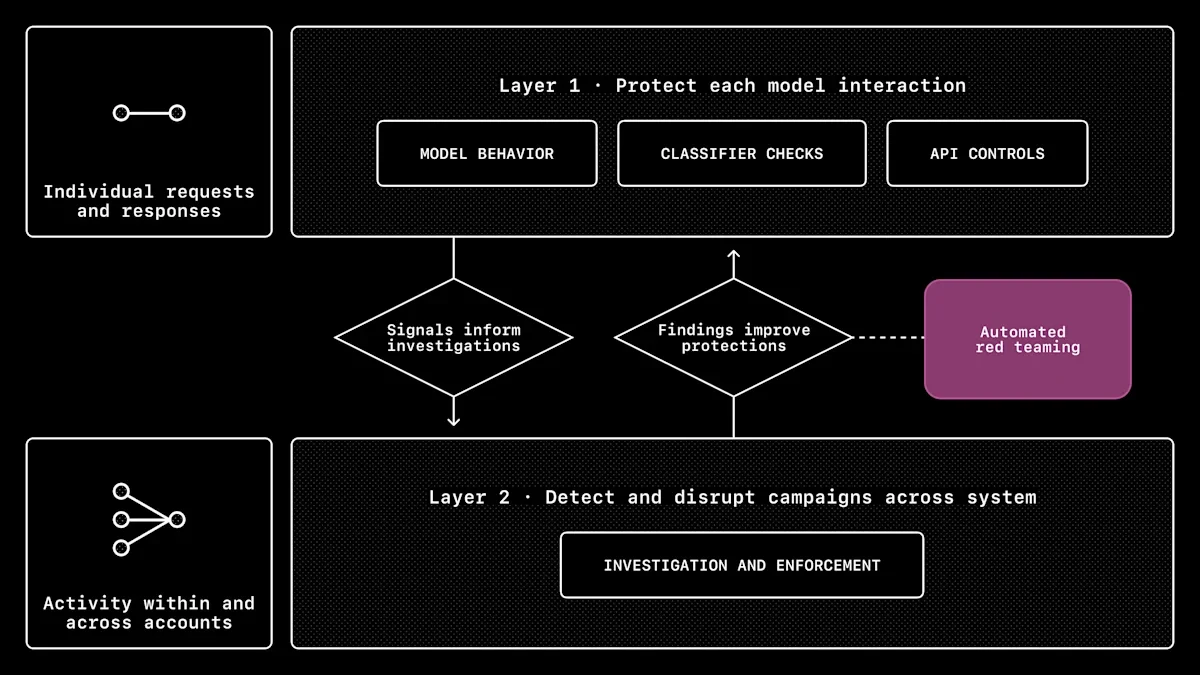
OpenAI’s two-layer defense against adversarial distillation. Image: OpenAI
The structural change in GPT-6.2 Astra and GPT-6.2 Sol is that a model’s protected reasoning is now tied to the conversation history that produced it. As new messages are added, the model can build on its earlier reasoning, but if an earlier message is rewritten, the API drops the reasoning that followed it. OpenAI also prevents older model families with weaker safeguards from reading GPT-6.2 Astra and Sol’s protected reasoning, and it closed a pathway that could have exposed another user’s encrypted reasoning.
The numbers
To measure the defenses, OpenAI ran adaptive black-box evaluations, in which automated red-teamers adjust their attacks based on how the system responds, with the same view an external user would have. Aggregated across six attacker models, extracting protected reasoning from an earlier request succeeded 54.0% of the time against GPT-6 Astra with its original safeguards, and 0.2% against GPT-6.2 Astra with its updated safeguards. Extracting reasoning from the current request fell from 22.9% to 0.9%. On GPT-6.2 Astra, the average attack success rate was below 1% for each attack type.
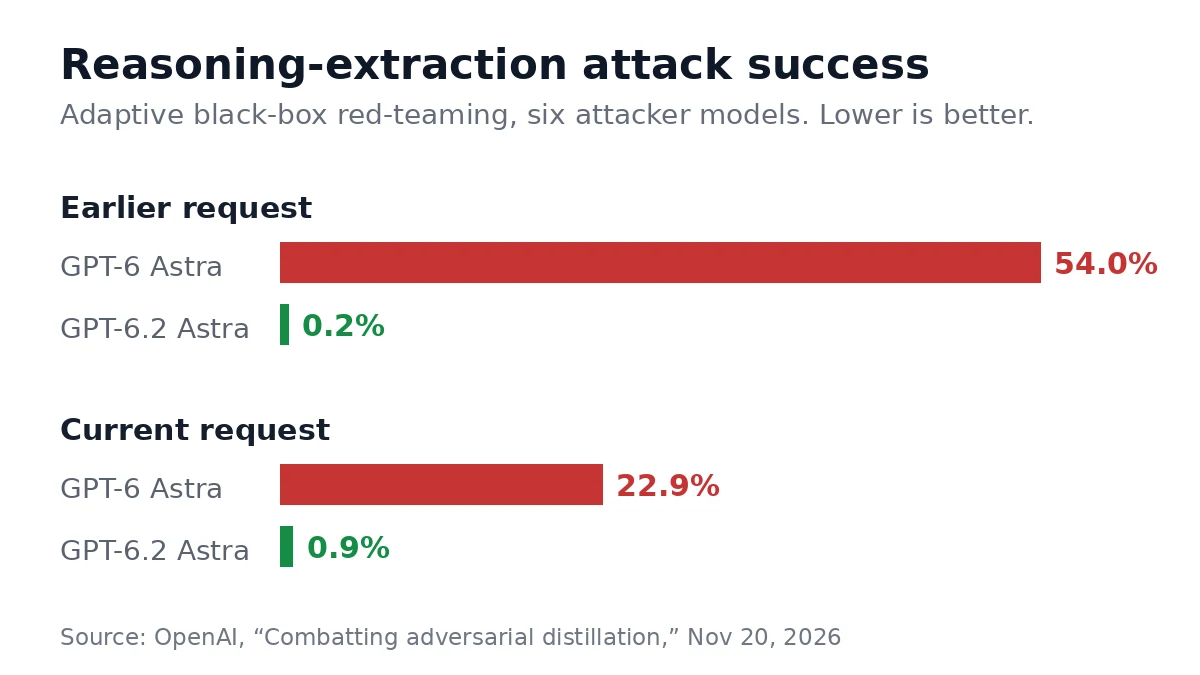
Attack success rates in OpenAI’s adaptive red-team tests. Graphic: GPTOnline, based on OpenAI’s published results
OpenAI says it is now applying selected safeguard improvements to GPT-6 Astra as well. The figures are the company’s own internal results, and the six attacker models were not named, so the numbers have not been independently verified.
Campaigns, Congress, and legislation
The post also puts the technical work in a national security frame. OpenAI says it has seen multiple unauthorized distillation campaigns on its platform this year, and that its weekly enforcement actions against them have ranged from thousands to tens of thousands of accounts, with the rate increasing significantly this past summer. It shares indicators of compromise with other model providers so they can investigate related abuse.
In February, the company says, it briefed Congress on activity indicating that DeepSeek was attempting to distill US frontier models. In September, it reported disrupting a campaign to extract its models’ protected reasoning and attributed a core part of that activity to individuals associated with Moonshot AI, the developer of Kimi. OpenAI says it plans to share more soon about recent campaigns it has disrupted.
The company also says it supports legislation that would give the US government more tools to identify and sanction foreign actors that illicitly extract capabilities from American AI models, naming the Chip Security Act, the AI OVERWATCH Act, and the MATCH Act. Stronger export controls can limit adversaries’ access to the hardware needed to train frontier models, OpenAI argues, while distillation defenses make it harder to acquire some of the same capabilities from models already trained.
Why it matters
The post lands in a week of rising US pressure on Chinese models, days after Cursor told lawmakers it is weighing phasing out Chinese open-weight models over geopolitical risk. By publishing its defense framework and naming names, OpenAI is doing two things at once: showing other model developers a playbook for protecting reasoning traces, and making a public case that distillation is a national security problem that needs legislation, not just engineering.
The open question is how much the defenses hold up outside OpenAI’s own tests. The 54% to 0.2% drop is striking, but it comes from the company’s internal red-teaming, and the post gives no per-domain breakdown or query budgets. What is independently checkable is the policy direction: reasoning traces are now bound to conversation history in GPT-6.2, and OpenAI is treating extraction as an attack to be disrupted, not a terms violation to be ignored.