A Financial Times investigation published on November 21 traces a network that moved restricted Nvidia AI chips to China-based users, and it places former Megaspeed executive Alice Huang at the center of that network. The paper says the web included an alleged Cambodian criminal enterprise, Nvidia cloud partners, gaming entrepreneurs and hundreds of shell companies, and that together they made billions of dollars moving the chips into China.
The investigation, based on interviews with more than a dozen people and hundreds of corporate filings, describes three pieces that made the diversion work: a group allowed to buy and resell the chips, customers able to pass US checks, and an underground route for hardware and money.
How the network worked, according to the FT
The first piece was Inspur, a major Nvidia partner that builds chip servers in China. Washington added Inspur to its entity list in March 2023 over alleged help for the Chinese military, but its part-owned San Jose unit was not listed. That unit was renamed Aivres and kept trading with Nvidia. A person with direct knowledge told the FT that staff inside Nvidia questioned whether Aivres should qualify as a partner, and that Nvidia decided it met all compliance and export control rules.
The second piece was a buyer able to clear Nvidia’s checks, which include three years of records and proof of non-Chinese ownership. According to the FT’s sources, some Inspur clients turned to Century Huatong, a Chinese gaming group that had become a data center investor. The answer, the paper says, was an offshore shell branded as a “neocloud” provider. That shell became Megaspeed, and Alice Huang was its “trusted” outward-facing executive.
The third piece was the underground route itself: hundreds of shell companies, gaming tycoons and an alleged Cambodian criminal enterprise that moved chips into China and money out, the FT reports.
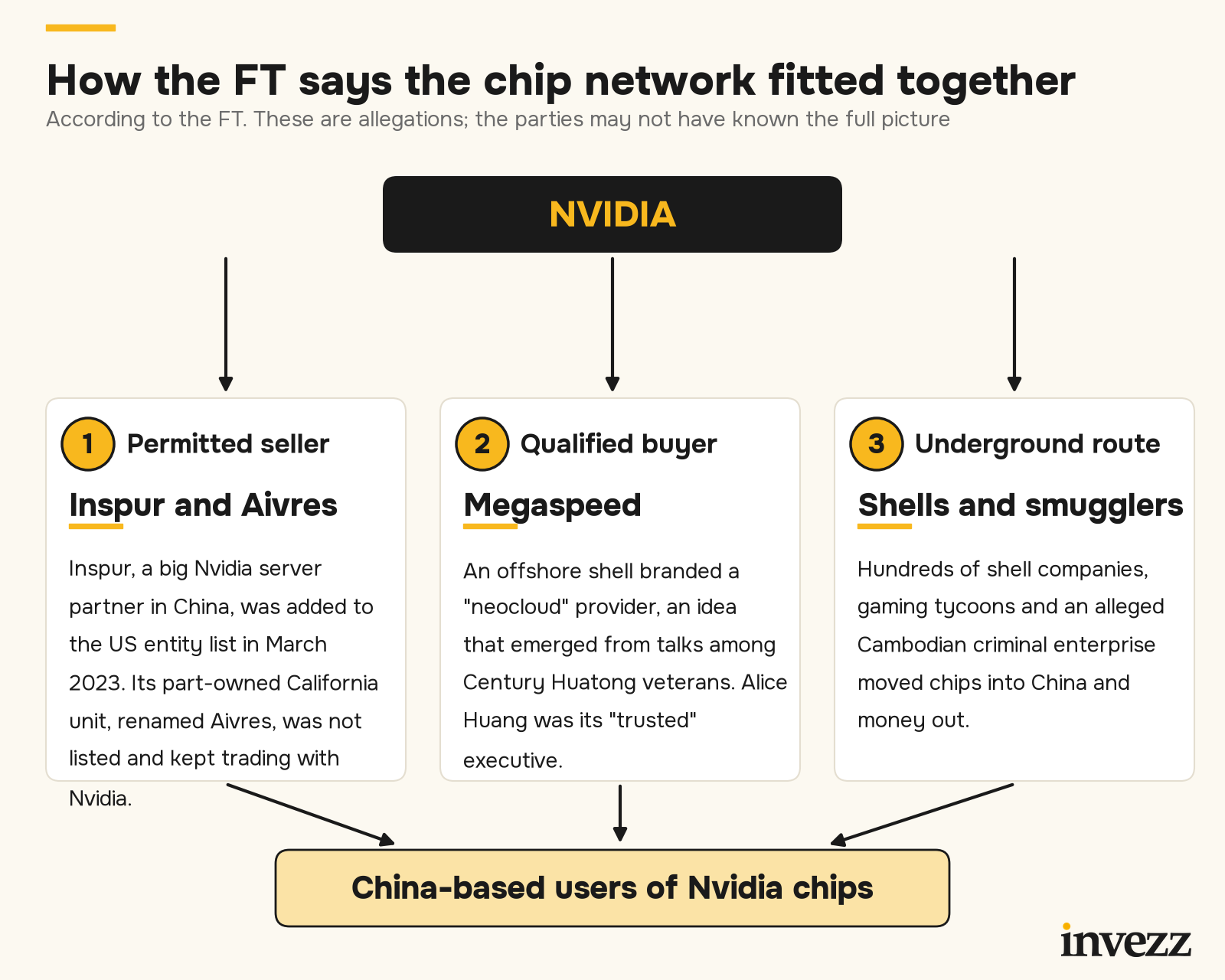
Diagram: Invezz, based on the Financial Times investigation. The FT says the network had three parts: a permitted seller, a qualified buyer and an underground route.
What the companies say
Nvidia says its shipments were all legal and authorized by the US government, spokesman John Rizzo said this week, according to The Business Times. Nvidia said in June 2025 that it had placed Megaspeed on its block list.
Megaspeed says it operates “fully within the bounds” of export controls, CNBC reported, and that Alice Huang left the company in August 2025. Reuters has not been able to reach her. No charges against her have been reported.
China’s foreign ministry calls the spy claim “unsubstantiated” and “nothing but smears”, the Associated Press reported. US Attorney General Todd Blanche said on November 12 that the Justice Department had reached no conclusion on whether she was a spy.
A companion New York Times investigation
A separate New York Times investigation published on Friday traced about $3.6 billion in Chinese government funding through companies linked to Huang’s relatives or business associates, according to a report by Ynetnews summarizing the Times. The investigation found ties between those companies and state-owned Chinese defense contractors, but it did not establish whether Nvidia chips ended up being used in Chinese military projects.
The Times cited a confidential report by Strider Technologies, an intelligence firm, which found that the funding supported technology projects including data centers equipped with Nvidia chips. The same reporting noted that Nvidia had applied to sell 40,800 H200 chips to New Century Lethal Data Service, a subsidiary of Shanghai-based Century Litung and an entity linked to Megaspeed. House Foreign Affairs Committee records released this week showed that 879,868 Nvidia and AMD AI chips were approved for sale to Chinese buyers out of more than 3.4 million requested.
How the saga reached this point
The story began on October 29, when the New York Times reported that US intelligence suspected Alice Huang, a former Megaspeed executive, of being a Chinese asset. On November 8, Nvidia’s board opened an independent investigation into whether Jensen Huang had been the target of a foreign intelligence effort. Jensen Huang admitted he had been unfaithful to his wife, without naming the woman. The board accepted his resignation as chief executive, president and director on November 11 and announced it the next day. Chief financial officer Colette Kress became interim chief executive.
On November 12, Singapore said police had investigated Alice Huang over Megaspeed’s server purchases and found insufficient evidence of an offense. She received a stern warning for giving inaccurate information and was barred from returning. On November 17, the Commerce and Justice departments said they had been investigating Megaspeed since 2024 and had interviewed Alice Huang in June 2025. Jensen Huang has agreed to a transcribed interview with three House committees on December 1.
Nvidia shares closed on Friday at $125.53, down 14 percent on the day, after Reuters reported that SEC staff are examining potential accounting issues at the company. Reuters noted that investigations are not evidence of wrongdoing.
Why it matters
The FT investigation is the most detailed account yet of how restricted AI chips may have reached China despite years of tightening US export controls. If the network worked as the paper describes, it shows that controls can be defeated not by a single smuggler but by a chain of legitimate-looking companies, each passing its own checks. The findings also deepen the political pressure on Nvidia, whose former chief executive is due to answer questions from Congress on December 1, and on US regulators, who must explain how much of the trade they knew about and when.