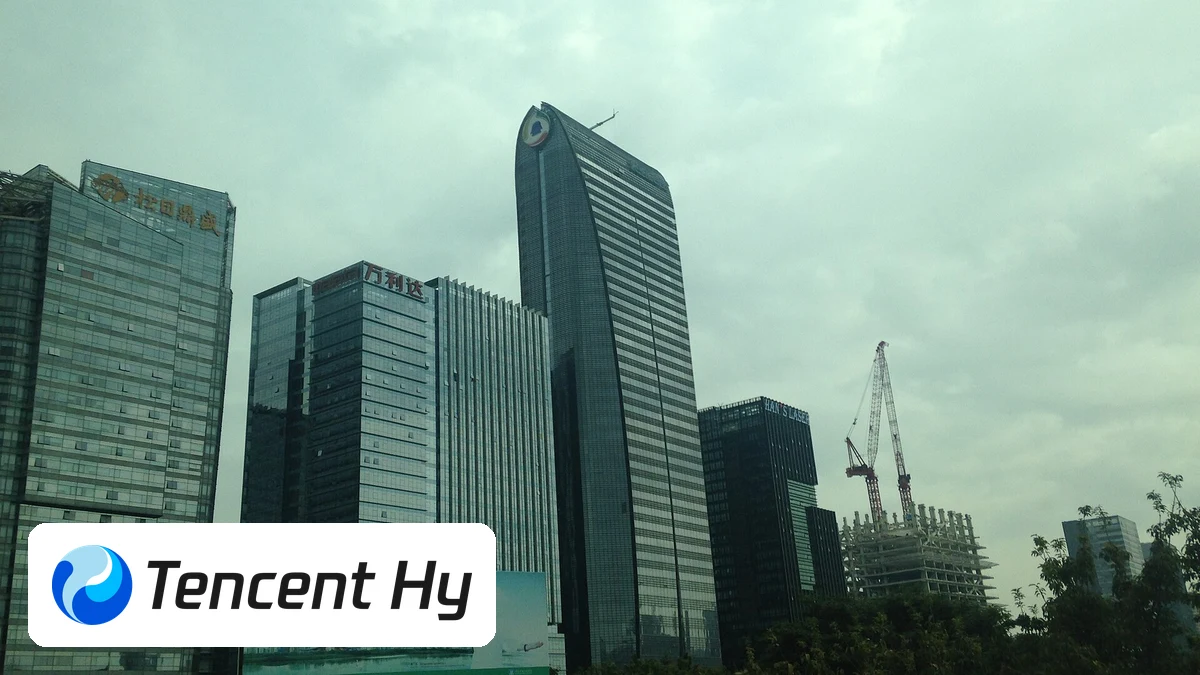
Tencent has published the full weights of Hy4, its flagship artificial intelligence model, letting developers download and run the 770-billion-parameter system on their own hardware. The release, posted to Hugging Face on Friday, November 20, closes a gap left when Hy4 launched on November 4 through Tencent’s apps and cloud API only, with the weights promised for later.
The download includes three versions: the instruction-tuned Hy4 model, an FP8 quantized build, and the pre-trained Hy4 base model. Tencent also published the weights on ModelScope and GitCode, and provides deployment recipes for the vLLM and SGLang serving frameworks.
What Hy4 is
Hy4 is a mixture-of-experts model with 770 billion total parameters in its language backbone, of which 49 billion activate for each token. It has 78 layers, 256 routed experts per layer, and a context window of 1,048,576 tokens, or about one million tokens. It handles text, images, and video, and supports computer-use workflows across command-line and graphical interfaces.
Tencent built the model with gated DeepSeek sparse attention and a built-in speculative decoding drafter called DFly2, which reuses the model’s key-value cache to speed up generation. A 1.23-billion-parameter vision encoder handles image and video input.
On Tencent’s own benchmarks, Hy4 Base scored 91.6 on MMLU and 73.9 on MMLU-Pro, ahead of DeepSeek-V4-Pro-Base on both tests. In a finance evaluation run with 213 professionals across 579 real-world tasks, Hy4 averaged 3.04 out of 4, ranking first among open-weight models. Tencent also says the model cut its hallucination rate from 15.76 percent on the Hy4 preview to 5.45 percent. These are the company’s own numbers, and independent testing has not yet confirmed them.
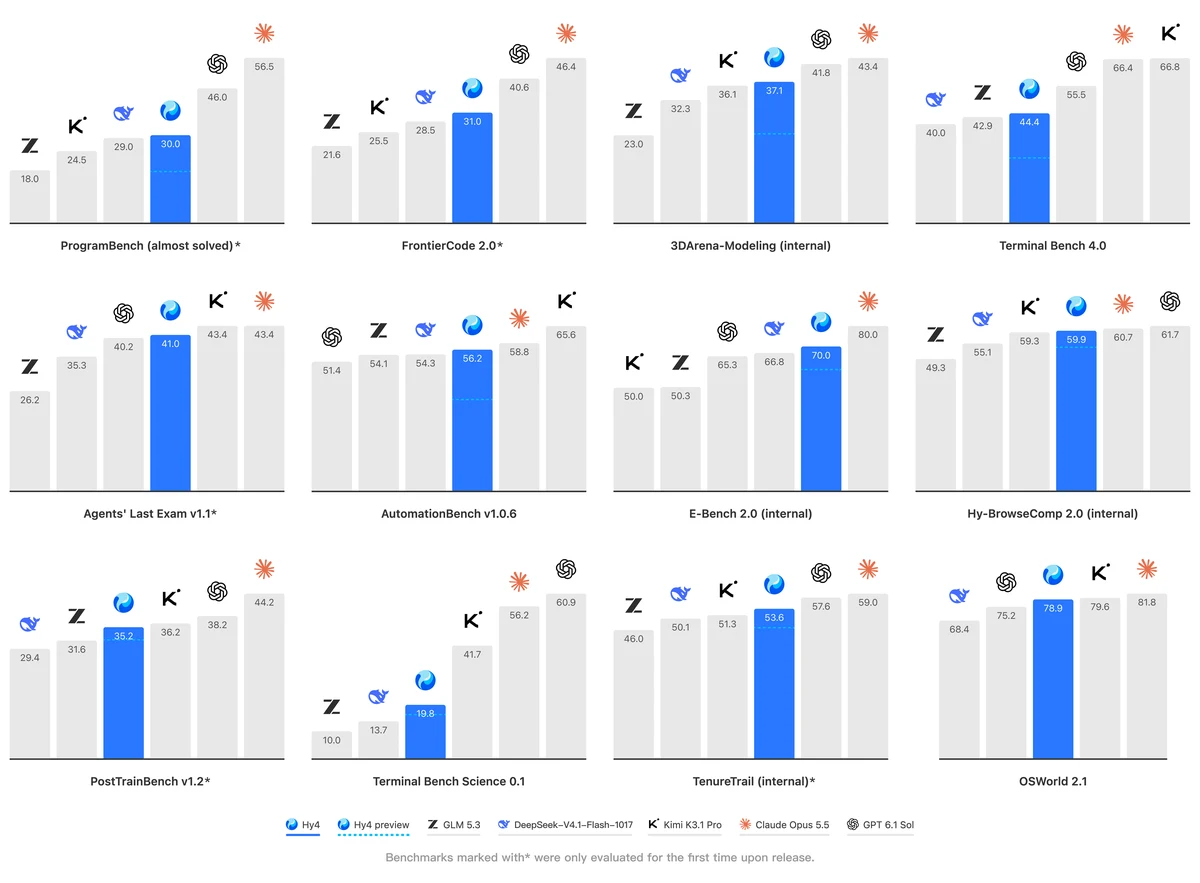
Tencent’s benchmark chart for Hy4, shown in blue, against rival open-weight and proprietary models. Image: Tencent
The license is not Apache 2.0
The release comes with a wrinkle that early coverage missed. TechNode reported that Hy4 was available under the Apache 2.0 license. Tencent’s own model card says otherwise: Hy4 is released under the Tencent Hy License, a custom license derived from Apache 2.0 but with extra commercial terms.
Section 10 of that license requires a separate written license from Tencent for operators that sell Hy4 inference as a service once their worldwide gross revenue passes $50 million in any 12 months, or their product passes 100 million monthly active users, according to GPU Journal’s reading of the license text. Purely internal use is exempt, and below those thresholds the weights are free to download and run.
The distinction matters for cloud providers and API businesses, which would need Tencent’s permission once they grow past the thresholds. The same license shipped with the smaller Hy4 Flash weights on November 17.
Why it matters
At 770 billion parameters, Hy4 is one of the largest open-weight models ever released, and its arrival extends a run of major Chinese open-weight releases this month, including Moonshot AI’s Kimi K3.1 Pro and the smaller Hy4 Flash. The one-million-token context window and built-in computer-use support position it for long document work, research, and agent workflows rather than simple chat.
Tencent is candid about the limits. Its model card states: “Although Hy4 is one of the strongest open-weight models available today, a notable gap remains between it and top proprietary models, particularly on challenging internal benchmarks for research-level mathematics, long-horizon coding, model self-improvement, and advanced visual question answering.”
The download is not small. The BF16 weights total about 1.55 terabytes, while the FP8 build is about 0.79 terabytes, so running the full model needs a multi-GPU server. Tencent also published a GGUF build for end-to-end testing through its AngelSlim compression toolkit.
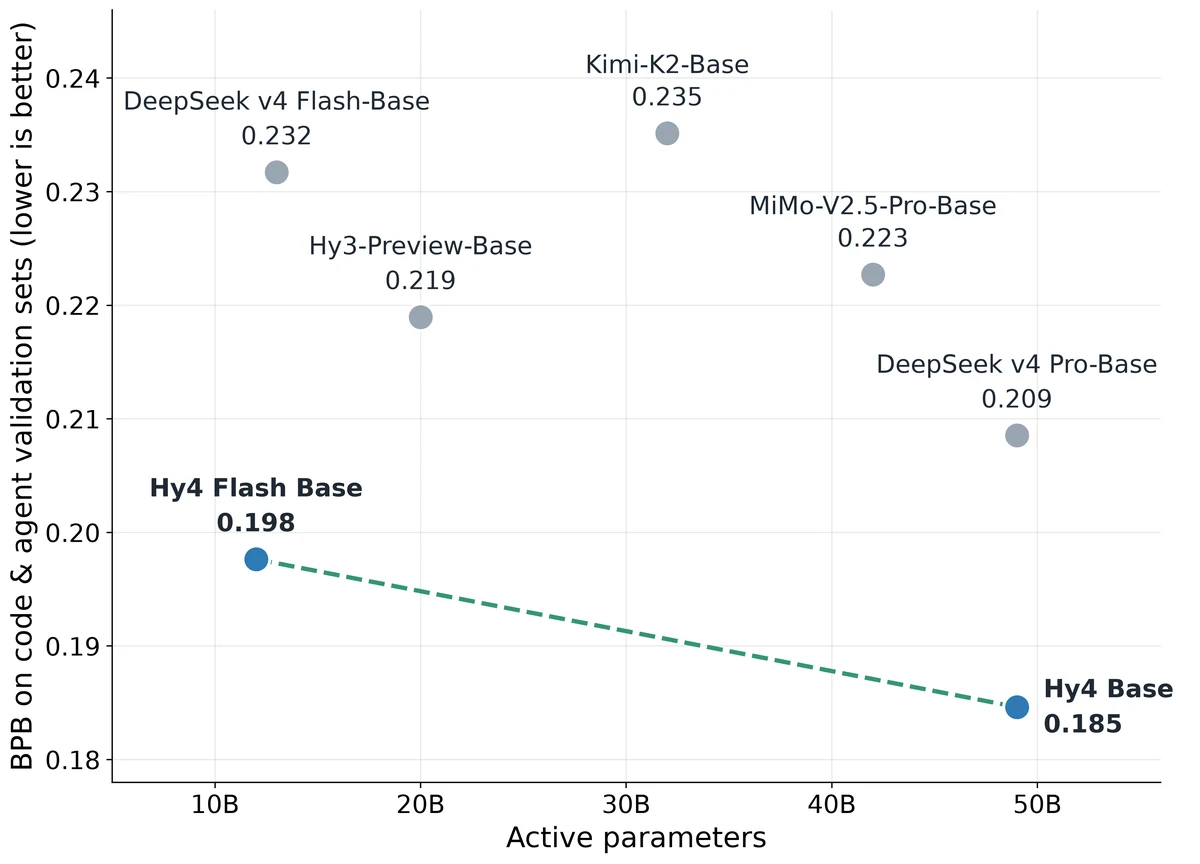
Hy4 Base scores 0.185 bits per byte on Tencent’s internal code and agent validation, lower than DeepSeek v4 Pro-Base at 0.209. Lower is better. Image: Tencent