OpenAI has released GPT-Live-1.1 in its API, an updated full-duplex voice model that listens and speaks in a single stream. The headline change for developers is a new standby mode that cuts the cost of idle time on a voice call to $0.02 per minute, down from $0.05 while a session is active, a 60% reduction.
The model is available now under the model ID gpt-live-1.1, according to OpenAI’s official model page. It follows GPT-Live-1, which reached the API on September 10, 2026, and has powered ChatGPT Plus and Pro voice since October 15, according to OpenAI’s forum announcement.
What Was Announced?
GPT-Live-1.1 is a full-duplex speech model for multilingual conversations. Unlike a traditional voice pipeline that chains speech recognition, a language model and text to speech, the GPT-Live family reasons over incoming and outgoing audio together in one model, handling turn detection and returning transcripts natively. OpenAI describes the update in plain terms on its model page:
“GPT-Live-1.1 can listen while it speaks. Compared with GPT-Live-1, it transcribes speech more accurately and maintains a more consistent accent and voice across languages.”
The release was announced by OpenAI’s developer account on X and covered on November 21, when the model appeared in OpenAI’s API documentation. The model runs in OpenAI’s cloud only, through the v1/live/sessions endpoint, with clients connecting over WebRTC or WebSocket.
The GPT-Live-1.1 model icon. Image: OpenAI
What Changed From GPT-Live-1?
OpenAI lists four improvement areas for the 1.1 release: more natural and consistent accents across languages, more accurate speech transcription, better handling of precise details such as letters and numbers, and more reliable instruction following and task completion. No benchmark scores were published for GPT-Live-1.1, so the quality gains are self reported for now.
Live sessions hold a 128,000-token default context window. Inputs and outputs are audio and text. Image and video are not supported, and neither are structured outputs, fine tuning or predicted outputs. Streaming and function calling work, and the voice model can hand reasoning and tool calls to a backend text model, with OpenAI naming GPT-6 Astra for complex issues and Luna for high volume tasks.
How Standby Mode Works
Standby is the practical change in this release, and it applies to both GPT-Live-1 and GPT-Live-1.1. When a session goes quiet, standby pauses inference while the WebRTC connection stays open, so the conversation can resume without throwing the session away.
Developers configure it through the session settings: a wake policy that waits for speech, an idle timeout of 5 to 60 seconds, and an optional voice activity threshold that defaults to 0.5. After the timeout, the server emits a paused event, and when the user speaks, a resumed event fires. The session ID and history are kept. OpenAI warns that the first reply after a short utterance may be slower, and advises keeping the microphone track active during standby.
Pricing and Availability
Voice sessions are billed by duration. Active time costs $0.05 per minute, or $3.00 per hour, while standby WebRTC time with inference paused costs $0.02 per minute, or $1.20 per hour. Backend model and tool usage is billed separately, which matters for builders: a heavy backend can cost more than the voice layer itself.
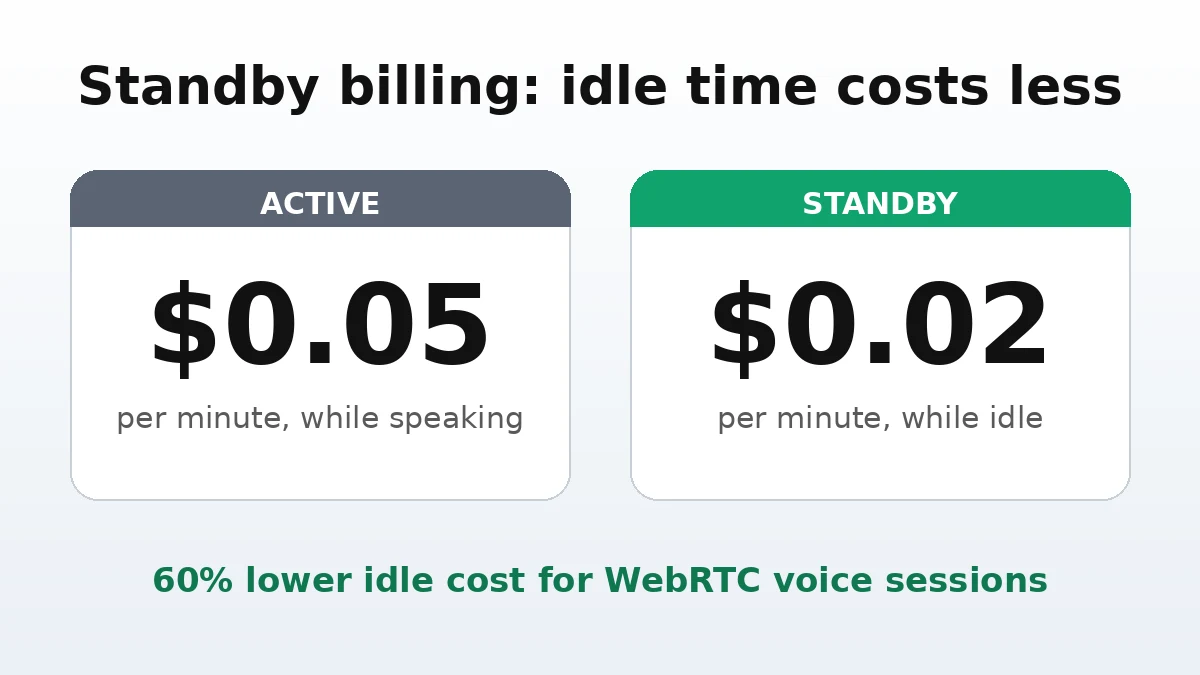
Standby billing cuts idle WebRTC time to $0.02 per minute, against $0.05 while active. Graphic: GPTOnline, based on OpenAI pricing.
The model is API only. Developers switch an existing Live session by setting the model to gpt-live-1.1, though changing the model requires a new session. GPT-Live-1 and GPT-Live-1.1 have separate concurrent session limits, each applying across inference regions. Outbound SIP calling reached all organizations on November 2, so phone agents are supported as well.
Why It Matters
Voice agents spend much of their time waiting: listening for a caller, holding while a tool runs, or sitting silent between turns. At the old rate, every idle minute cost the same as an active one. Standby billing makes always-on voice agents materially cheaper to run, which is the difference between a demo that works and a service that can stay connected all day.
The release is incremental rather than a flagship launch, and the absence of published benchmarks means developers will have to judge the accent and transcription gains in their own testing. But for teams already running voice agents on OpenAI’s API, the cheaper idle time is available immediately, with no code change beyond a model ID.
Sources
- GPT-Live-1.1 Model, OpenAI API
- OpenAI Ships GPT-Live-1.1 for Voice Agents, Cuts Idle Cost to $0.02/Min, MarkTechPost, November 21, 2026
- OpenAI developer account announcement on X, November 2026