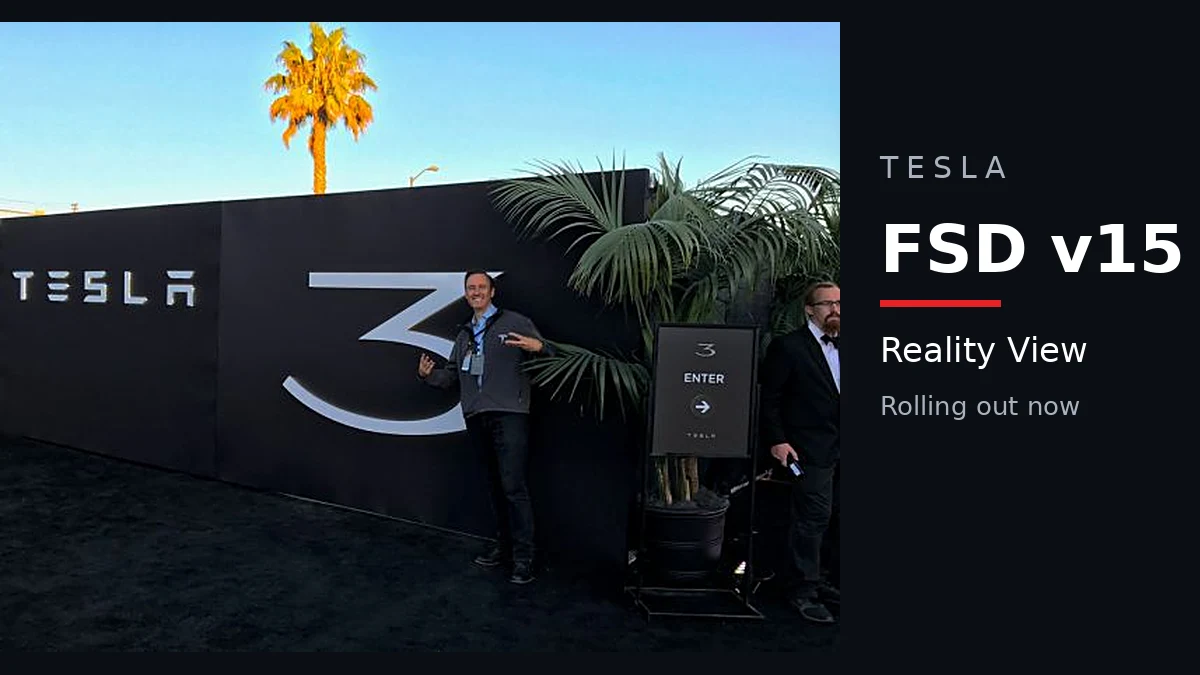
Tesla has started rolling out Tesla FSD v15, the biggest update to its Full Self-Driving driver-assistance software in more than a year, headlined by a photorealistic live view of the road that the company calls Tesla Reality View. The company announced the release on November 21, 2026, saying it is going to a first wave of customers now, with a wide release to follow in December 2026.
Tesla says v15 upgrades “every part of the end-to-end driving network” and claims 25 times better handling of safety-critical cases. That figure is a company-reported improvement in its critical intervention rate, not an independently verified crash-rate comparison, and Tesla has not published the baseline or method behind it.
What Is Tesla Reality View?
Reality View replaces the sparse wireframe graphics Tesla drivers have watched for years with a moving, photorealistic picture of the street around the car, seen from a virtual camera floating just above and behind the vehicle. Tesla describes it as a single end-to-end visualization that replaces all explicit model signals while using less total compute than the old display.
The view is generated in real time by the driving model itself, not by a game engine. Elon Musk said the system produces real-time AI video generation using half of one AI4 TRIP accelerator, and summed up the look in three words: “It’s like GTA.” Drivers can also tap a point in the view to send the car there, and turn chevrons appear in the sky to show where the system plans to turn.
The point, Tesla says, is to let occupants see and control what FSD is planning to do. The release notes put it this way: Reality View “lets you see and control what FSD is planning to do.”
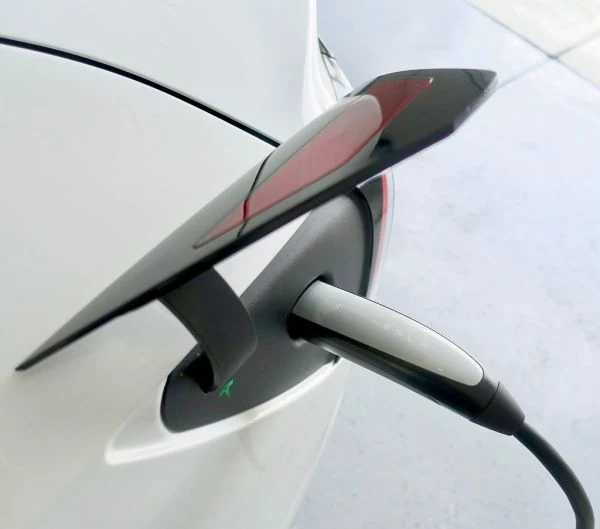
A Tesla Model 3 charging. Photo: Steve Jurvetson via Flickr (CC BY).
A New Vision Encoder Shared With Robotaxi and Optimus
Behind the display, v15 brings an upgraded vision encoder that Tesla says is shared between FSD, its Robotaxi service and the Optimus humanoid robot. The encoder was trained on millions of internet videos for improved generalization and data efficiency, and Tesla credits it for the reported improvement in the critical intervention rate.
Sharing one vision system across driving, robotaxis and a humanoid robot is a notable bet. It means lessons learned from one program can, in principle, transfer to the others, but it also means a weakness in the shared encoder could show up in all three.
Navigation, Parking and Everyday Driving
The rest of the release reads like a list of FSD’s most persistent complaints. Navigation now uses an end-to-end learned model based on fleet route preferences at the start and end of trips, with Tesla planning to extend that approach to entire routes in later v15 releases. Parking can draw on a driver’s personal parking history, and the map can show multiple parking options at the destination.
Tesla also lists better detection of road signs, small animals, road debris, potholes and tire chains, plus avoidance of deep standing water. Speed handling changes cover school zones, speed limits and bad weather, and FSD can now slow down for speed cameras. Driver monitoring works better when drivers wear hats or sunglasses, Autoshift now uses FSD-based gear predictions, and a new Bike Rack Mode allows FSD to stay enabled with a bike rack or similar hitch accessory.
Rollout, Eligibility and What Tesla Has Not Said
Tesla AI lead Ashok Elluswamy said the release was going to the first wave of customers on November 21, and Musk said earlier the same day that v15 “goes to wide release next month” and will arrive with this year’s holiday update. Tesla has not announced a firm date or a complete list of eligible vehicles, and it has not said how many cars are in the first wave or which countries get it first.
The company has previously told investors that its AI4 computer is enough to run v15, so owners of older Hardware 3 cars should not assume the update is coming to them. FSD v15 also remains Full Self-Driving (Supervised), so the driver must keep paying attention and be ready to take control at any moment. Nothing in Tesla’s announcement promises unsupervised driving for owners.
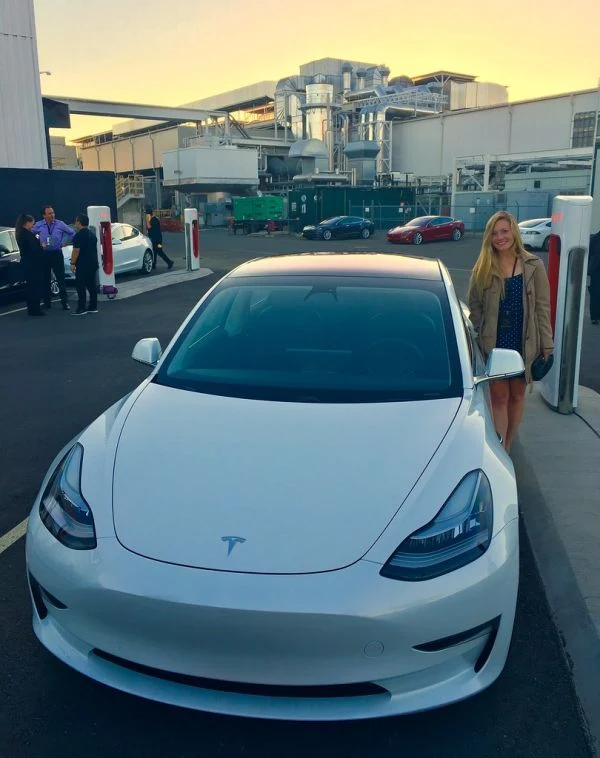
A Tesla Model 3 at a Supercharger during the first Model 3 deliveries in 2017. Photo: Steve Jurvetson via Flickr (CC BY).
Why It Matters
FSD v15 is Tesla’s clearest attempt yet to make its driver-assistance system legible to the person behind the wheel. If Reality View works as shown, a driver can see the system’s intent in a familiar, video-like form instead of decoding abstract lane lines and boxes, which could build trust or expose mistakes earlier. The shared vision encoder also ties Tesla’s car, robotaxi and robot programs to a single perception stack, raising the stakes on each release.
Caution is warranted all the same. As Electrek’s Fred Lambert noted, “FSD has never improved in a straight line,” and every major version has brought real gains along with new problems. The 25x safety claim will only mean something once the wider December rollout puts v15 in many more hands.