China’s Ministry of State Security (MSS) ran a campaign to help Chinese companies acquire advanced AI chips and gather intelligence on the global chip industry, according to a New York Times report published on Saturday. The campaign has run for at least two years, the report said, citing serving and former security and intelligence officials from Asia, the United States and Europe.
The MSS set up a working group under its chief, Chen Yixin, to lead the effort, which included helping Chinese companies acquire and smuggle advanced chips into the country, as well as collecting intelligence on the semiconductor sector and its supply chains.
A campaign run from the top of the party
According to the report, the effort is coordinated at the party level by the Central Science and Technology Commission, a body established by President Xi Jinping in 2023 and led by Ding Xuexiang, a member of the Politburo Standing Committee. The campaign is part of a broader push by Xi for technological self-reliance and for overcoming restrictions imposed by the United States and its allies.
Chen, who became state security minister in late 2022, has repeatedly described the campaign against Western technology restrictions as an important responsibility of his agency. In April, he called for intensifying the struggle against technological blockades and advancing artificial intelligence innovation, industrial development and applications, according to a Communist Party journal cited by the report.
The Alice Huang connection
The revelations come amid United States scrutiny of Chinese businesswoman Alice Huang, whom American officials allege was working with the Chinese intelligence agency to spy on Jensen Huang, Nvidia’s co-founder and chief executive. The Saturday report adds to a November 20 investigation by the newspaper, which detailed extensive, though largely indirect, links between companies associated with Huang’s family and Chinese state-owned defense contractors supplying the People’s Liberation Army.
Citing a confidential analysis by independent intelligence firm Strider Technologies and its own review of corporate filings, the November 20 report said around $3.6 billion in Chinese government funding had flowed through companies associated with Huang’s family or business associates. The money funded technology projects, including data centers that received Nvidia chips. The report noted, however, that the available research did not establish whether the Chinese military had actually used computing power from these data centers.
Huang ran Megaspeed, a Singapore-based data center company that bought billions of dollars worth of Nvidia chips and provided high-end computing capacity to Chinese companies. The company is under investigation by the United States Justice Department over suspected illegal shipments of advanced chips to China.
The Saturday report said United States officials were also examining whether Megaspeed had helped supply Nvidia chips to data centers linked to Chinese military research. It further said the United States administration was seeking to close a perceived loophole that allowed Chinese companies to access advanced Nvidia chips through data centers located outside China.
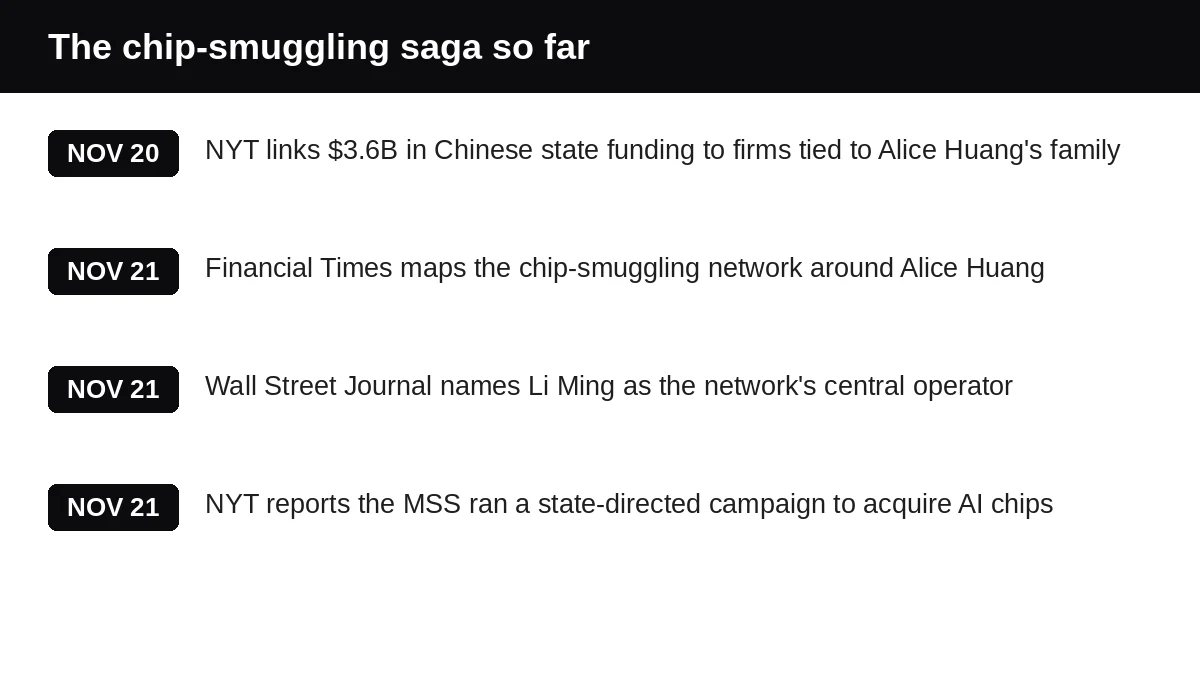
Timeline: GPTOnline, based on reporting by the New York Times, Financial Times and Wall Street Journal
A new rule for overseas data centers
The Trump administration announced last week that it would move ahead with a new rule requiring overseas data centers to obtain a government license before supplying significant volumes of computing power to companies headquartered in countries on a list that includes China, Russia and Iran. The restriction is scheduled to take effect in about 90 days, according to the newspaper.
China has rejected the espionage allegations as “pure fabrication”. The report added that the United States officials’ assessment of Huang’s role in the Chinese intelligence agency’s efforts, and the extent of her connections to companies linked to the People’s Liberation Army, remain under scrutiny.
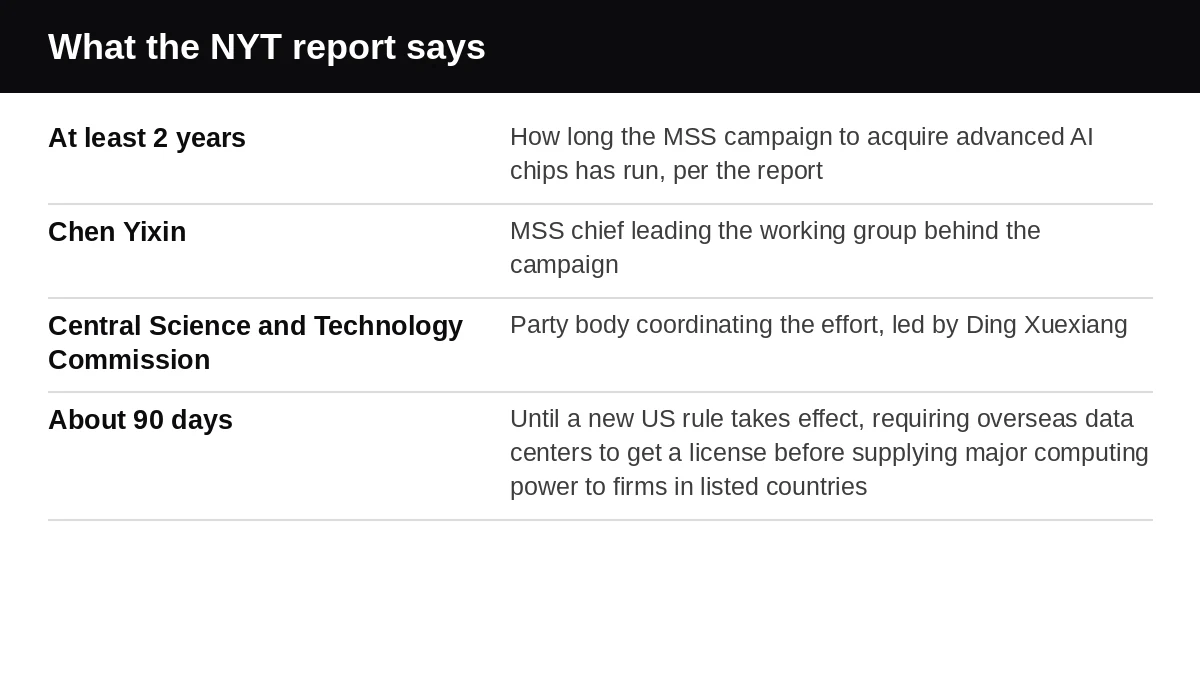
Chart: GPTOnline, based on the New York Times report as relayed by Deccan Chronicle
Why it matters
The report is the latest development in a fast-moving saga. The Financial Times mapped the network around Huang on November 21, and The Wall Street Journal named Li Ming, a Chinese national in Singapore, as the network’s central operator the same day. GPTOnline covered both reports in an earlier article on the FT investigation and a follow-up on Li Ming.
What the Times report adds is the state-directed frame: the smuggling was not only a commercial operation, the newspaper reports, but part of a campaign run by China’s intelligence agency and coordinated at the top of the ruling party. If the reported licensing rule takes effect as described, it would also reshape how cloud providers outside China can sell computing power to Chinese customers, a market that has become a central pressure point in the export-control fight.