Li Ming, a 52-year-old Chinese national living in Singapore, was the central operator of a corporate network that smuggled restricted Nvidia AI chips into China, the Wall Street Journal reported on November 21. The report names, for the first time, the person the Journal’s sources say ran the smuggling operation behind Megaspeed, the Singapore company where Alice Huang served as a managing director.
The account is the latest development in the chip smuggling investigation that the Financial Times traced in detail on November 21. Where that investigation put Alice Huang at the center of the network, the Journal reports that she was the public face of the operation, and that Li Ming made the key decisions behind the scenes.
Who is Li Ming?
Li Ming is a 52-year-old Chinese national who lives in Singapore. He is now out on bail and living in a luxury villa near the Chinese Embassy, according to the Journal. Singapore authorities charged Li and others with fraud in February 2025, in a case tied to alleged transshipment of Nvidia chips. Megaspeed was not named in the charging document.
Singapore prosecutors allege that Li bought computer servers equipped with Nvidia chips by deceiving a United States supplier, claiming the hardware was for his local company, Luxuriate Your Life. Instead, prosecutors say, the servers were shipped to neighboring Malaysia and then on to an unnamed third location.
The Journal reports, citing people familiar with the matter, that Li was deeply involved in Megaspeed’s activities and took part in major decisions, and that he also played a role in other companies trading Nvidia chips. Li’s lawyers declined to comment for the article.
How the network was built
According to the sources cited by the Journal, Li had been working with Alice Huang and her husband, Kang Wei, for years before the charges were filed. In 2021, the couple set up a cloud computing joint venture called Century Longteng, according to Chinese corporate registry records.
After the United States restricted sales of Nvidia chips to China, Li and the couple began building a business network across Southeast Asia to supply advanced computing power to Chinese customers. They acquired the Singapore unit of a Chinese video game company and renamed it Megaspeed, with Alice Huang registered as a company director.
Megaspeed told Nvidia that Chinese tech giant Alibaba was an anchor customer, and in November 2023 it became a member of Nvidia’s cloud partner program, giving it priority access to the company’s latest chips. Some of those servers were later sent to a Shanghai technology company called Century Litong, in violation of United States export controls, the Journal had previously reported.
After suspicions of smuggling emerged, the people who operated Megaspeed set up a new entity called Nova Gate Cloud, which continued to receive Nvidia chip supplies and run data center operations, according to the report.
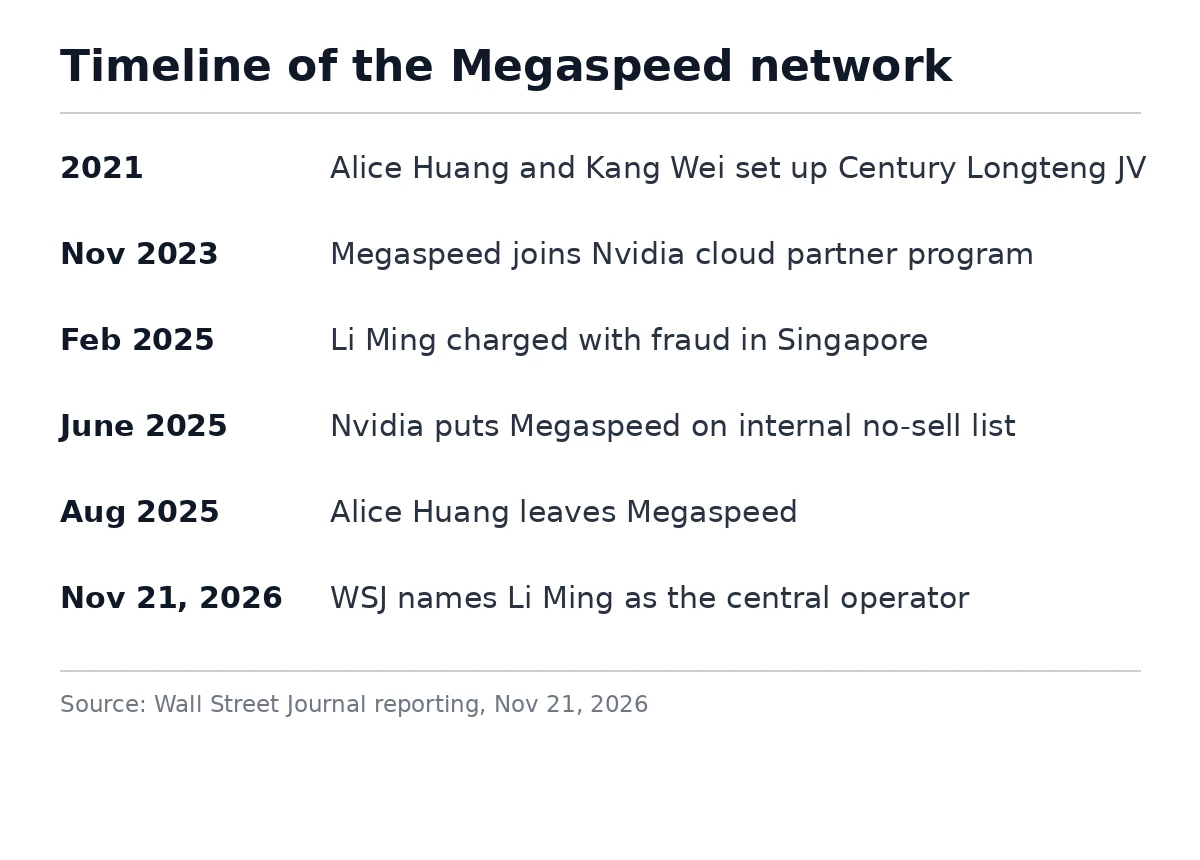
Timeline of the Megaspeed network. Chart: GPTOnline, based on Wall Street Journal reporting.
What happened next
Nvidia said it placed Megaspeed on an internal “no sell” list in June 2025, around the time the United States and Singapore were investigating the company. Megaspeed has said that it “conducts legitimate and lawful business”, and that Alice Huang left the company in August 2025. Singapore officials have said that after questioning her over smuggling suspicions, they let her leave the country and barred her from re-entering.
The Journal reports that the newly revealed connections show efforts to help Chinese companies close the gap in the AI race extended far beyond the Megaspeed scandal. The fraud charges against Li Ming remain pending, and he has not been convicted.
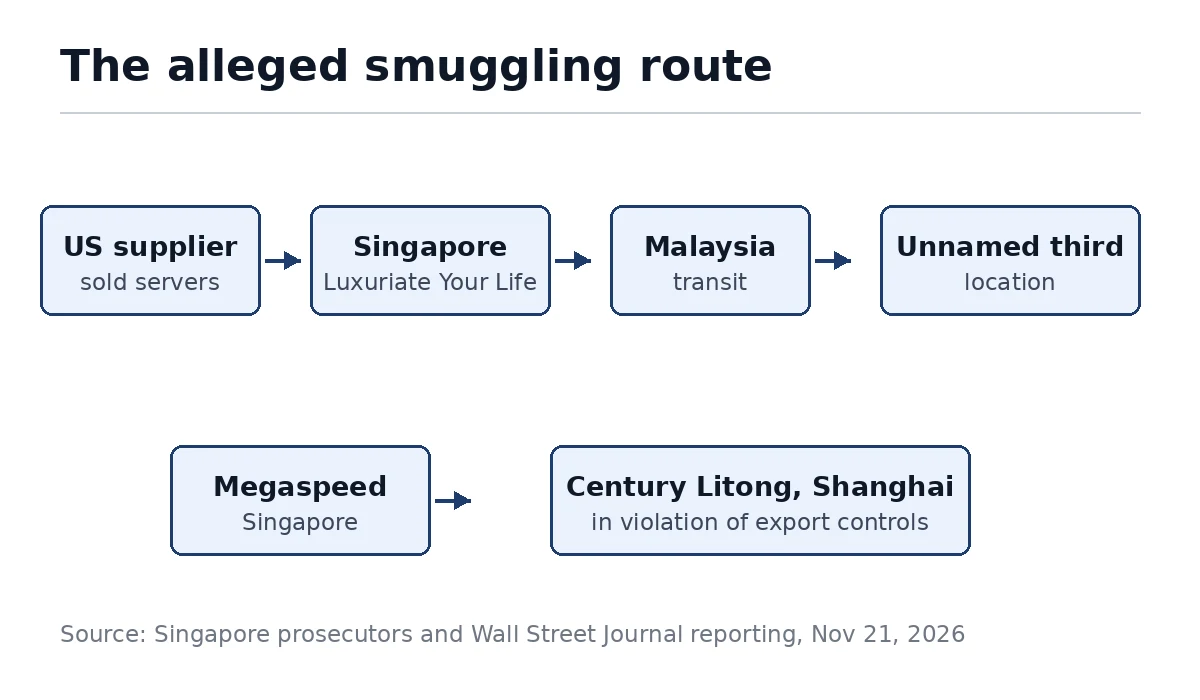
The alleged smuggling route described by Singapore prosecutors and the Wall Street Journal. Diagram: GPTOnline.
Why it matters
The identification of Li Ming shifts the focus of the investigation from its most visible figure to the person sources say actually ran it. It also widens the picture: the network described by the Journal spans more companies than Megaspeed alone, and it operated for years while Nvidia’s most advanced chips were barred from sale to China.
The case sits inside a much larger Washington and Singapore scrutiny of Nvidia’s China business, which has already produced a United States securities probe, Senate hearings and a California subpoena. For the AI industry, it is a reminder that export controls are only as strong as the intermediaries that move the hardware.
Related coverage on GPTOnline: FT Investigation Traces Nvidia AI Chip Network to China Through Alice Huang