AI server prices are climbing sharply after contracts have already been signed, with some buyers told to pay up to 45% more than the price they agreed months earlier. The Financial Times reported on November 22 that Dell, Hewlett Packard Enterprise, Lenovo and Supermicro are among the suppliers pushing through the increases, driven by a surge in memory costs that has upended the economics of AI infrastructure.
The report lands at a sensitive moment. AI server demand is still outstripping supply, and buyers who thought they had locked in a fixed cost are learning that a signed contract is no longer a guarantee of the final price.
What the Financial Times reported
According to the Financial Times, suppliers of AI servers are demanding higher prices from customers several months after contracts were signed, with some increases reaching 45%. That figure is the top of the range, not the average, and the report does not say how many contracts are affected or name every customer asked to pay more.
A second account of the report puts the range at 25% to 45% above the originally agreed price for Nvidia based AI servers. People familiar with the deals told the Financial Times that signing contracts with only indicative pricing has become standard practice, leaving buyers exposed when component costs move.
Among the buyers affected are major financial trading firms, including Jane Street, Optiver and Hudson River Trading, which buy large volumes of computing hardware. None of the four suppliers named in the report had commented in the material available at publication time.
Why memory costs are driving the hikes
Memory is the main culprit. JPMorgan research cited in coverage of the report shows memory costs have climbed more than 400% since early 2024. GPU servers are reported to cost at least 20% to 30% more, while CPU nodes have tripled in price or more, because memory makes up a large share of their cost.
The pressure was visible well before this week. Bloomberg reported earlier that Nvidia planned to raise AI server prices by more than 15% as memory supply tightened, and Tom’s Hardware reported that Dell and Lenovo were preparing increases of as much as 15% on servers and PCs.
HPE went further than most on paper. The company reworded its terms and conditions to let it reprice orders for cost increases that occur between an order being placed and shipped, and chief executive Antonio Neri described the stance as protecting margins through an “agile pricing posture”. Dell chief operating officer Jeff Clarke said on February 26: “We’re compressing discounting. Our quotes are valid for the shortest period of time they’ve ever been.”
Dell, the largest of the four vendors, disclosed a $95 billion AI server backlog in its September results, after $60.9 billion of quarterly orders. The backlog shows demand is not the problem. Delivering the hardware at the agreed price is.
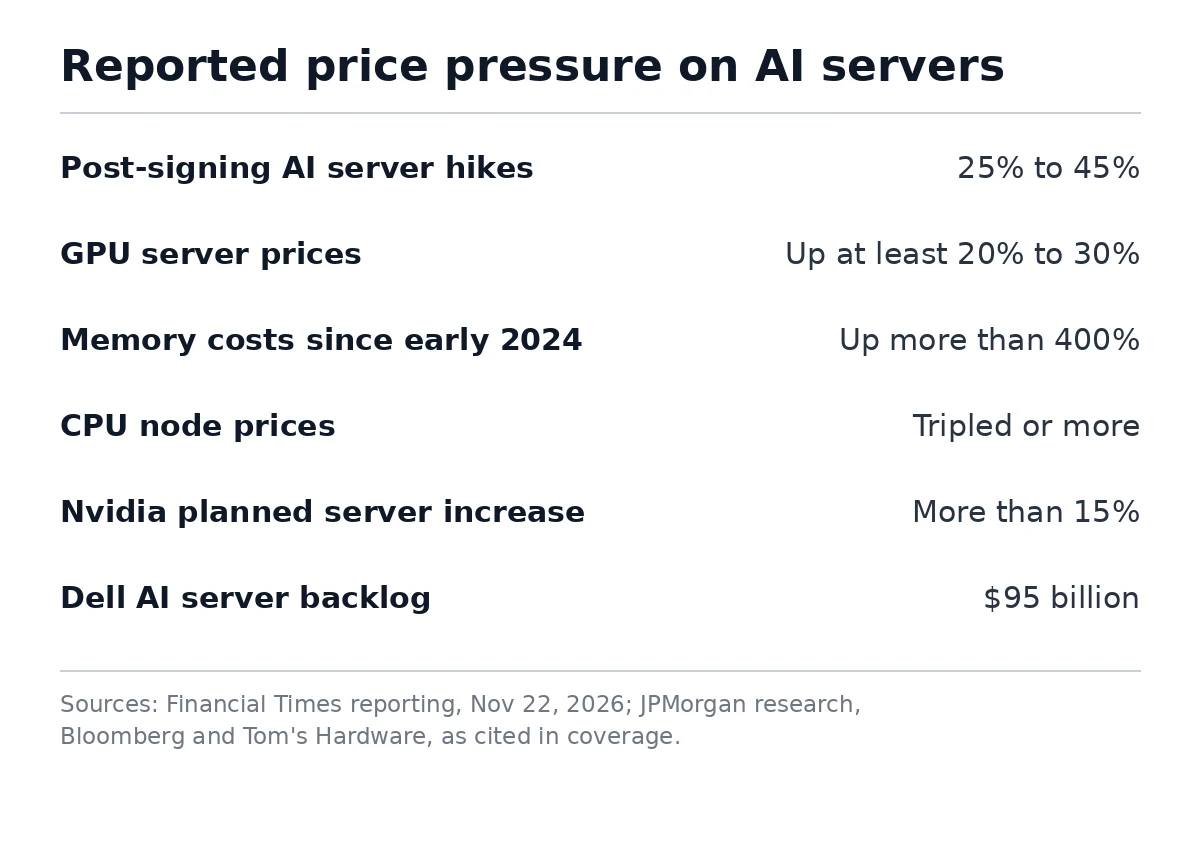
Reported price pressure across AI servers and memory. Chart: GPTOnline, based on FT reporting and JPMorgan research cited in coverage.
The dispute that reached court
At least one repricing fight has already reached the courts. Trading firm XTX sued Dell in Ireland in June, saying the companies had agreed a fixed $549 million price for servers and that XTX had paid an additional $5 million for price certainty, before Dell said the firm needed to pay at least another $62 million to $70 million to cover rising component costs. Dell told XTX it could not absorb the higher memory costs, according to the filings. The lawsuit remains ongoing.
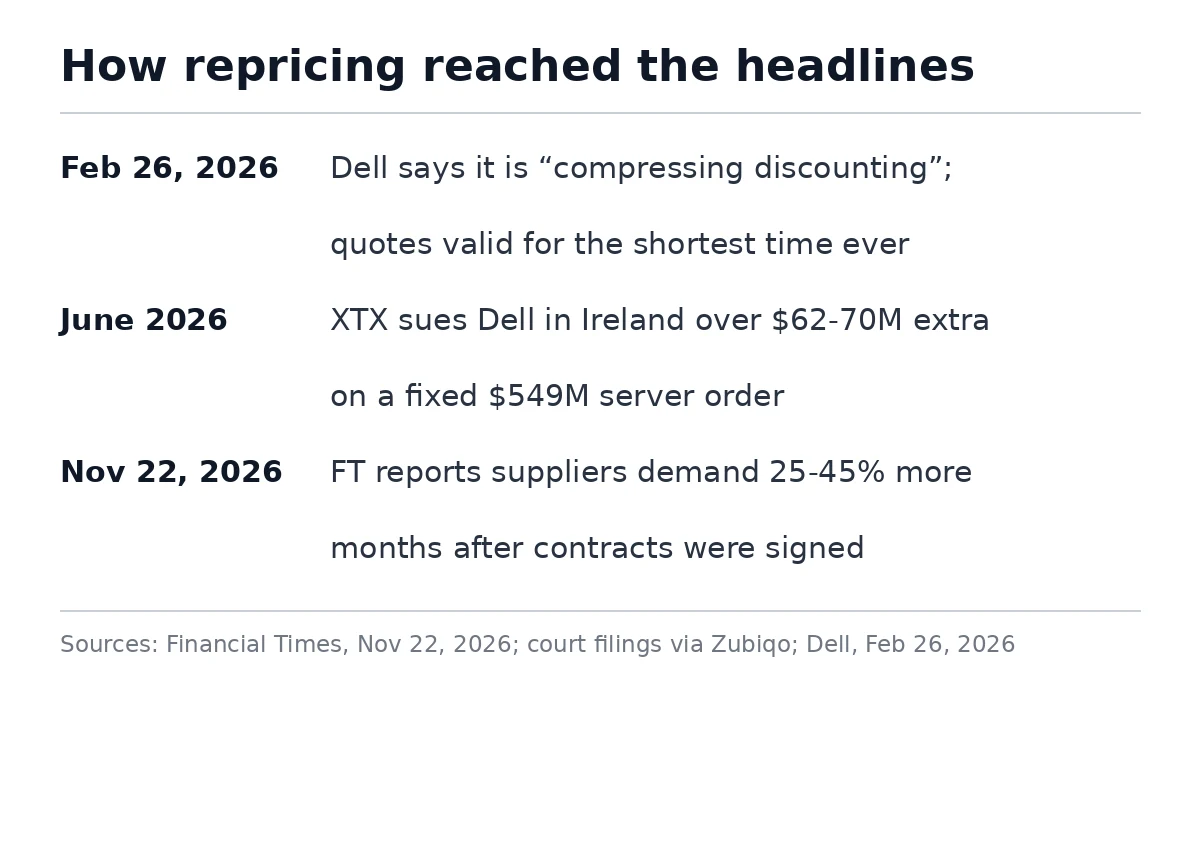
How post-signing repricing reached the headlines. Chart: GPTOnline.
Who ends up paying
The pain is uneven. Hyperscalers such as Microsoft, Amazon and Alphabet can absorb a bigger bill by nudging capital spending guidance upward, and their suppliers know it. The weaker position belongs to the neoclouds and former bitcoin miners that have reinvented themselves as AI hosts. Companies such as CoreWeave and Nscale borrow against signed customer contracts to buy hardware, so a higher server price lands on a financing plan that was sized to the old one.
If a data center operator holds a fixed price lease with a customer and a floating price purchase order with Dell or Supermicro, the gap comes straight out of margin. Whether those operators can pass the increase on depends on contracts that have not been made public.
Why it matters
The wider AI spending story has been built on the idea that buyers can plan. Analysts have pointed to a multi trillion dollar buildout, and that figure only holds if a server ordered today costs roughly what the spreadsheet says. Repricing after signing does not kill that thesis, but it makes every future budget softer, and it hands buyers a reason to push back or dual source next time.
It also costs the sellers something. A customer that receives a 45% surcharge on a signed deal will remember it at the next renewal, and the vendors are leaning on their pricing power at a moment when the AI trade is already jittery. The detail to watch is the next round of earnings calls, when Dell, HPE and Supermicro will each have to say whether post signing repricing is policy or exception, and how much of it is already in their guidance.