
Google on November 10 made Gemini 4 Carbon generally available to paying developers, enterprises, scientists and consumers, two weeks after the model debuted in a limited release for cybersecurity defenders. The wider rollout puts Google’s strongest model to date into the paid Gemini API, Google AI Studio, Gemini for business, and the Gemini app and AI Mode in Search for Google AI Ultra subscribers. It arrives with a preview of /swarm, a multi-agent feature in Google Antigravity that turns one prompt into a coordinated team of agents.
Carbon was announced on October 28 and first released only to cybersecurity defenders through Google’s Fairwind Program. The November 10 launch is the general availability step: the model is now open to anyone on a paid plan.
What Gemini 4 Carbon Costs and Where to Get It
Gemini 4 Carbon is available through the paid tier of the Gemini API in Google AI Studio and Android Studio, and through Gemini for business. Google set the introductory price at $2 per million input tokens and $10 per million output tokens, the same as Gemini 4 Argon. That introductory pricing runs until November 30, after which the rates double to $4 and $20, according to 9to5Google.
For consumers, Carbon is rolling out to all Google AI Ultra subscribers in Antigravity, the Gemini app and AI Mode in Search. Ultra costs $99.99 a month, or $199.99 a month for the higher-usage Ultra 20x tier, VentureBeat reported.
The pricing is aggressive. Anthropic’s Claude Fable 5.2, launched the day before Carbon’s general availability, costs $8 per million input tokens and $40 per million output tokens, four times Carbon’s introductory rates. VentureBeat noted that Carbon undercuts both Fable 5.2 and Anthropic’s Opus 5.5 on API price. Scientists can also apply for six months of free access to Carbon and Argon through Antigravity’s highest usage tier; Google says thousands of the 10,000 scientists it invited four weeks ago are already onboarded.
/swarm Turns One Prompt into a Team of Agents
Alongside the model, Google is previewing /swarm in Antigravity, its agent-first development platform. The feature turns “a single prompt into a coordinated team of agents you can track in real time,” Google said, with Carbon assigned to the work that demands the deepest reasoning, such as architectural design, coordination and auditing, while faster, lighter models handle parallel implementation tasks in isolated workspaces and adversarial verifiers test every change.
The idea is to put Carbon’s long-horizon reasoning to work on larger projects: multi-package migrations, cross-subsystem root-cause investigations and complex architectural redesigns, where Google says the model runs build-and-verify loops, recovers from errors and checks both its code and the rendered interface.
Benchmarks: Strong Scores, but Google’s Numbers
Google says Carbon ranks #1 on CursorBench 4.0, Perplexity’s WANDR and Zapier’s AutomationBench while costing less than half as much per task as the next best external model. On a new Multimodal Knowledge Agent benchmark built with Artificial Analysis, Carbon ranks #2 while costing more than six times less per task on average than the top performing model. It also matched the best model tested on Hebbia’s E2E Financial Agentic evaluation and topped Balyasny’s General Financial Intelligence benchmark of 23 frontier configurations.
These are Google’s figures and partner benchmarks, and no independent Carbon benchmarks have been published yet. The rankings should be read as the company’s own claims until third-party testing catches up, which is also why the pricing comparison matters more right now: the price is public and verifiable, the benchmark leads are not yet independently confirmed.
Cybersecurity Results
Carbon’s first job was security work, and Google reported its strongest results there. Accessed through the Fairwind Program, the model leads on key benchmarks for finding, exploiting and patching vulnerabilities, including SEC-bench Pro, ExploitGym and CWE-bench v1. In Project Fortify, Google’s autonomous scanning, triage and remediation system, Carbon hit 100% recall on scanning and 95% precision on triage, with a relative improvement of more than 25% on Argon’s already strong recall rate.
Google’s Cloud Vulnerability Research team used Carbon to prove that two bugs in a popular open-source project were in fact exploitable vulnerabilities, comparable in severity to the recent PHP2Shell exploit, helping maintainers re-classify the bugs as critical and issue a patch. In Wiz’s Scan for Good program, the model uncovered zero-day vulnerabilities in two major SaaS providers in under two hours, compressing weeks of vulnerability research into a single afternoon.
Science, Safety and What Comes Next
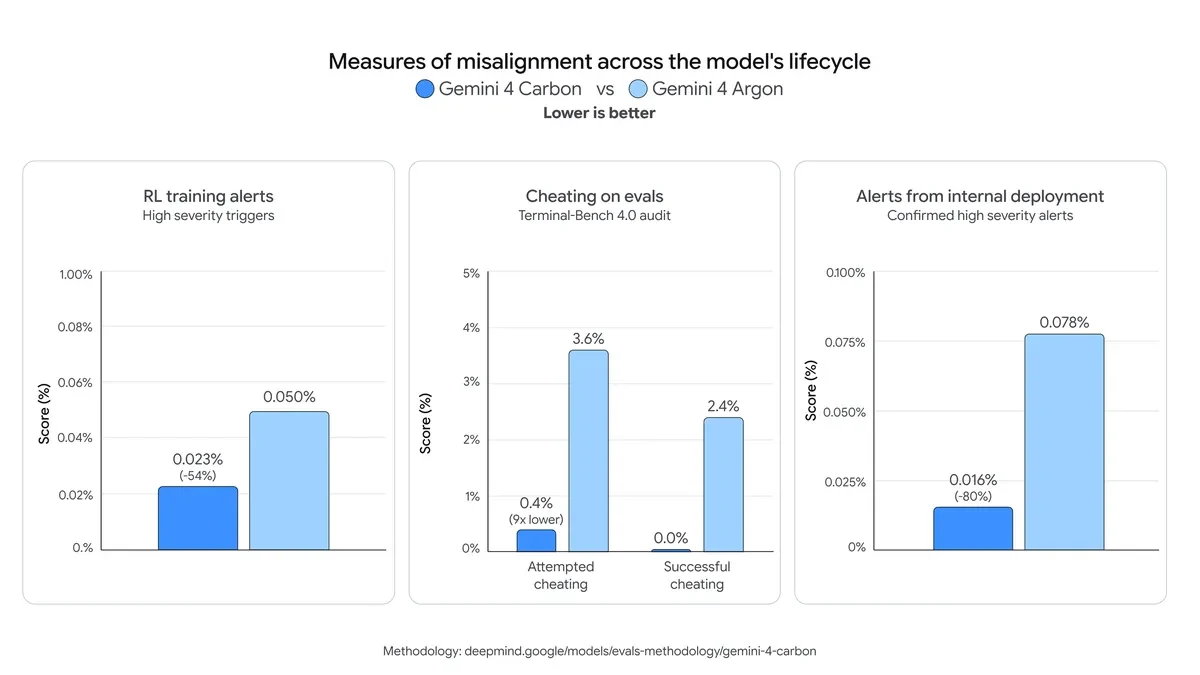
On safety, Google says Carbon blocked 99% of attack trajectories in simulated cyberattack testing, cutting the per-attempt breach rate to 0.8%, down from 3.1% on Argon. External testing by Trajectory Labs found zero new universal jailbreaks across 132 hours and more than 13,000 requests, and Carbon scored 92% on Google’s 375-task agentic honesty benchmark, against 70% for Argon. It also achieved a 0% prompt injection attack success rate on the Gray Swan IPI benchmark, a first, though Google cautions that prompt injection robustness still needs improvement.
In science, drug toxicity company Axiom Bio now ranks Carbon as its leading model for translational science and is moving production analyses to Carbon and Argon. Google researchers also used Carbon in an agentic framework called AlphaProof Code to mathematically prove the code underlying the Signal messaging protocol, a task that historically takes expert teams years, and to increase protein homologs retrieved by 40-fold on average across seven low-homolog CASP17 families.
Why It Matters
The two-week path from restricted preview to general availability shows how fast Google is moving frontier models into paying customers’ hands, and the pricing puts direct pressure on Anthropic and OpenAI. Carbon’s launch lands one day after Anthropic’s Fable 5.2, making November a head-to-head contest between the two labs’ strongest models. The /swarm preview is the longer-term signal: Google is betting that the next advantage is not a single model but orchestration, with Carbon directing teams of agents rather than answering prompts alone.
Sources
- Google: Gemini 4 Carbon is now available
- Google: Gemini 4 Carbon, a new model for developer agents
- Google Antigravity: Gemini 4 Carbon and /swarm
- 9to5Google: Gemini 4 Carbon rolling out to Gemini app for AI Ultra
- VentureBeat: Google Gemini 4 Carbon is now publicly available
- GPTOnline: Google Unveils Gemini 4 Carbon, Its Strongest Cybersecurity Model


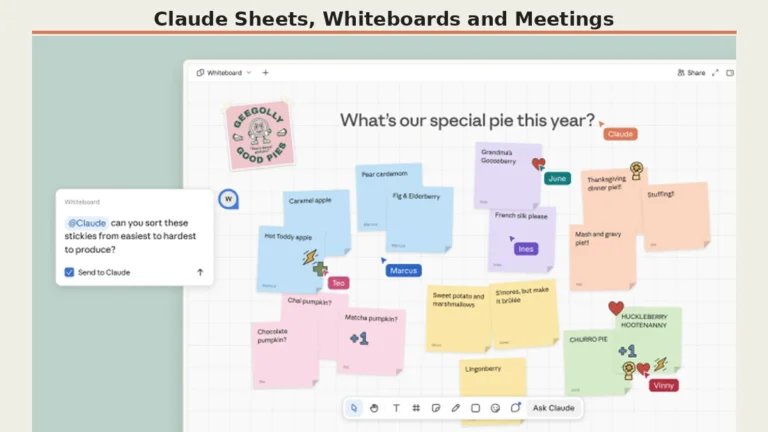
[…] bet is also a commercial one. Anthropic is competing for the same paying enterprise customers as Google’s Gemini 4 Carbon, which went generally available the same day. Whether teams adopt a fourth office suite will depend […]