Correction, November 10, 2026: An earlier version of this article, based on a wire report, incorrectly stated that SoftBank Group posted a $16.6 billion quarterly profit. The company’s confirmed results show a net loss of 1.1 trillion yen ($7 billion). This article has been corrected.
SoftBank Group swung to a net loss of 1.1 trillion yen ($7 billion) in the July-September quarter, hit by a costly bet on equipment for AI data centers in the United States and a broad selloff in technology shares. Reuters reported the figures from Tokyo on Tuesday, November 10, a sharp reversal from the 2.5 trillion yen profit the group reported in the same quarter a year earlier, when rising OpenAI valuations lifted its portfolio.
The result missed even the low end of expectations. Three analysts polled by LSEG had forecast anything from a 233 billion yen profit to a 113 billion yen loss. SoftBank shares still rose 13.9 percent in Tokyo trading on Tuesday, as investors looked past the quarterly loss to the value of the group’s OpenAI stake.
What the SoftBank Loss Shows
The largest single hit came from a subsidiary that bought power generation equipment for AI data center projects in the United States, only for those plans to be revised. SoftBank said the episode cost it $3.7 billion in the first half of the fiscal year. Financing costs also more than doubled, to 462 billion yen, as the group borrowed heavily to fund its AI commitments.
SoftBank did not issue a forecast for the full fiscal year, as usual. A year ago, the same OpenAI stake produced a huge investment gain as stock markets hit record highs. This quarter, falling tech valuations and the data center equipment hit pushed the group to a loss instead, a reminder of how quickly the portfolio can swing in either direction.
One distinction matters for readers: these are the results of SoftBank Group Corp., the investment holding company listed in Tokyo as 9984.T, not SoftBank Corp., the telecom operator, which reports separately.
Image: SoftBank Group logo (public domain, via Wikimedia Commons).
The OpenAI Engine Behind the Volatility
OpenAI’s valuation has risen steadily and sharply through the year, and SoftBank has been one of its largest beneficiaries. In March, SoftBank agreed to lead a funding round of up to $40 billion in OpenAI at a valuation of $300 billion. In October, a source told Reuters that SoftBank was among a consortium of investors acquiring $6.6 billion worth of shares from OpenAI employees at a higher valuation of $500 billion.
SoftBank completed a $30 billion follow-on investment in OpenAI on October 1, lifting its cumulative investment to $64.6 billion for an ownership interest of about 13 percent. The scale of that bet is the reason SoftBank’s quarterly results have become a proxy for sentiment about the AI boom itself. A public listing for OpenAI would let SoftBank monetize the stake, but Reuters reported that OpenAI’s IPO plans have been pushed to next year.
The group is not slowing down. It recently signed joint development agreements with Grab and PETROS for a $1.85 billion AI infrastructure buildout in Malaysia, targeting five gigawatts or more of AI compute capacity.
Selling Nvidia, Funding the AI Bet
The earnings report also confirmed a striking portfolio move. In October, SoftBank sold 32.1 million shares of Nvidia, including those held by its asset management subsidiary, for $5.83 billion, exiting its entire holding in the chipmaker. The sale was not reflected in the second-quarter earnings, and the company did not disclose a rationale for it.
SoftBank is in the midst of massive AI-related investments, its most ambitious since the launch of the Vision Fund vehicles in 2017 and 2019, and it is in need of funding. The proceeds are earmarked for initiatives including the $500 billion Stargate project to expand US data center capacity and as much as $40 billion pledged to OpenAI.
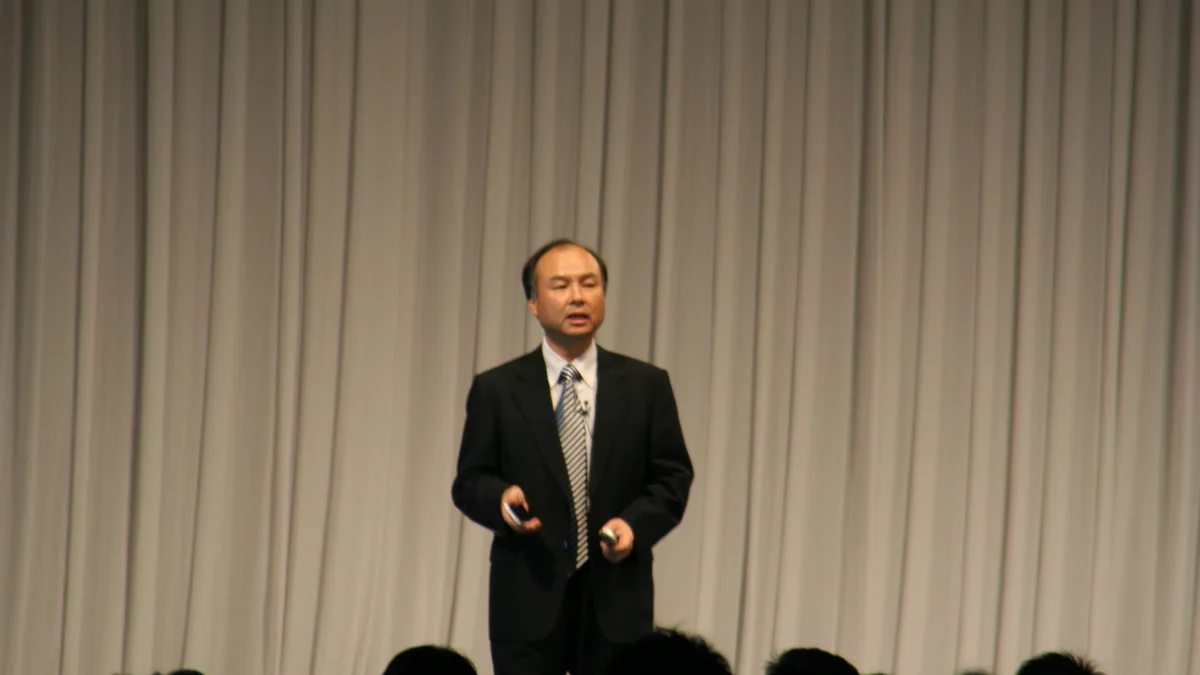
SoftBank founder and CEO Masayoshi Son speaking in 2008. Image: nobihaya, via Wikimedia Commons (CC BY 2.0).
Why It Matters
The results arrive at a moment of intense scrutiny. SoftBank’s shares had fallen 11 percent on Friday as AI stocks sold off, and the cost of insuring its debt against default hit a four-year high, with investors questioning how the group would fund its AI commitments and weather a sector downturn. Tuesday’s loss deepens those questions, even as the share price rebound suggests investors still believe in the OpenAI bet. The SoftBank loss does not change the scale of the group’s AI commitments, but it does raise the cost of funding them.
Reuters also noted growing concern among investors about an “AI bubble”, in which the enormous sums committed to capital investment by leading firms may not generate the profits to justify them. The Democratic Party’s midterm sweep has heightened expectations of regulatory scrutiny of the AI industry, adding to the pressure on valuations.
Founder and chief executive Masayoshi Son is experienced in making leveraged bets on what he sees as transformative technologies, but his track record is mixed. An early bet on Chinese e-commerce site Alibaba proved lucrative, while other bets have gone awry, such as shared office provider WeWork. The OpenAI wager is now the largest single bet of his career, and this quarter it cost him.
The next test comes quickly. SoftBank said last week that China blocked its $5.4 billion acquisition of ABB Robotics, a reminder that geopolitics can still interrupt its AI plans, and the group still has to show that its data center ambitions, including the Ohio campus planned for OpenAI, can be built on schedule. For now, the market has given a mixed verdict: a $7 billion loss, and a share price up nearly 14 percent on the day.