Google on October 28 announced Gemini 4 Carbon, its newest frontier model and its strongest yet for cybersecurity and long horizon engineering work. The launch comes only two weeks after Google introduced Gemini 4 Argon, the first model of the Gemini 4 generation, and it underlines how fast the company is now iterating at the frontier. Unlike a general public release, Carbon is rolling out first to a small group of cyber defenders, with broader access to follow.
“Today, we’re announcing the next frontier model: Gemini 4 Carbon, our strongest model with state-of-the-art cybersecurity and long horizon capabilities,” Google said in its announcement. The company positions Carbon as a model built for sustained, multi-step engineering work, not just single answers.
What was announced
Carbon builds directly on Argon and is designed for what Google calls long horizon tasks: hard engineering problems that take days of persistent work, such as tracking down subtle bugs across large codebases and low level systems. Google says its internal teams have watched Carbon run for days, pushing through dead ends to root cause and patch complex flaws. The model also gains in coding, agentic and scientific tasks, and in full stack web development, where it jumps 89 Elo points to fourth place (1768) on WebDev Arena.
On the updated Artificial Analysis Intelligence Index v5.0, Carbon ranks first with a score of 59, ahead of Anthropic’s Claude Opus 5.5 at 58 and OpenAI’s GPT-6 Astra at 57, according to VentureBeat’s coverage of the announcement. Google itself highlights the same ranking in its blog post. Independent rankings are one data point, not a verdict on every task, and VentureBeat notes Carbon still trails rivals on some professional tasks.
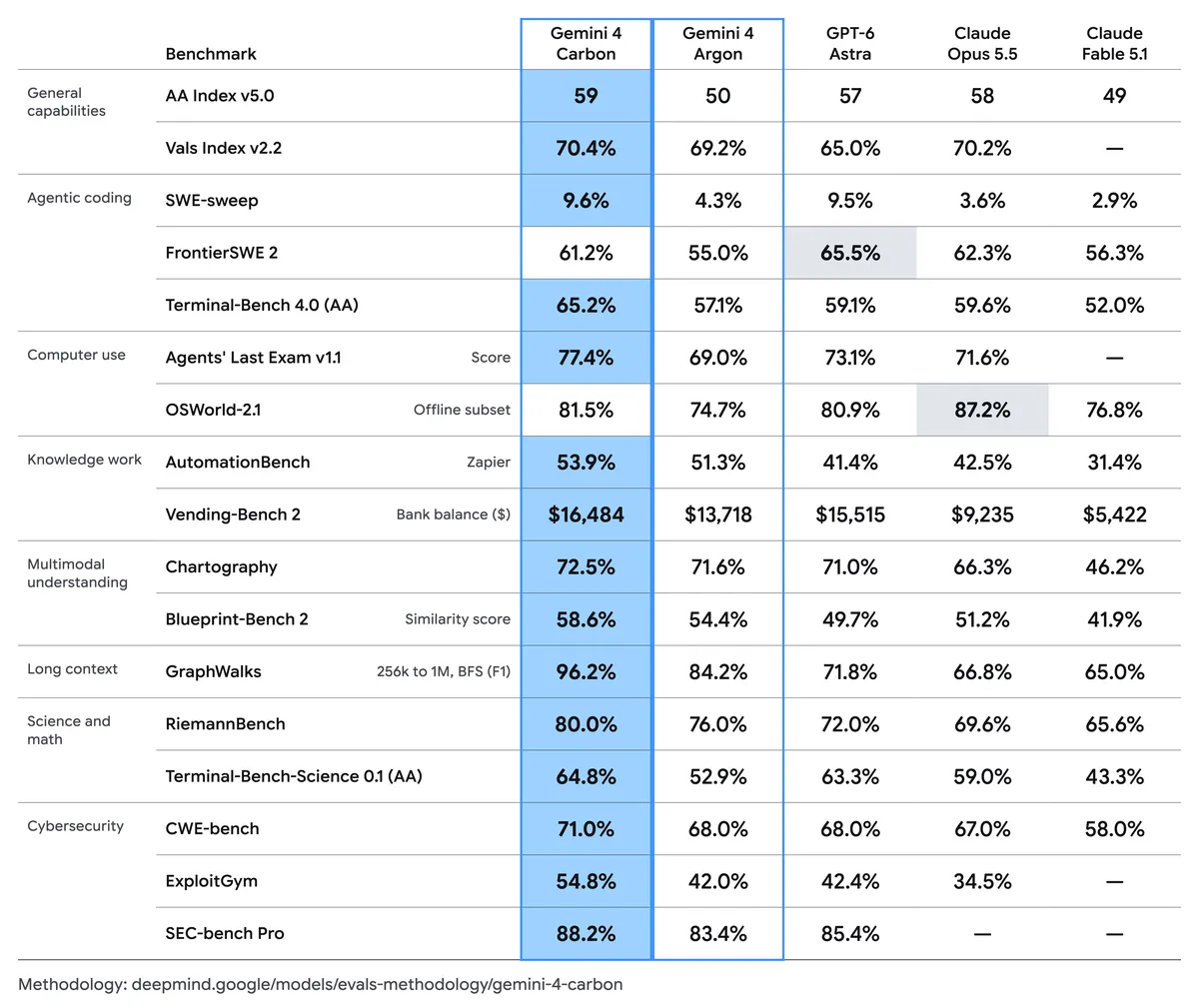
Image: Google
Cybersecurity benchmark results
Cybersecurity is the headline. Google says Carbon achieves state-of-the-art performance across the full defense lifecycle: finding vulnerabilities, validating whether they can be exploited, and fixing them at the root cause. The company reports:
- 88.2% on SEC-bench Pro for finding real vulnerabilities in real world software.
- 54.8% on ExploitGym for checking whether a flaw is actually exploitable.
- 71.0% on CWE-bench for patching the root cause, turning validated findings into working code fixes.
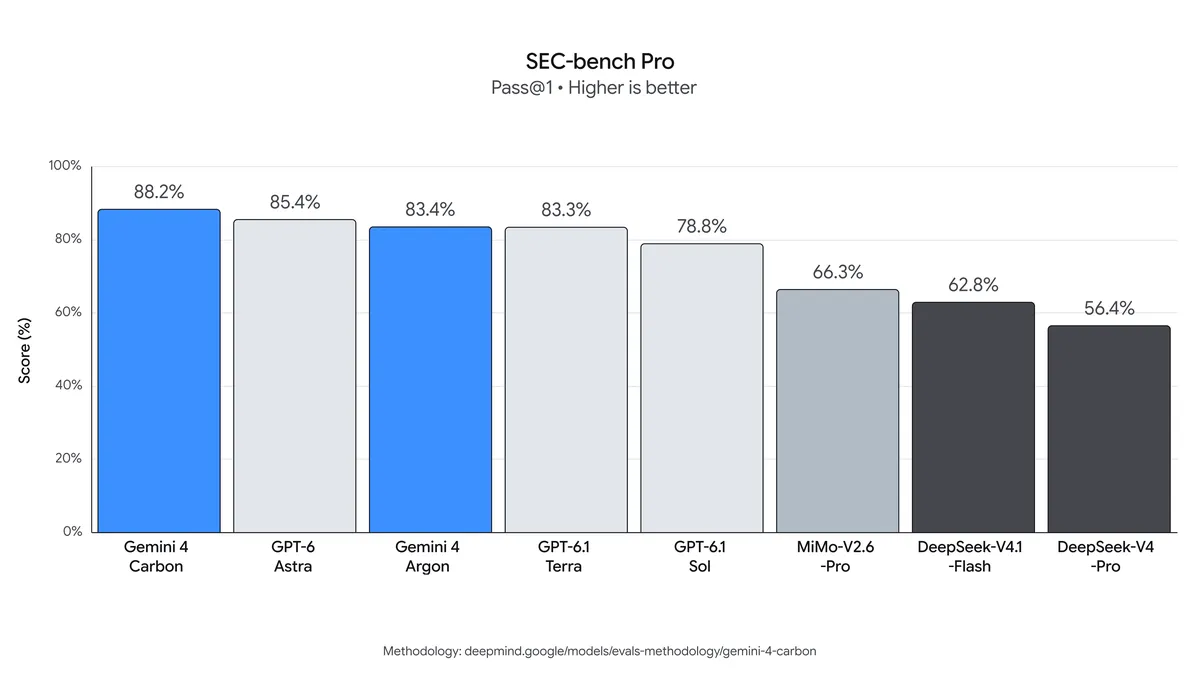
Image: Google
On internal benchmarks, Google says Carbon more than doubles Argon’s success rate for generating secure code, and its Chrome team reported Carbon producing high quality patches more than 10 times better than another lab’s large frontier model, which Google did not name. One important caveat comes from Google itself: the external cybersecurity benchmarks were evaluated without guardrails, so the scores describe raw capability, not performance under the safety controls that will govern real deployments.
Safety work behind the launch
Google frames Carbon as a safety step as much as a capability step. The model builds on Argon’s safety stack, combining training, real time misuse defenses, prompt injection resilience and chain of thought monitoring. In internal testing, Carbon cut successful cheating on Terminal-Bench 4.0 to 0.0%, reduced high severity misalignment alerts in live coding environments by almost 80%, and cut unsupported claims by about half compared with Argon. On Gray Swan’s Indirect Prompt Injection benchmark, Carbon resisted every evaluated attack attempt, reaching a 0.0% attack success rate after Argon’s 0.7%.
That caution also shapes the rollout. Google says it is engaged in the U.S. government’s voluntary process for pre-release model testing, and it is gathering feedback and iterating on guardrails before Carbon reaches developers, businesses and consumers through its product surfaces.
Limited access and pricing
Starting this week, Carbon is available to a subset of cyber defenders, with access gradually phasing to additional trusted partners through Google’s Fairwind Program. Google says broader availability will follow as soon as possible, but it has not given a date. Introductory pricing matches Argon at $2 per million input tokens and $10 per million output tokens, with cached input tokens priced at 95% off the input price. Reuters reports the same introductory pricing, while coverage of Google’s footnote notes the rates later rise to $4 and $20 per million tokens once the introductory period ends.
Why it matters
Carbon matters for two reasons. First, it shows the frontier race compressing into weeks, not quarters: Argon to Carbon in fourteen days, with each step aimed at a sharper slice of real work. Second, it puts cybersecurity at the center of that race. A model that can find, prove and patch flaws at this level is a powerful defensive tool, and the same capability in the wrong hands is a risk, which is exactly why Google is gating access to vetted defenders first. For security teams, the practical question is not the benchmark table but how quickly Carbon moves from a Fairwind pilot to the tools they actually use, and at what price once the introductory rates expire.