
OpenAI has launched GPT-6.2 Astra and GPT-6.2 Sol, its newest pair of AI models, with lower prices, stronger results on professional work, and tighter safety controls. Both models are available starting today, November 17, 2026, in ChatGPT Work and Codex, and through the OpenAI API.
“We’re introducing GPT-6.2 Astra, our new frontier model for your hardest projects, and GPT-6.2 Sol, our efficient, versatile model for everyday work,” OpenAI said in its announcement. “Both models deliver better results on demanding tasks with fewer output tokens, so you can get more done within your usage limits.”
What Was Announced?
GPT-6.2 Astra is the flagship model, aimed at demanding professional work such as coding, science, legal drafting, and computer use. OpenAI says it writes cleaner code, builds better frontends, and produces slides, spreadsheets, and documents that follow the templates and conventions of a field more closely. GPT-6.2 Sol is the smaller, cheaper model for everyday work, and OpenAI says it now comes surprisingly close to Astra on several coding tests.
The launch follows GPT-6 Astra, released in September 2026, and GPT-6.1 Sol, introduced a few weeks later at DevDay. OpenAI says both new models finish demanding tasks with fewer output tokens, which matters because users on paid plans hit usage limits more slowly.
On the coding side, OpenAI says Astra is better at making and testing changes inside an existing project. “Early testers reported cleaner code style and more focused tests, with fewer rounds of revision,” the company said.
Pricing and Availability
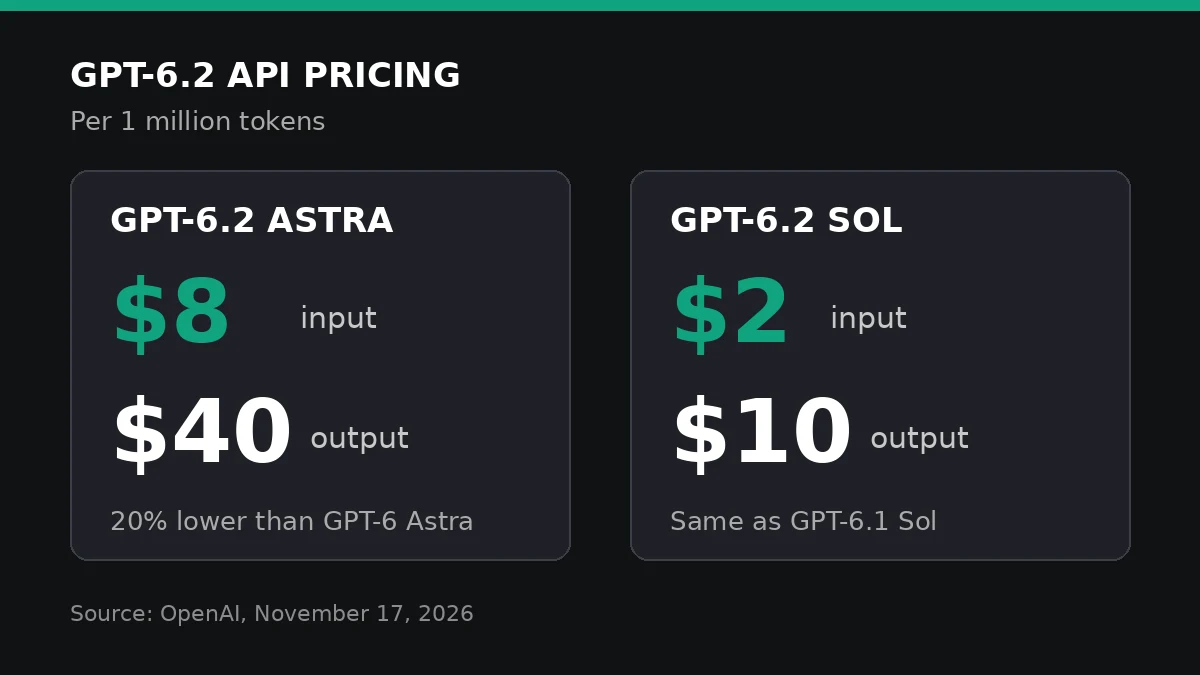
GPT-6.2 Astra costs $8 per million input tokens, $0.40 per million cached input tokens, and $40 per million output tokens through the API. That is 20% lower than GPT-6 Astra, with a 60% discount on cached input. GPT-6.2 Sol keeps GPT-6.1 Sol’s prices of $2 per million input tokens, $0.10 cached, and $10 per million output tokens.
Both models are available to all Plus, Pro, Enterprise, and Edu users in ChatGPT Work and Codex. Developers can call them in the API as gpt-6.2-astra and gpt-6.2-sol. OpenAI is also expanding its Ultrafast mode, which generates tokens at up to 4.5 times the standard rate. Pro 500 subscribers get Ultrafast on both models, while Pro 200 subscribers get it for the first time, starting with GPT-6.2 Sol. Eligible Enterprise and Edu workspaces get the same access once an admin enables it.
Benchmark Results, as Reported by OpenAI
OpenAI’s headline numbers come from its own testing, not independent verification, and the company says several results are measured at a small fraction of a rival’s cost per task. On Agents’ Last Exam, which tests multistep professional work, GPT-6.2 Astra scores 5.2 points higher than GPT-6 Astra at less than a third of the cost, and 5.5 points ahead of Claude Fable 5.2 at 5% of the cost.
For scientists, OpenAI calls GPT-6.2 Astra its best model yet. It sets a new high on Terminal-Bench-Science 0.1, scoring 9 percentage points higher than GPT-6 Astra at less than one-third the cost, and a new high on the Vals Science Index. On legal work, the Harvey LAB-AA v1.1 test shows Astra more than doubling Claude Fable 5.2’s pass rate at about one-sixth the cost.
Sol is the efficiency story. On Cognition’s FrontierCode 2.0, GPT-6.2 Sol comes within 0.5 points of GPT-6.2 Astra at about one-fifth the cost, with both models at maximum reasoning effort. On OpenAI’s LifeVal test of everyday tasks, Sol outscores GPT-6 Astra at about one-seventh the cost. On Artificial Analysis’s AA-3D test, where human judges compare interactive 3D experiences, Astra ranks first with 1,318 Elo, ahead of Claude Fable 5.2 at 1,271 and Sol at 1,259.
Stronger Safeguards for Stronger Models
The safety disclosures are a central part of this release. Like GPT-6 Astra, both new models meet the Critical threshold for cybersecurity and the High threshold for biological and chemical capabilities under OpenAI’s Preparedness Framework. OpenAI says it is deploying them with its strongest safeguards to date, including tighter restrictions on higher-risk cybersecurity assistance, which may also limit some legitimate vulnerability research and security testing.
GPT-6.2 Astra is also OpenAI’s first externally released model to meet the High threshold for AI self-improvement, which measures a model’s ability to accelerate AI research. OpenAI says it built more oversight into training and deployment, including a system called Control Room that tracks research workloads and can halt model output when intervention is needed.
Why It Matters
OpenAI is now shipping new frontier models on a roughly two-month cadence, and each step pairs a capability gain with a price cut. Astra’s 20% price drop, combined with fewer tokens per task, makes frontier performance cheaper for businesses that run coding agents and document work at scale. Sol’s near-parity with Astra on coding tests at a fifth of the cost sharpens the same point from the other direction: for many everyday jobs, the cheaper model is now close enough.
The timing also matters. Microsoft unveiled six of its own MAI models on the same day, pitching near-frontier performance at a fraction of rival prices. OpenAI’s answer is to cut Astra’s price while raising its benchmark scores, a direct reply in a pricing war that now defines the model market.