Microsoft has unveiled six AI models built in-house, pitching near-frontier performance at a fraction of rival prices, in its most direct challenge yet to OpenAI and Anthropic. The announcement came on November 17, 2026, at the company’s Ignite conference in San Francisco, on the same day OpenAI launched GPT-6.2 Astra and Sol.
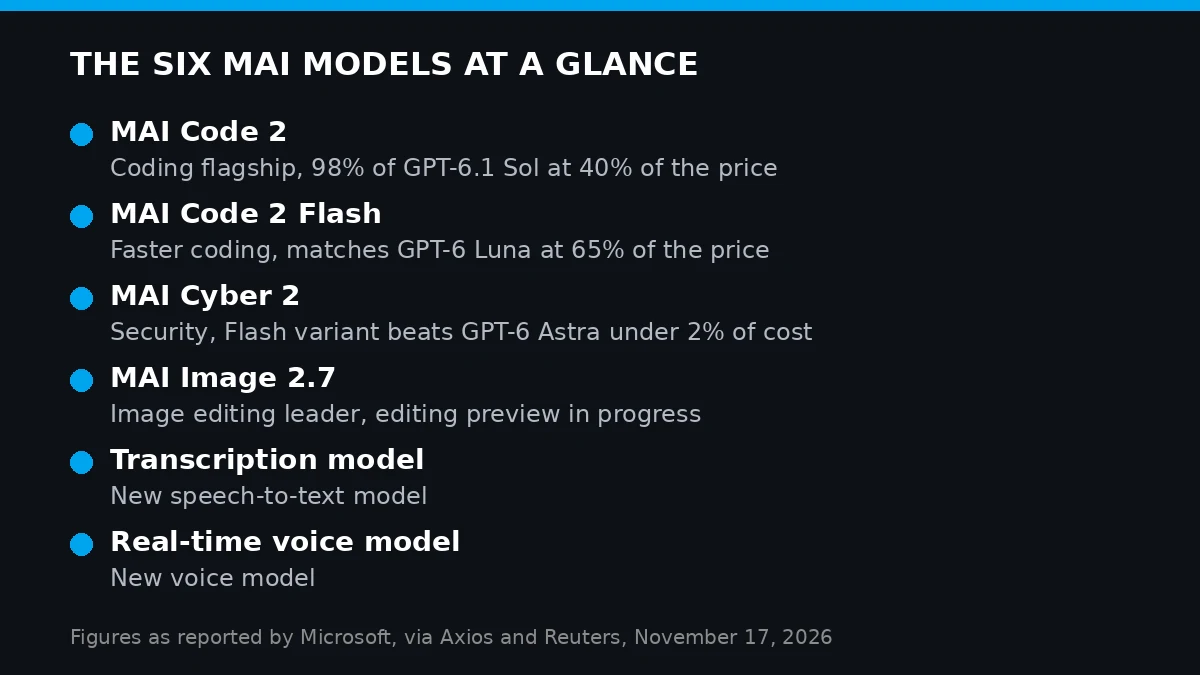
The lineup covers coding, cybersecurity, image generation, transcription, and real-time voice. The headliner is MAI Code 2, a programming model Microsoft says almost matches the performance of leading rival models while costing far less. Microsoft will make it available through GitHub Copilot, potentially moving some coding workloads away from outside models.
What Microsoft Claims
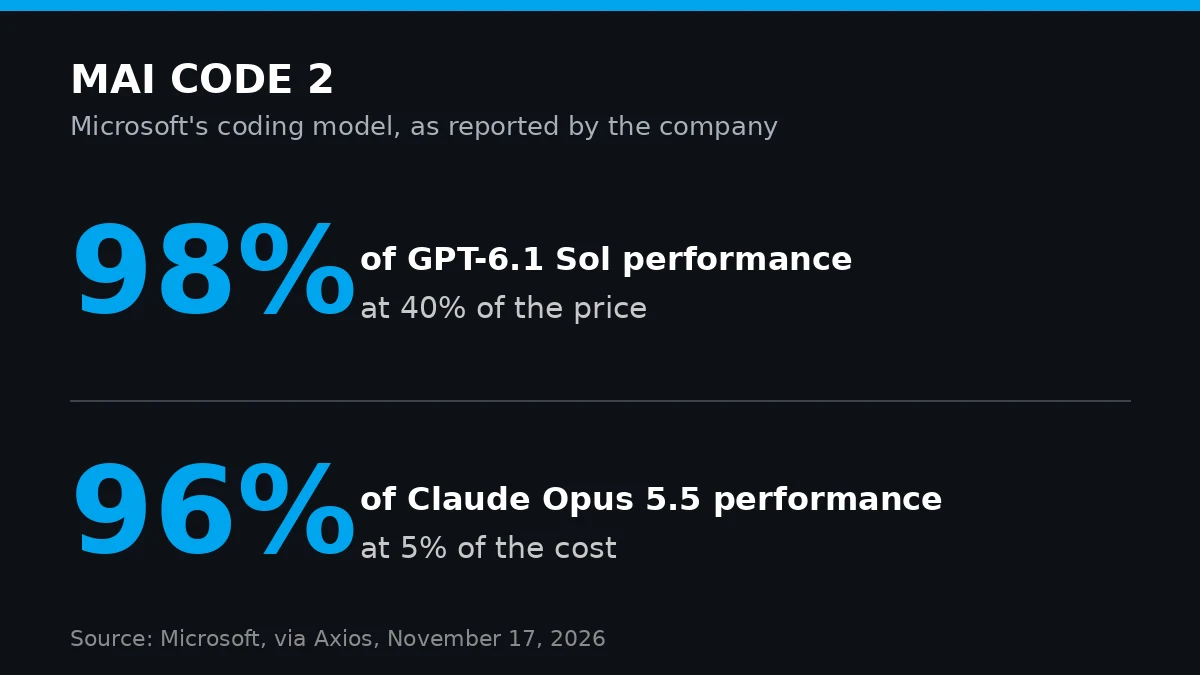
Microsoft says MAI Code 2 achieves 98% of GPT-6.1 Sol’s performance at 40% of the price, and 96% of Anthropic’s Claude Opus 5.5 performance at 5% of the cost. The smaller, faster MAI Code 2 Flash matches GPT-6 Luna’s performance at 65% of the price, and Claude Haiku 5.5 at 20% of the cost, according to the company.
On security, Microsoft says MAI Cyber 2 Flash outperforms GPT-6 Astra on a cybersecurity benchmark for less than 2% of the cost per task. Microsoft’s security blog confirms MAI-Cyber-2 is now in preview, alongside MAI Cyber 1.1 Flash, inside its MDASH agentic code scanner. The company plans to offer the cyber model to a limited group of customers, to help address a surge in software vulnerabilities that AI tools are increasingly bringing to light.
Microsoft also places MAI Image 2.7 first for image editing. Its editing preview began in late October, starting with restyling, relighting, and text changes to existing images, with text-to-image generation still to come. New transcription and real-time voice models round out the six, aiming to compete with leading alternatives.
A Strategy Built on Specialization
Microsoft AI chief Mustafa Suleyman told Reuters the company’s strategy is to build technology for specific domains, keeping costs low while matching rivals and in some cases topping model benchmarks. “This isn’t just one model. It’s not a flash in the pan,” he said. “This is a system, a hill-climbing machine that we have built, which co-optimizes performance and price.”
Suleyman told Axios that specialization lets Microsoft pack more capability into the same number of parameters. “It basically means that you cram more tokens and knowledge and expertise into the same amount of parameters,” he said. A model built for routine coding gives up capability in advanced mathematics and scientific research, a trade Microsoft is willing to make.
Readers should note the caveats. The performance comparisons use benchmarks Microsoft selected, and promotional discounts account for some of the pricing advantages, according to Axios. Independent testing has not yet confirmed the claims.
Availability and the Bigger Picture
MAI Code 2 will ship through GitHub Copilot, where Microsoft can steer coding traffic toward its own models. Suleyman predicted substantial adoption but declined to set a target for the share of Copilot traffic moving to Microsoft’s models, according to Axios.
Microsoft is also offering enterprise customers licensed model weights they can customize with proprietary data, with deployment inside Azure. Suleyman said the arrangement would “feel like open source” and provide greater security and control.
The company is working on a frontier general-purpose model as well. Suleyman said Microsoft has reached state-of-the-art results in pre-training and is progressing strongly in reinforcement learning, but he declined to give a release timeline. “My team is building true superintelligence,” he told Axios.
Why It Matters
Microsoft has long depended on OpenAI and other AI companies for its most advanced models, even as it invested billions in OpenAI. The MAI family, which debuted at Build in June 2026, is the company’s bid to own more of the stack itself. If MAI Code 2 performs as claimed inside Copilot, Microsoft can cut its dependence on outside providers and keep more of the economics of its most popular AI product.
The announcement also sharpens the security debate. Suleyman told Reuters that a recent cybersecurity reckoning, illustrated by OpenAI agents hacking the Hugging Face platform, pushed him to focus on safeguards as well as performance. Preventing AI from taking harmful actions, a research area known as alignment, was his top priority, he said.
For now, the claims are Microsoft’s own, and the market will judge them by adoption. But the direction is clear: the company that once rented its intelligence now wants to build it, sell it, and price it below everyone else.