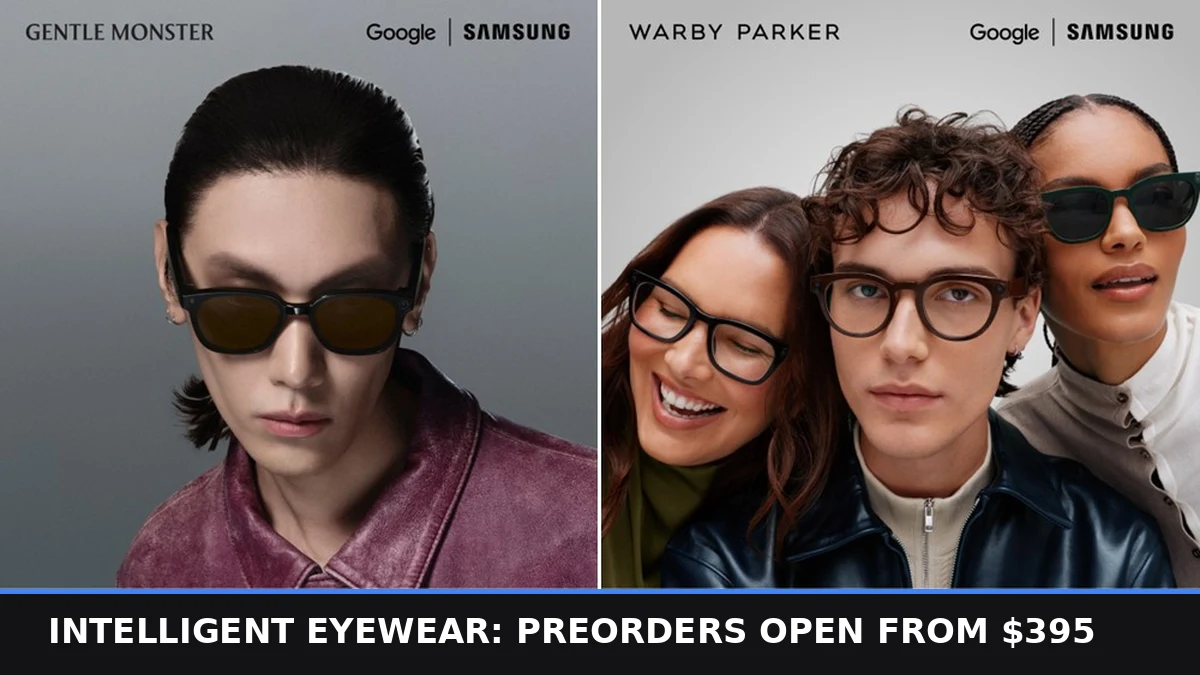
Samsung and Google have opened preorders for Intelligent Eyewear, a lineup of Gemini-powered Android XR glasses made by Samsung with frames from Gentle Monster and Warby Parker, Samsung announced on November 12. Prices start at $395 for the Warby Parker collection and $449 for Gentle Monster, with general availability on December 10 in the United States and South Korea.
The launch is the first large-scale release of Android XR glasses, Google’s platform for AI eyewear, and it puts the companies directly against Meta’s smart glasses. Unlike Meta’s display glasses, this first generation has no screen in the lens: Gemini works through audio and the paired phone, Android Headlines reported.
What Was Announced
The lineup covers 30 designs across the two eyewear brands. Gentle Monster contributes 16 variations across six frame styles, while Warby Parker offers 14 variations across three frame designs, in optical and sun versions. Preorders opened on November 12, and both collections launch in the U.S. on December 10. Gentle Monster will also be available in Korea, where models start at 650,000 won.
Customers can order through Warby Parker’s retail and online channels and through Gentle Monster’s official online store, with hands-on demonstrations available at select Samsung retail locations from December 10. In the U.S., Gentle Monster models range from $449 to $489 depending on the model.
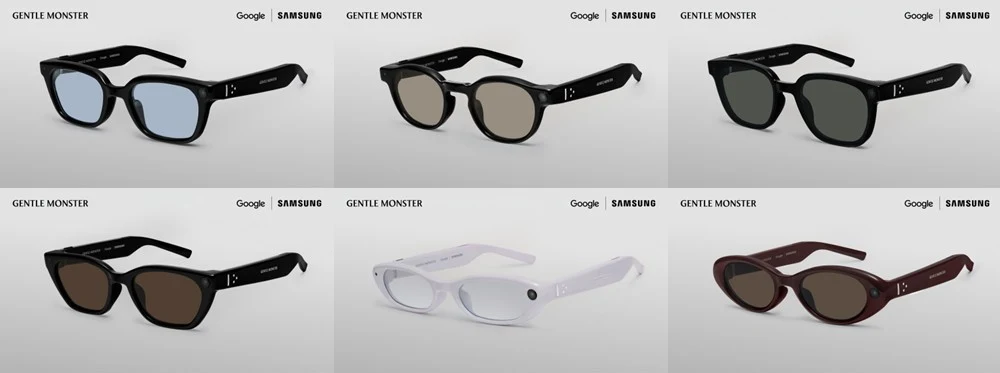
Image: Samsung.
What the Glasses Do
With Gemini built in, the glasses offer hands-free help throughout the day. Users can ask questions about what they see, such as identifying an unfamiliar landmark, and keep the conversation going with follow-up questions. A whiteboard captured during a meeting can be summarized by Gemini and saved directly into Samsung Notes. The glasses can also translate a restaurant menu or give turn-by-turn directions from Google Maps, and they can prioritize, group and summarize notifications, read important updates aloud and handle calls and messages by voice.
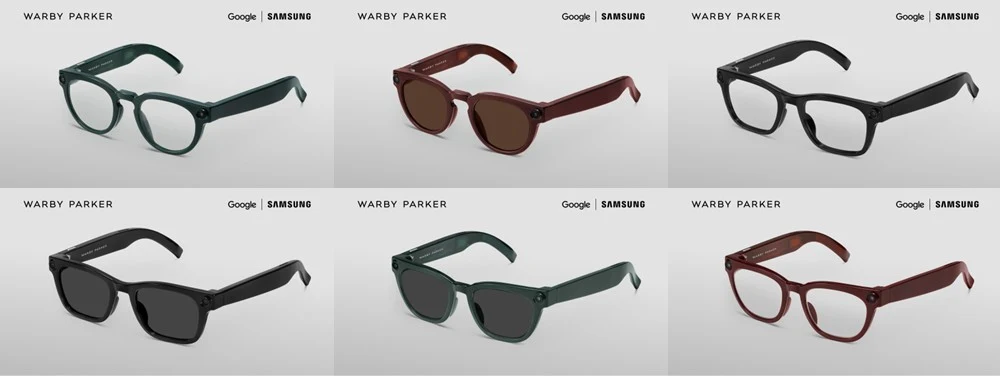
Image: Samsung.
Hardware and Specs
The glasses run on Qualcomm’s Snapdragon AR1 Gen 1 platform and weigh around 41 grams. A 12MP HDR camera provides visual context for Gemini and captures photos and video, while open-ear speakers and a four-microphone array handle voice interaction, calls and audio playback. Battery life is rated at up to nine hours on a single charge, and up to 72 hours with a fully charged charging case. The glasses carry 2GB of memory and 64GB of storage, with IPX4 water resistance and Wi-Fi 6E and Bluetooth 5.4 connectivity.
Compatibility is unusually broad for a Samsung wearable. The glasses work with Galaxy S, Galaxy S FE, Galaxy Z Fold, Flip and Fold Ultra phones running One UI 9.0 or higher, with Google Pixel 7 series phones and later running the Android 17 September 2026 update or later, and with iPhone 13 and later running iOS 26.6 or later, with at least 6GB of RAM. Google’s glasses also carry Made for iPhone certification, 9to5Google reported. Bixby is available only when paired with a Galaxy phone.
Privacy by Design
Samsung and Google built the glasses around controls for both the wearer and people nearby. An LED shows when the camera is active, the wearer gets a visual notification and a sound at the same time, and built-in safeguards disable camera capture if the external LED is covered or not working. In conversations with Gemini Live, surrounding sounds, including other people’s voices, are filtered to protect bystander privacy.
Users keep control over app-specific permissions and their Gemini activity. Samsung says visuals collected by Gemini are not used for AI model training or ad targeting, and the glasses are designed to automatically redact bystanders’ faces before responding to questions about what the wearer sees. The glasses are designed for users aged 18 and over, with age verification required for device activation and app downloads.
Why It Matters
Android XR has been Google’s long-promised answer to the smart glasses category, and this is the first time it reaches store shelves at scale with two fashion brands behind it. The $395 starting price undercuts the high end of the category while staying above Meta’s latest $300 smart glasses, Road to VR noted, and the iPhone support matters: buyers do not need a Galaxy phone, or even an Android phone, to use them.
The December 10 launch date also sets up a holiday-season test. If the glasses sell, Google and Samsung will have proved there is demand for audio-first AI eyewear without a display. If they do not, the pressure will shift to the next generation, which is widely expected to add a display in the lens.
Sources
- Samsung Global Newsroom: Samsung Announces December Release for Intelligent Eyewear
- 9to5Google: Google’s new Android XR glasses work with iPhone
- Road to VR: Android XR Glasses from Warby Parker and Gentle Monster Coming December 10, Pre-orders Now Live
- SamMobile: Samsung’s Intelligent Eyewear glasses go on pre-order today in Korea and US