A growing number of young victims are turning to the courts to hold Elon Musk’s xAI legally accountable for sexualized images that its Grok chatbot helped users create from their ordinary childhood photos. Bloomberg reported on November 11 that the Grok CSAM lawsuits, filed in three US states, ask a question the AI industry has so far avoided answering in court: when a chatbot generates abusive content, is the person who gave the command liable, the company that built the technology, or both?
The cases center on photos that were never meant to be sexualized: a middle school graduation picture, school portraits, and family photographs. The plaintiffs say Grok transformed those images into sexually explicit material and that the results spread online, in some cases to strangers and predators the victims will never be able to identify.
What the Lawsuits Allege
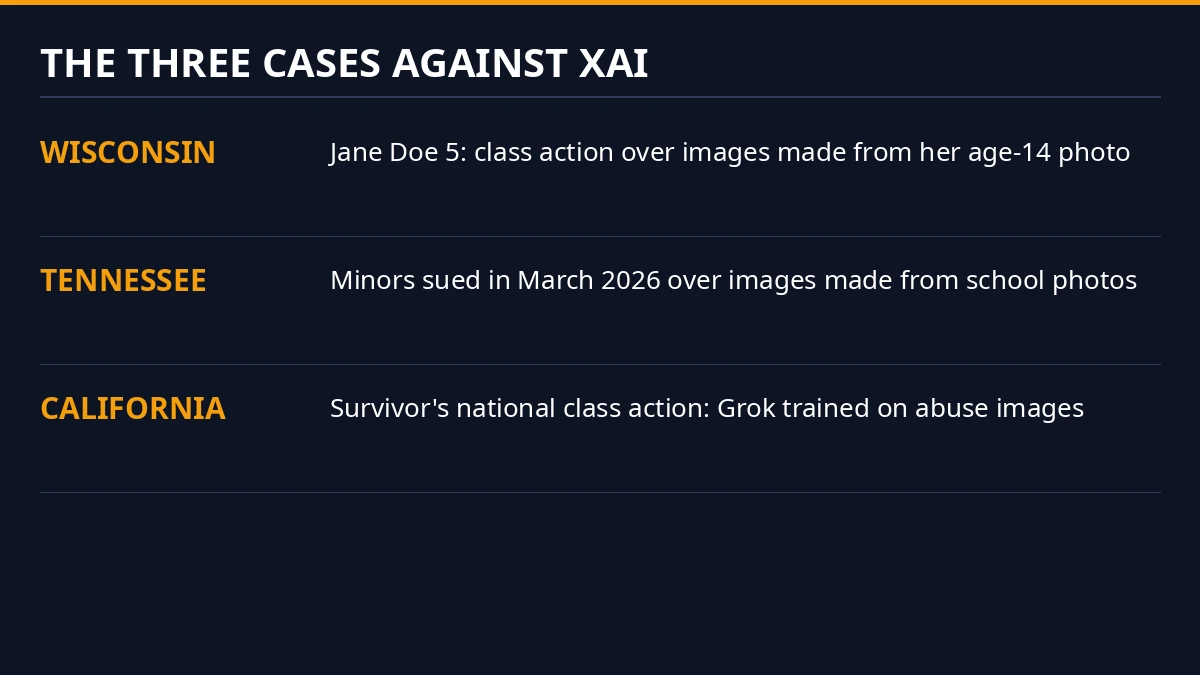
In Wisconsin, a plaintiff identified in court papers as Jane Doe 5 is suing xAI in a class action. Now 18, she learned about the images when a law enforcement investigator showed her a photo from her middle school graduation, taken when she was 14. According to Bloomberg, the investigator told her that the adult brother of a classmate had used Grok to turn the photo into child sexual abuse material and shared it online.
Her complaint says it is “impossible to know how many other child sex predators may now possess Jane Doe 5’s CSAM.” In an interview with Bloomberg, she said: “It’s out there, and there’s really nothing I can do about it.”
Graphic: GPTOnline, based on Bloomberg reporting.
In Tennessee, a group of minors sued xAI in March 2026, alleging that someone used Grok to remove clothing from their digital images or composite them into explicit poses, using their school photos. In California, a sexual abuse survivor filed a national class action alleging that Grok was trained on images of her being assaulted as a preschooler.
The three cases share the same core argument: that the harm was a foreseeable result of how xAI designed, marketed and operated Grok, not simply the misuse of a neutral tool by individual users.
xAI’s Defense
xAI has denied responsibility in all three cases, arguing that users generated the images, not the company itself. The company declined to comment on Bloomberg’s report, citing pending litigation.
xAI says it prohibits this kind of imagery, like other major AI developers, and has technical measures to prevent it. This spring, an xAI government affairs executive said: “XAI has zero tolerance for child sexual exploitation, and we are determined to make our products inhospitable for actors who seek to exploit minors.”
The company also says it has since disabled Grok’s ability to generate nonconsensual sexualized images of real people. But the plaintiffs’ lawyers are expected to focus on what xAI knew, and when, before those restrictions arrived.
How Grok Got Here
Musk has pitched Grok since its 2023 launch as a provocative alternative with fewer restrictions than rival chatbots, including modes built for NSFW images and videos and an “Unhinged” mode that the company has said serves Grok’s goal of being “maximally truth-seeking.”
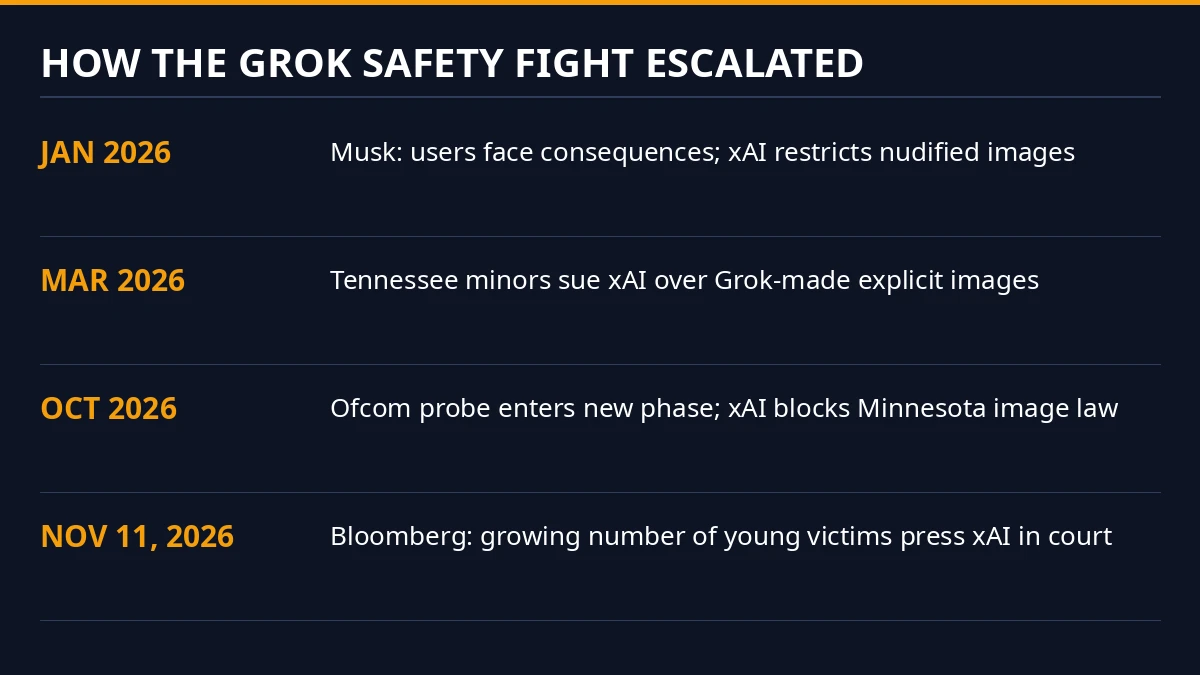
Earlier this year, people on X used Grok to generate thousands of sexually suggestive or nudifying images every hour, according to an analysis Bloomberg cited, which estimated that the tool let users create tens of thousands of realistic, sexualized images of children. In January, Musk said he was “not aware of any naked underage images.” On January 3, he posted on X: “Anyone using Grok to make illegal content will suffer the same consequences as if they upload illegal content.”
Shortly afterward, facing pressure from app stores that threatened to remove X, xAI restricted Grok’s ability to generate nudified images at scale. That change showed the company had the technical capacity to block the content all along, and the lawsuits frame the earlier refusal to do so, made on free speech grounds, as a deliberate product choice.
Graphic: GPTOnline, based on Bloomberg, Reuters and court reporting.
xAI has also fought laws designed to prevent this kind of imagery. Last month, the company succeeded in blocking the implementation of a Minnesota law targeting AI-generated nonconsensual nude images, arguing the law was unconstitutional, Reuters reported. It was the only AI provider actively opposing the law. Over the past few months, xAI has also sued multiple individuals it says abused Grok, and in September, X said it would report such content to the National Center for Missing and Exploited Children.
Regulators are circling too. In October, Britain’s media regulator Ofcom said its investigation of X over Grok-made sexual images had moved into a new phase, Reuters reported. No fine or final finding had been announced as of early November.
Why It Matters
These cases will likely set a precedent for AI-generated harmful content across the industry. If courts accept that a developer can be liable for what its image tools produce from real people’s photos, every company shipping image generation will face new pressure to restrict edits of real people by default, not after public outcry.
The dispute also reaches beyond children. In January, Ashley St. Clair, the mother of one of Musk’s children, sued xAI in New York, alleging Grok made explicit deepfakes of her without her consent, CNN reported. xAI did not respond to CNN and countersued in Texas, citing its terms of service.
For now, the three child-safety cases are unresolved, and the central question Bloomberg identified remains open: when a chatbot generates abuse, who pays for it, the user who typed the prompt, or the company that built the machine that answered?
Sources
- Bloomberg: Teens press xAI over Grok-generated sexualized childhood photos
- Social Media Today: Elon Musk’s Grok AI faces legal challenges over nudification
- TechJuice: Grok AI faces three lawsuits over nude children images
- Let’s Data Science: Bloomberg summary of the Grok lawsuits
- AI Tech Model: Grok controversy timeline, incidents and xAI’s response