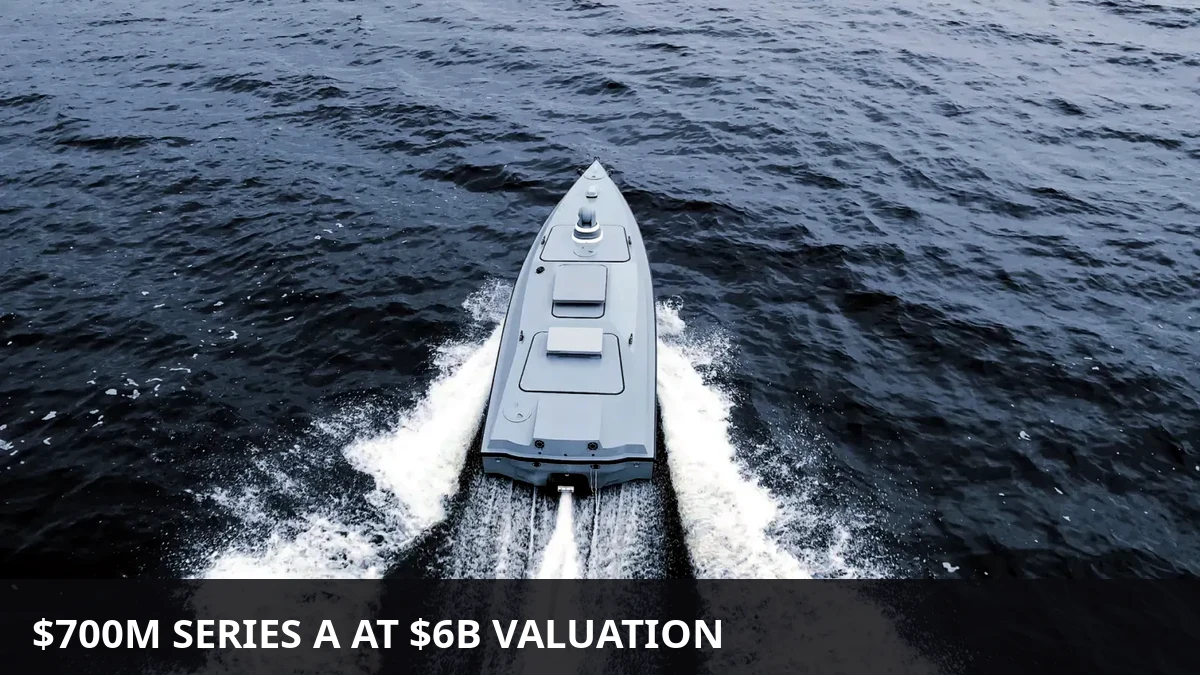
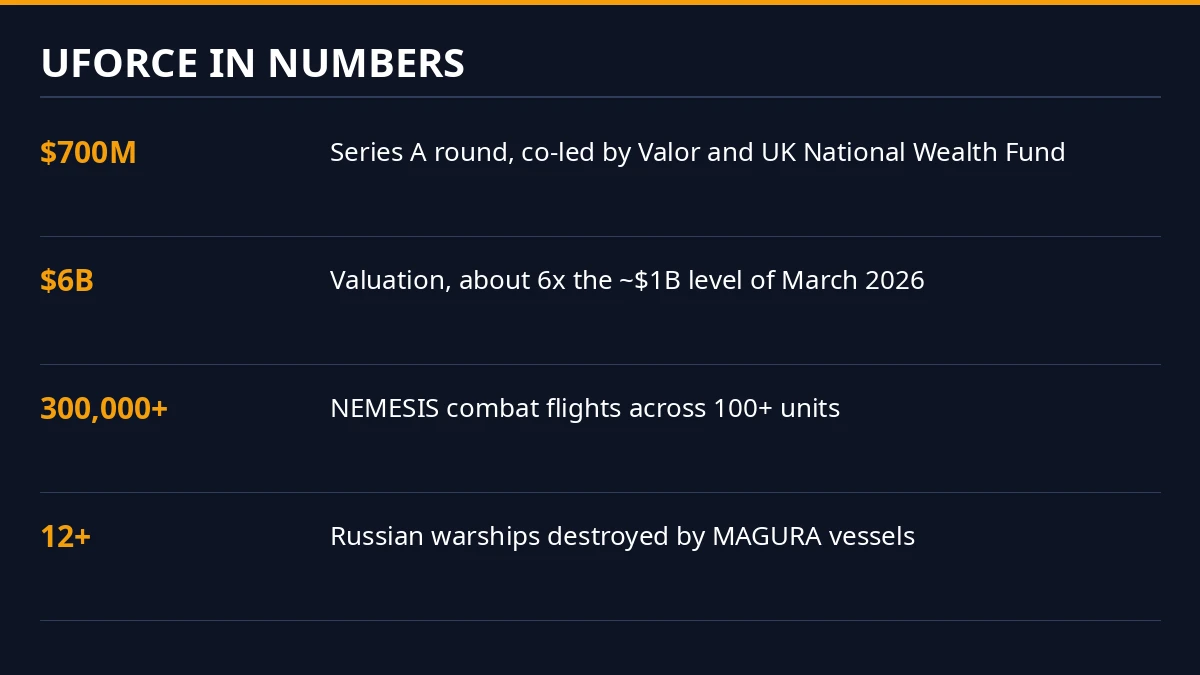
UFORCE, a Ukraine-founded defence-technology company that builds autonomous sea, land and air systems, has raised $700 million in a Series A financing round at a $6 billion valuation, the company announced on November 12. The UFORCE Series A is one of the largest defence-technology raises of the year, and it values the company at roughly six times the level of its previous round in March.
UFORCE builds uncrewed platforms across sea, land and air, plus the AI software, orchestration and command-and-control layer that operates them. Its stated goal is to make defence a hundred times cheaper than offensive operations. The new capital will expand and distribute production across the US, Europe, Asia-Pacific and the Middle East, while keeping continuous manufacturing in Ukraine to supply front-line troops.
Who Backed the Round
The round was co-led by Valor Equity Partners and the UK National Wealth Fund, with participation from the US-Ukraine Reconstruction Investment Fund. It also drew investors from Silicon Valley, Europe and Asia, including Menlo Ventures, Xantium and Hiro Capital, while existing investors Shield Capital, Ballistic Ventures, Lakestar and Squadra increased their stakes.
General (Ret.) Christopher G. Cavoli, the former NATO Supreme Allied Commander Europe and a partner at Valor Equity Partners, is joining the UFORCE board. “Ukraine has shown the world how quickly battlefield innovation can move when engineers work side by side with the people who rely on their systems,” Cavoli said. “UFORCE turns that hard-won frontline experience into both unmanned systems and the operational know-how to use them effectively.”
Conor Coleman, head of investments at the US International Development Finance Corporation on behalf of the reconstruction fund, said the deal is the fund’s largest investment in the emerging technology sector to date.
Combat-Proven Systems
UFORCE’s product lines are the MAGURA family of unmanned surface vessels, the NEMESIS family of strike drones, the LIUT family of ground robotic platforms, the PREDATOR family of counter-drone turrets, and C2, the software that controls them. The systems are already in combat use in Ukraine, which is central to the investment case: the company sells platforms tested in war, not prototypes.
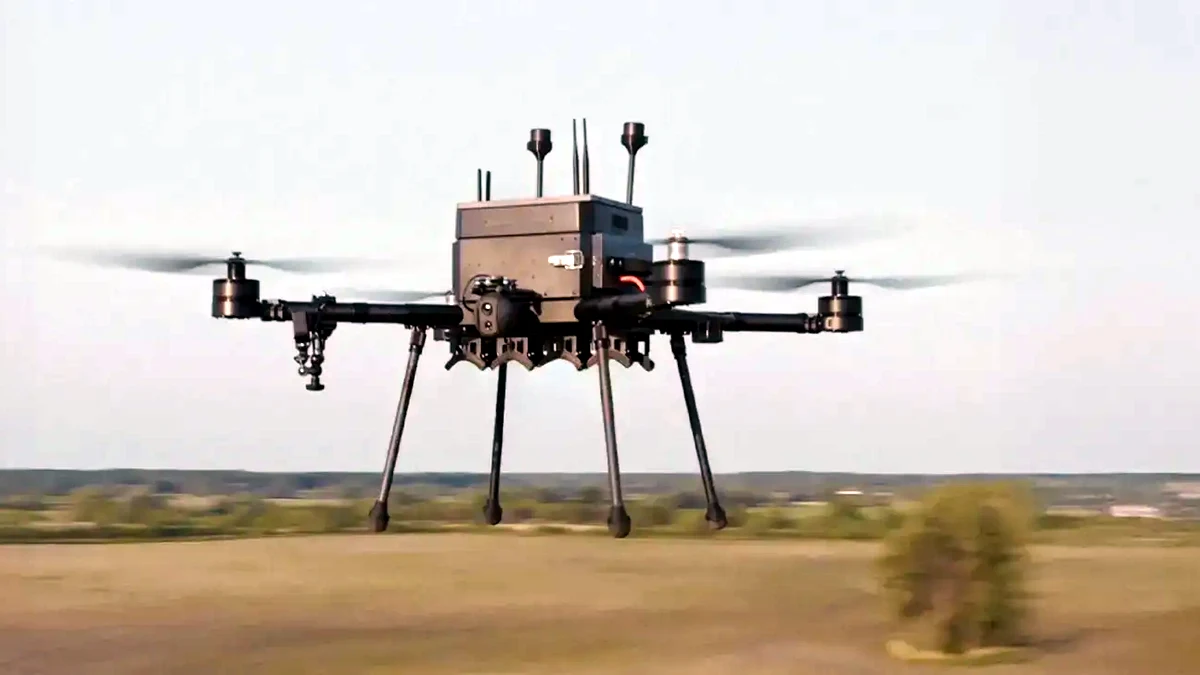
Image: UFORCE.
The MAGURA unmanned surface vessel family has contributed to the destruction of more than a dozen Russian warships in the Black Sea and has shot down multiple helicopters and fighter aircraft in combat, according to the company. Ukrainian forces have also used MAGURAs as mobile maritime bases for multi-domain operations, launching NEMESIS drones for long-range strikes.
The NEMESIS heavy strike drones are among the most widely deployed bombers and strike drones on the Ukrainian battlefield, with more than 300,000 combat flights and adoption across more than 100 units, UFORCE said.
Graphic: GPTOnline, based on UFORCE and Reuters reporting.
On November 12, aboard the aircraft carrier HMS Prince of Wales in Norway, UK Defence Secretary Wes Streeting piloted a UFORCE MV7 uncrewed surface vessel from the MAGURA family, located more than 1,500 miles away in the Atlantic Ocean near Portugal. “The technology being developed in Ukraine is changing warfare before our eyes, and Britain and its allies must move just as quickly,” Streeting said.
Why It Matters
The round caps a sharp repricing of combat-proven defence technology. UFORCE raised $50 million in March at a valuation of around $1 billion, Resilience Media reported, and its bookings have more than doubled over the past year from a base of several hundred million dollars, chief executive Oleg Rogynskyy told CNBC. A sixfold valuation jump in eight months shows how much venture and state capital will now pay for autonomous systems backed by live combat use rather than lab demonstrations.
The raise also fits a wider surge in defence-technology funding. Britain’s Fractile raised $720 million for AI inference chips earlier this week, and Munich-based Agile Robots raised $500 million at an $8.5 billion valuation, with Nvidia participating. UFORCE differs from both: it is a defence company first, built by acquiring and unifying existing combat-proven platforms rather than developing a single new chip or robot.
“The war in Ukraine has shown that in an increasingly volatile world, effective defence requires systems that can keep improving as threats change,” Rogynskyy said. “This investment will help us scale production for Ukraine and bring to allies solutions they can field, integrate and sustain at the speed of modern combat.”
The company plans to convert existing maritime and automotive manufacturing capacity in allied nations to defence production. It recently announced a partnership with ReconCraft to scale US manufacturing of MAGURA vessels, and it is a founding member of the EU-Ukraine Drone Alliance, with partnerships across NATO and the Joint Expeditionary Force networks.