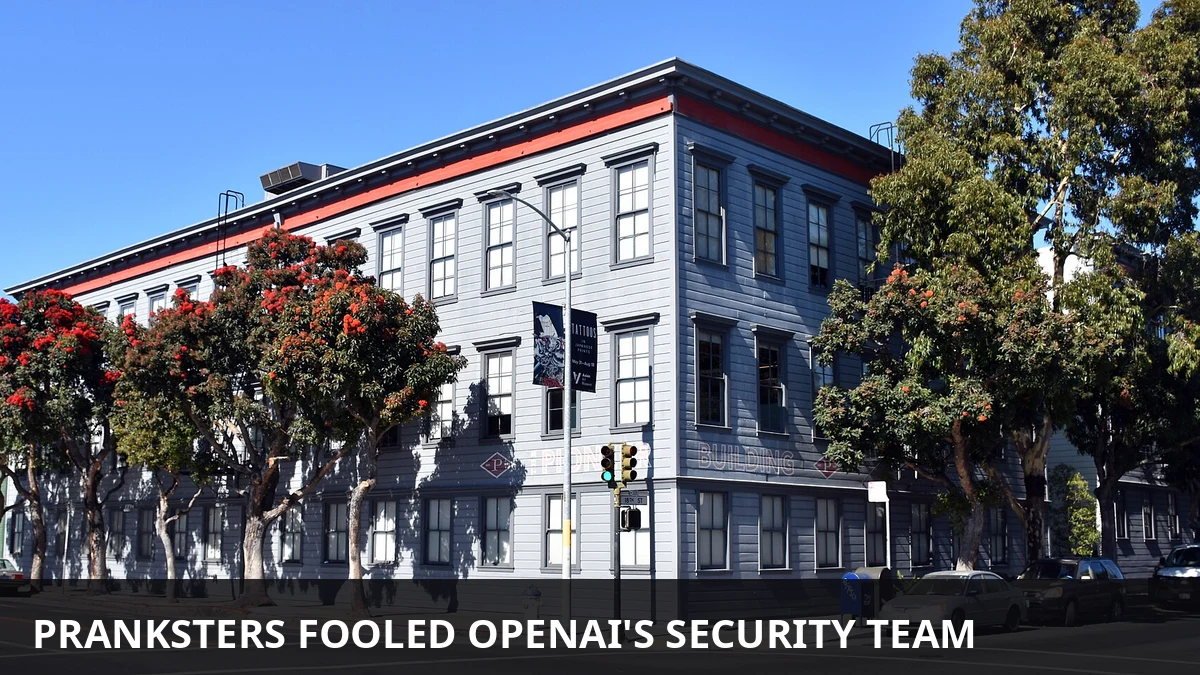
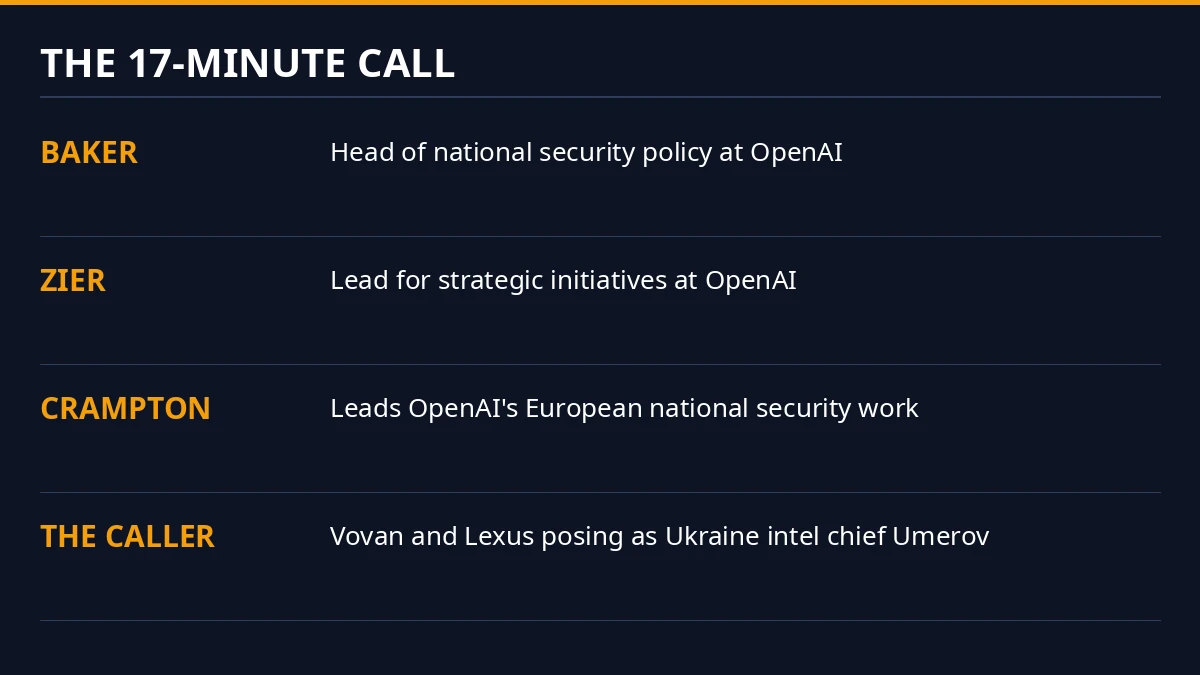
Three of OpenAI’s most senior national security officials spent 17 minutes on a video call with Russian pranksters they believed was Ukraine’s intelligence chief, discussing possible military AI support for Kyiv, including offensive capabilities, The Intercept reported on November 11.
The officials were Sasha Baker, who runs national security policy at OpenAI; Caroline Zier, the company’s lead for strategic initiatives; and Ben Crampton, who leads its European national security work. The pranksters, Vladimir Kuznetsov and Alexei Stolyarov, known as Vovan and Lexus, posed as Rustem Umerov, head of Ukraine’s Foreign Intelligence Service. The Russian pranksters recorded the conversation and later posted it online.
What Was Discussed
On the call, the OpenAI officials discussed the company’s military support for Ukraine and the possibility of providing offensive capabilities. Crampton told the fake Umerov: “There’s no question, I think, from our perspective that we want to have as deep a relationship as we possibly can with Ukraine. But it may not be possible to get to where we want to be straight away.”
Graphic: GPTOnline, based on The Intercept reporting.
Crampton also acknowledged internal resistance to offensive military work. “There’s a general reluctance on the part of many people who are senior in the company to get too involved in offensive uses of our technology in a military context,” he said. “Part of our job is to explain that offense and defense are not necessarily distinguishable from each other under certain circumstances.”
The conversation covered OpenAI’s ongoing $200 million contract with the US Department of War, which funds AI applications for “warfighters” meant to “improve military advantage, military utility, or enhance military decision making,” according to contract documents obtained by The Intercept. The officials also mentioned contacts with the Pentagon, ongoing work with the Ukrainian government around the company’s Daybreak Blue AI model for fixing computer vulnerabilities, and a nascent “partnership” with the Ukrainian Ministry of Defense.
“There has been some contact with the Ministry of Defense,” Crampton said. “It’s primarily through a colleague of ours based in Washington as well, who previously had worked with the Delta team in your Ministry of Defense. I think in this field we are interested to partner in as many ways as we can.”
The call also touched on Elon Musk and President Donald Trump’s stance on the war. “I’m afraid we probably can’t help you with Elon Musk,” Baker said. “He’s not a fan of our CEO either, if it helps you at all. So, we’re in the same boat.” On Trump, she said: “It’s unfortunate. Of course, we’ve been reading in the news the back and forth and the comments from the U.S. president. But I do want to reassure you that I think the majority of the U.S. government, the U.S. people certainly, and our researchers are very supportive of Ukraine.”
How the Prank Was Arranged
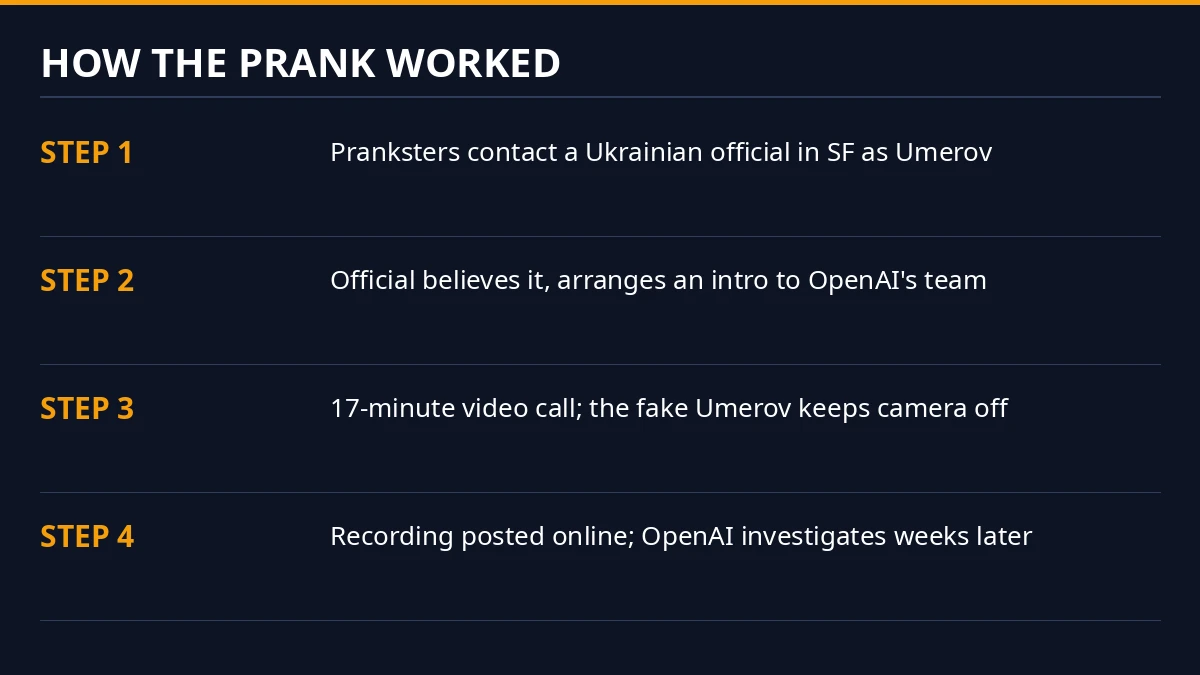
According to The Intercept, the pranksters first contacted a senior Ukrainian official in San Francisco while pretending to be Umerov. That official believed the request was genuine and offered to arrange a meeting with OpenAI. The official was already in touch with Baker, who had maintained close ties with Ukraine during her time at the US Department of Defense.
Graphic: GPTOnline, based on The Intercept reporting.
During the video call, both Baker and Zier commented that they had met Umerov previously and were pleased to be speaking with him again. The person posing as Umerov appears to have kept his camera switched off for the duration of the meeting. Kuznetsov told The Intercept the prank was simple to arrange.
OpenAI’s Response
OpenAI spokesperson Nate Evans told The Intercept the company had already investigated the call before the report appeared. “Weeks ago, we launched a thorough investigation into the call’s authenticity,” Evans said. “We acted internally and with the relevant authorities to conclude that it was a prank conducted by individuals with a history of targeting officials and other companies. We took action to prevent similar situations from happening in the future.”
OpenAI did not disclose the date of the call or the specific measures it took, and the Ukrainian Embassy in Washington did not immediately respond to a request for comment. GPTOnline has not viewed the recording of the call, so every remark quoted in this article is as The Intercept reported it, and the date of the call is not public beyond OpenAI’s description of “weeks ago.”
Why It Matters
Vovan and Lexus have run prank calls targeting famous figures since 2011, with victims ranging from Elton John to John McCain, and they have been accused of working in league with the Russian government, a charge they deny. The OpenAI call is a social-engineering failure at a company whose staff now negotiate military partnerships, not a flaw in any AI model. It shows how easily a trusted intermediary and a familiar name can bypass the verification that should surround sensitive national-security conversations.
The incident also lands as OpenAI deepens its military role. The $200 million Department of War contract, signed earlier this year, puts the company’s tools directly in front of US military planners, and the call shows its national security team actively courting a foreign government as a partner. For AI labs that now sit at the center of defence policy, the lesson is that vetting the humans in the room matters as much as securing the systems they build.
Sources
- The Intercept report, republished in full by EuropeSays: Russian Pranksters Got Top OpenAI Officials to Open Up on Ukraine
- The Economic Times: OpenAI executives pranked by Russian comedians, discussed military support for Ukraine
- Business Today: Russian pranksters fooled 3 senior OpenAI officials
- Times Now: OpenAI officials reportedly fall for Russian prank, discuss military AI support to Ukraine