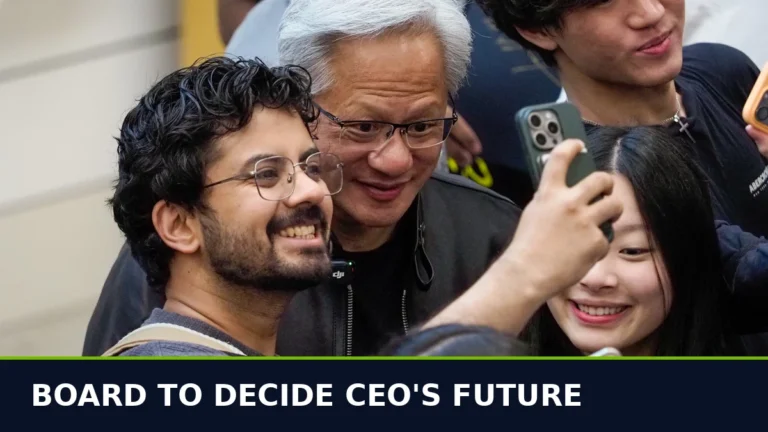
Nvidia’s board has begun working with an outside firm to identify possible replacements for Jensen Huang, Bloomberg reported late Wednesday, as the directors weigh whether the chief executive can survive the scandal engulfing the world’s most valuable chipmaker. The board is also considering naming a temporary chief executive while it searches for a permanent successor, according to a person familiar with the matter cited by Bloomberg.
The report came hours after the Wall Street Journal said the board was preparing to oust Huang and planned to meet as soon as Wednesday to determine his future. People familiar with the matter also told Bloomberg the board did meet on Wednesday to discuss Huang’s future, a session that followed the New York Times report of a second extramarital affair, this time with a Nvidia executive who reports to him.
No decision has been announced, and Nvidia has not confirmed any succession search. The company has said that “Jensen (Huang) is committed to continuing to lead Nvidia as CEO without interruption,” and analysts quoted by major outlets do not expect him to step down. But the fact that the board is now lining up outside help to find a successor, even as a contingency, marks a sharp turn from its public vote of confidence days ago.
Why succession is suddenly urgent
Nvidia has never had a formal succession plan for Huang, who co-founded the company in 1993. Around 60 senior executives report directly to him, and no second-in-command has ever been publicly identified. The gap is now the board’s most pressing problem: if Huang leaves, voluntarily or not, there is no obvious heir waiting.
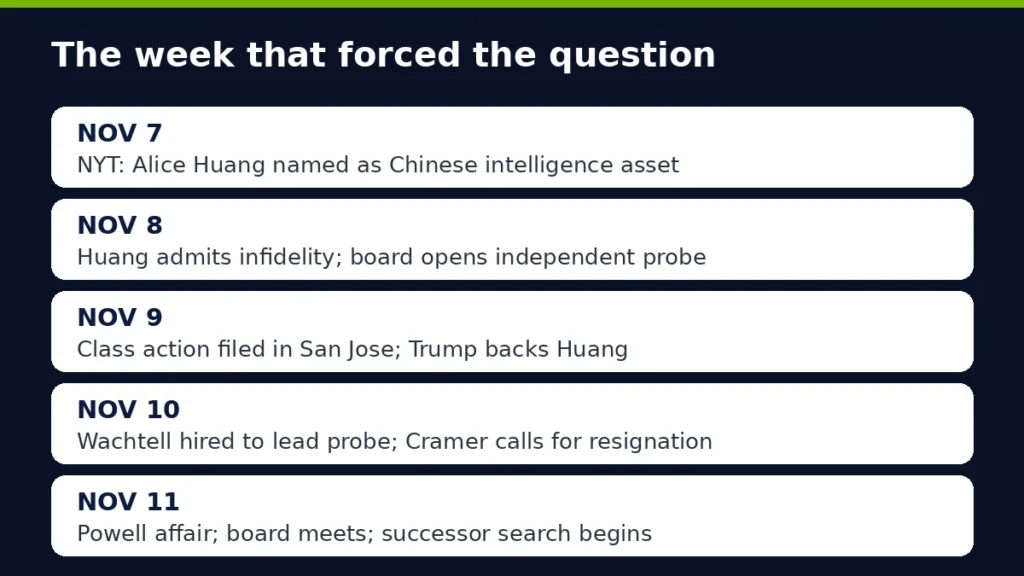
The crisis began when the Times reported that a Chinese executive Huang had grown close to, Alice Huang, had been identified by U.S. officials as a Chinese intelligence asset. On November 8, Huang told employees he had been unfaithful to his wife, and the board opened an independent investigation into whether he had been targeted by a foreign intelligence effort. The board said at the time it had “no reason to believe” national security or company secrets were compromised.
Since then the pressure has built almost daily. A proposed class action was filed on November 9 in federal court in San Jose. On November 10, the board retained the law firm Wachtell, Lipton, Rosen and Katz to lead the probe, and Republican Senator Kevin Cramer of the Senate Banking Committee called on Huang to resign. On November 11, the Times reported the second affair, with Kimberly Powell, 48, Nvidia’s vice president of health care, citing five people who worked at the company. Hours later, the Journal reported the board was preparing to oust him.
Who could take over
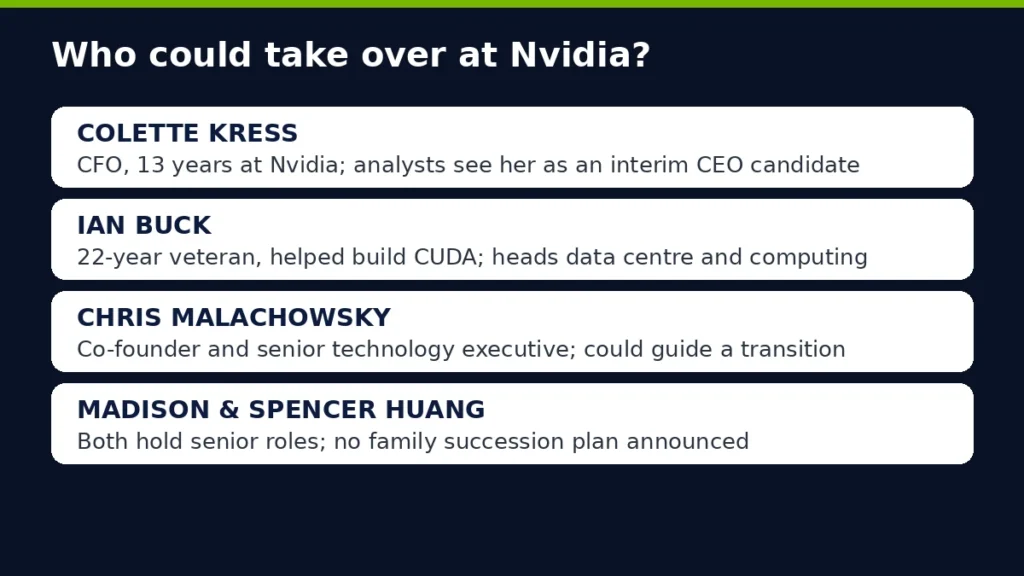
Speculation has centred on a handful of internal names, according to the Associated Press and Business Insider. Chief Financial Officer Colette Kress, who has spent 13 years at Nvidia overseeing its finances through a period of rapid expansion, is among the most visible senior executives and could be considered for the interim role, analysts cited by Business Insider said. Ian Buck, a 22-year Nvidia veteran who helped develop CUDA, the software platform at the heart of the company’s AI business, and now heads its data centre and computing operations, has been identified by analysts and former employees as a possible long-term successor.
Co-founder Chris Malachowsky, still a senior technology executive at the company, could play an important role in any transition, according to the reports. Huang’s children, Madison and Spencer, both work at Nvidia in senior roles, and Huang has said he hopes his successor comes from inside the company, but the company has announced no family succession plan.
Outside names have also begun circulating in press speculation. Taiwan media, citing The Information, reported that headhunters may have begun probing contingencies, with AMD chief executive Lisa Su and Arm chief executive Rene Haas floated as possible candidates. Those reports remain speculation, and Nvidia has denied that Huang is leaving.
Market and political pressure
Investors have grown steadily more nervous. Nvidia shares fell 5.3% on Monday after the board announced its investigation, and dropped a further 3.6% in after-hours trading on Wednesday, to $167.47, following the Times report on Powell. Prediction market odds of Huang announcing his resignation or removal by year end jumped to roughly 31%. Baird analysts wrote that Huang “might have to step down as CEO of Nvidia,” and the firm downgraded the stock.
The political pressure is also mounting. President Donald Trump has said the FBI is probing Huang’s relationship, while also backing the chief executive. Three House committee chairmen have asked Huang to appear for a closed-door briefing on November 18. Nvidia reports third-quarter earnings on November 17, the day before that briefing.
Why it matters
Nvidia sits at the center of the global race for artificial intelligence, with a market value of about $4.3 trillion and a dominant share of the chips that power AI systems. A leadership change at the top of that company would ripple across the entire AI economy, from cloud providers and chip buyers to the U.S. government’s export-control policy toward China.
The Nvidia succession question also exposes an unusual governance structure. The company has no chairman, a rarity among large public companies, and three of its 10 independent directors have held their seats for 25 years or more. Huang owns 3.6% of Nvidia’s shares. Bernstein analyst Stacy Rasgon summed up the dependence in a phrase quoted by CNBC: “Jensen is Nvidia. Nvidia is Jensen.”
For now, the board has said nothing publicly about the reported succession search or the Wednesday meeting. If the directors follow through on the plan described by the Journal’s sources, the founder who turned Nvidia into the premier supplier of AI chips would leave the company he built. If they do not, the board will have to explain why a second reported affair, this time with a direct report, does not change its earlier vote of confidence.
Sources
- Bloomberg report (via Sina Finance, republished by Binance News), “Nvidia Works With Outside Firm to Find New CEO”
- Wall Street Journal, “Nvidia is Preparing to Oust CEO Jensen Huang”
- Business Standard, “Nvidia has no clear successor to Jensen Huang. Who could take over?”
- New York Times (via DNYUZ), “Jensen Huang Said to Have Had Relationship With Nvidia Executive Who Reports to Him”
- Reuters, “Senior Republican on US Senate banking panel calls on Nvidia CEO Huang to resign”
- ChosunBiz, “Reports float Lisa Su, Rene Haas as potential Nvidia successors; company denies Huang exit”
- GPTOnline, “Nvidia Board Preparing to Oust CEO Jensen Huang, WSJ Reports”
- GPTOnline, “Nvidia Board Launches Independent Probe Into Reports CEO Jensen Huang Was Targeted by Foreign Spying”
- GPTOnline, “Trump Backs Jensen Huang, Says He Should Stay as Nvidia CEO”