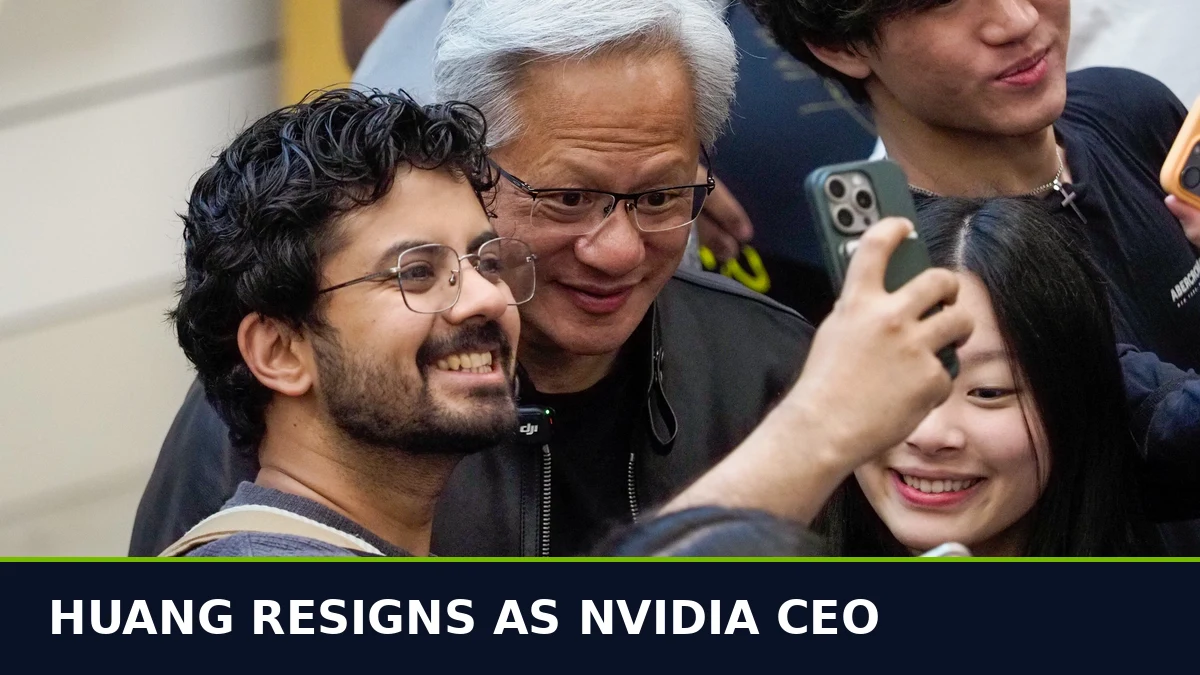
Nvidia announced on Thursday, November 12, that Jensen Huang has resigned as president, chief executive officer and a member of the board, effective immediately, the company said in a press release. Chief Financial Officer Colette Kress will serve as interim chief executive while the board searches for a permanent successor, ending a five-day crisis that began with revelations about Huang’s relationship with a Singapore technology executive U.S. officials suspect of spying for China.
The board accepted Huang’s resignation on Wednesday, TechCrunch reported, citing a regulatory filing. The announcement did not state a reason for his departure and disclosed no findings from the independent investigation the board opened on November 8. Jensen Huang resigns after 33 years leading the company he co-founded in 1993, and he also gives up his board seat. He owns about 3.6% of Nvidia stock, according to USA Today.
Who Takes Over
Kress has served as Nvidia’s executive vice president and chief financial officer since joining the company in September 2013. She will keep the CFO role while serving as interim CEO. Before Nvidia, she spent nearly 25 years in finance roles at Cisco and Microsoft, according to the company’s announcement.
“NVIDIA’s strength has always come from its people, and together with our leadership team, I am committed to building on the extraordinary foundation Jensen created over the last 33 years,” Kress said. “We will continue advancing the work that has made NVIDIA a leader in accelerated computing and AI, and execute on the opportunities ahead. Our focus remains on serving our customers, partners, developers and shareholders.”
The board also appointed Harvey C. Jones as its first-ever chair of the board. Jones, a former chief executive and executive chairman of Synopsys, has served on Nvidia’s board since 1993. “Colette has helped lead NVIDIA through a period of extraordinary growth and has a deep understanding of our business, customers, operations and financial position,” Jones said. “The Board has full confidence in Colette and the leadership team, and we expect the company’s operations, customer commitments and product roadmap to continue without interruption.”
The board said it is initiating a search for a permanent chief executive and will consider internal and external candidates. No timeline was given.
The Market Reaction
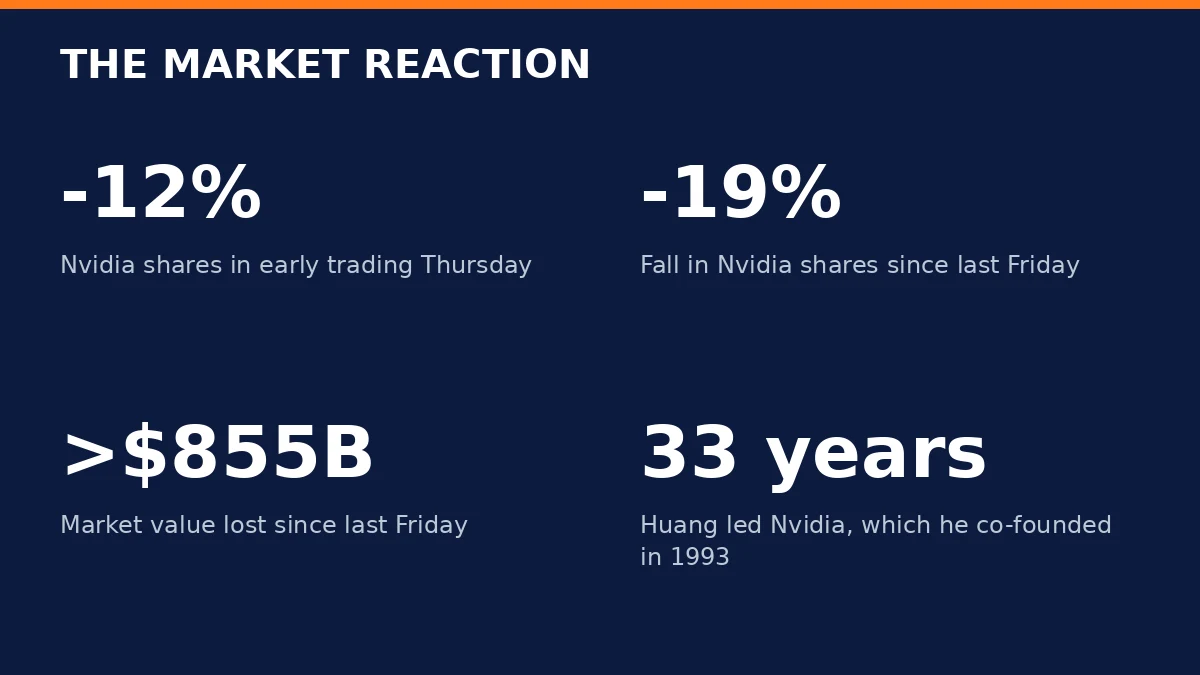
Investors sold Nvidia shares sharply on the news. The stock fell nearly 12% in early trading on Thursday, TechCrunch reported, and has now fallen more than 19% since last Friday, wiping out more than $855 billion in market value. Shares of AI infrastructure companies tied to Nvidia fell with it: CoreWeave was down about 12% in premarket trading, Nebius fell 20% and IREN fell 8%.
Graphic: GPTOnline, based on TechCrunch market reporting.
What Led Here
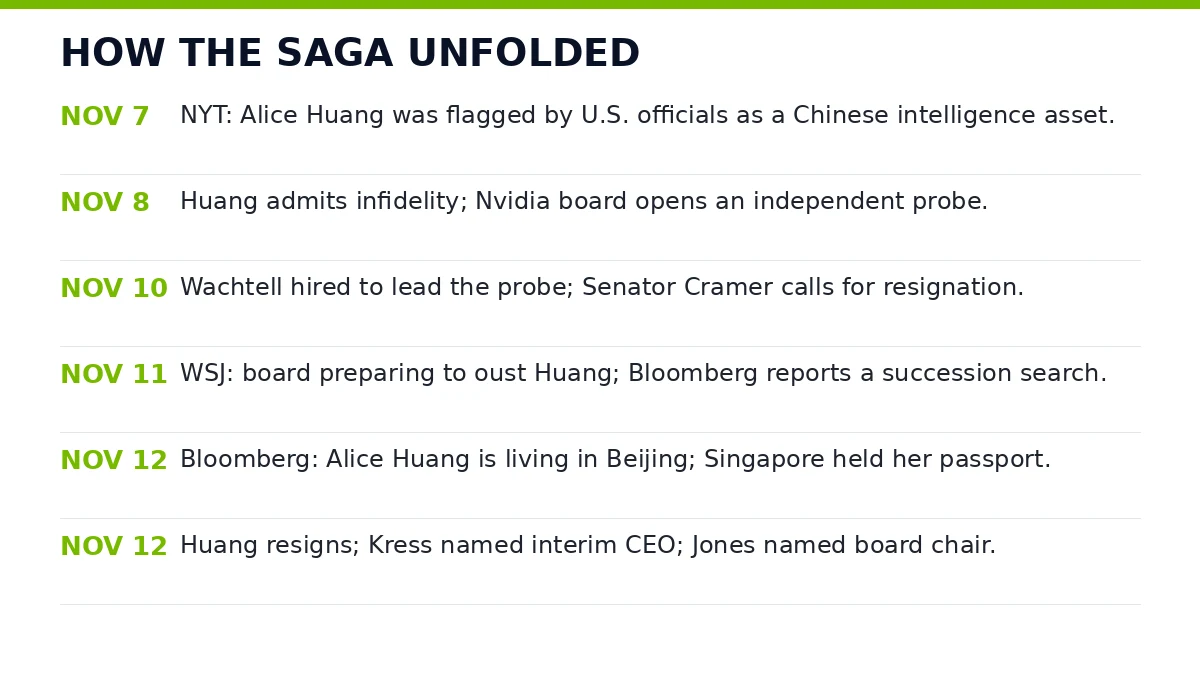
The resignation closes a scandal that unfolded in less than a week. On November 7, the New York Times reported that Alice Huang, founder of Singapore-based data center firm Megaspeed, had been identified by U.S. officials as a Chinese intelligence asset. The next day, Huang admitted to staff that he had an extramarital affair with her, and Nvidia’s board opened an independent investigation, saying it had no reason to believe national security or company secrets had been compromised.
Events then moved fast: a shareholder class action was filed on November 9; the board hired the law firm Wachtell and former acting U.S. attorney Joon Kim to lead the probe on November 10; the Times reported a second affair, with Nvidia health care vice president Kimberly Powell, on November 11; and the Wall Street Journal reported that evening that the board was preparing to oust Huang, while Bloomberg reported it had hired an outside firm to search for a successor. On November 12, Bloomberg reported that Alice Huang had returned to China and is living in Beijing, and the Times reported that Singapore held her passport from June 2025 to February 2026.
Graphic: GPTOnline, based on Nvidia, New York Times, Wall Street Journal and Bloomberg reporting.
The independent investigation remains without public findings. The November 8 board statement said a committee of independent directors, assisted by outside counsel, would oversee the work, and neither that statement nor the November 12 transition announcement disclosed findings or a completion date. The announcement also did not say whether the board’s decision was connected to the investigation.
Why It Matters
Huang’s departure raises immediate questions about the future of Nvidia’s sprawling AI investments, which helped bankroll the infrastructure boom the company itself supplies. As of the end of its second quarter, Nvidia reported $99 billion in investments and another $25 billion in commitments, according to TechCrunch. That includes $30 billion invested in OpenAI and $10 billion in Anthropic, plus $2 billion each in CoreWeave and Nebius and up to $105 billion in credit guarantees for an OpenAI data center campus in Ohio.
Investors were already uneasy about the enormous amounts of debt companies are raising to sustain the AI infrastructure buildout. Huang’s exit adds a leadership question to a financial one, and the board’s search for a permanent successor will now run in parallel with Nvidia’s third-quarter earnings report on November 17, which the company confirmed will go ahead as scheduled at approximately 1:20 p.m. PT, followed by an earnings call at 2 p.m. PT.
What Happens Next
Kress leads Nvidia into that earnings report as interim CEO, with the board’s search for a permanent chief executive just beginning. The House of Representatives has scheduled a briefing on the chip-diversion allegations for November 18, and the independent investigation’s findings, when they come, will determine whether the scandal ends with the resignation or continues into a wider reckoning over how Nvidia’s chips reached China.