LangChain, the startup behind one of the most widely used frameworks for building AI agents, raised $300 million at a $3 billion valuation, the Wall Street Journal reported on Thursday, more than doubling its value in a year.
CapitalG, Alphabet’s independent growth fund, led the round. Existing investors IVP and Sapphire Ventures took part, alongside new investors GIC and DFJ Growth. LangChain plans to use the money to expand LangSmith, its enterprise platform for monitoring, evaluating and deploying AI agents.
Chief executive Harrison Chase told the Journal that the company’s aim is to help large companies build, manage and deploy their own AI agents. The three-year-old startup has 435 full-time staff and plans to grow to 850 employees by the end of next year.
What the round looks like
The new valuation is more than double the $1.25 billion LangChain reached in October 2025, when it raised $125 million in a Series B led by IVP. The jump reflects how quickly agent infrastructure has moved from an open-source side project to a commercial market, as enterprises rush to put AI agents into production and need tools to watch what those agents actually do.
LangSmith is the commercial layer of that bet. It gives companies tracing, evaluation, prompt management and deployment controls for agents built on LangChain’s open-source frameworks, LangChain and LangGraph. The company says it works with 35% of the Fortune 500, has passed 1 billion open-source downloads and ingests more than 1 billion events per day on LangSmith.
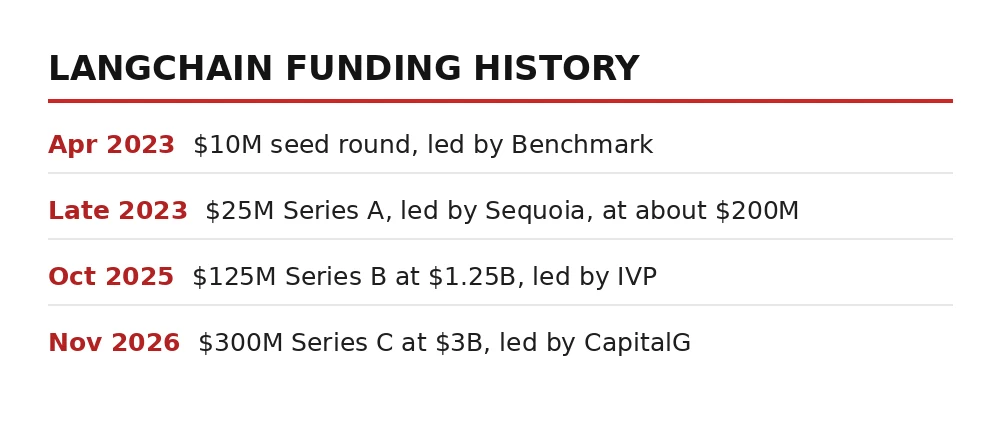
LangChain’s funding history, from a $10 million seed in 2023 to a $300 million Series C in 2026. Graphic: GPTOnline. Sources: Wall Street Journal, Forge.
Funding history
LangChain was founded in 2022 by machine learning engineer Harrison Chase, and it started as an open-source project to simplify building applications on early large language models. Its funding has tracked the rise of agents:
- April 2023: $10 million seed round led by Benchmark.
- Late 2023: $25 million Series A led by Sequoia Capital, at a valuation of about $200 million.
- October 2025: $125 million Series B at a $1.25 billion valuation, led by IVP, alongside the release of version 1.0 of LangChain and LangGraph.
- November 2026: $300 million Series C at a $3 billion valuation, led by CapitalG.
The new round brings LangChain’s total funding to about $460 million, according to Forge, a private-share marketplace that tracks the company’s financing.
Market context
The round lands in a cooling funding market. Global AI venture funding passed $500 billion in the first nine months of 2026, but deal value in the third quarter fell 43.4% from the second quarter to $94.3 billion, according to PitchBook data cited by the Journal. Against that backdrop, a $3 billion valuation for an agent-infrastructure company stands out as a bet that the agent layer, not just the models, will capture lasting enterprise spending.
LangChain is not the only agent company raising at a premium. Its newest product is Deep Agents, an agent harness built on LangGraph, and its commercial platform now spans observability, evaluation and managed deployment. The company is positioning LangSmith as the control plane for agents that enterprises cannot afford to let run unsupervised.
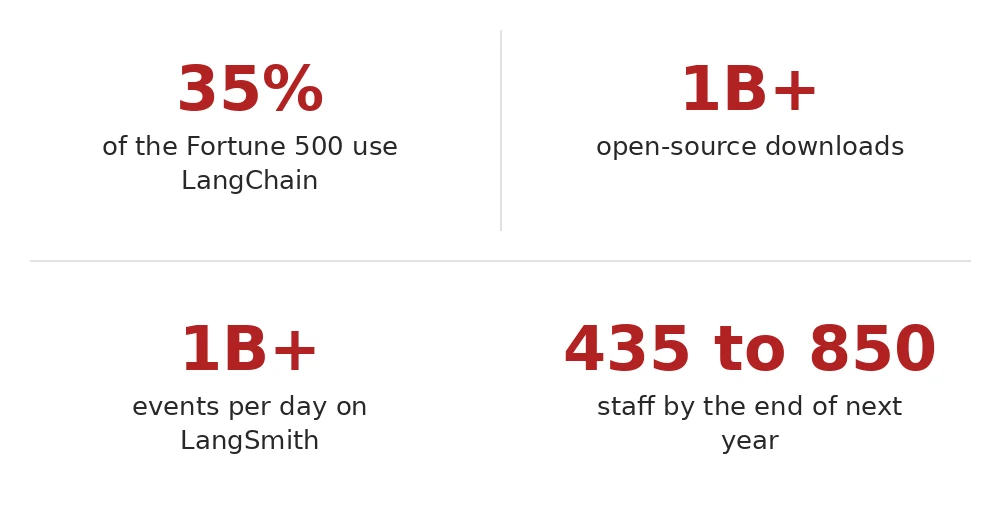
LangChain in numbers. Graphic: GPTOnline. Sources: Wall Street Journal, LangChain.
Why it matters
Agents are moving from demos to production, and production is where the hard problems live: an agent that takes the wrong tool call, leaks a credential or loops on a task can cost real money. Companies need to trace, evaluate and control those agents, and LangChain is betting that the company which already owns the framework developers use will also own the platform that runs those agents in production.
The valuation also says something about where investors think the value sits in the AI stack. With model prices falling and open-weight models improving, the durable business may be the layer that makes agents reliable enough for a bank, a hospital or a factory to trust. LangChain, backed by Alphabet’s growth fund, is now one of the best-funded companies building that layer.