Meta has indefinitely paused its controversial commercial terms, which would have let the company scrape the websites of Meta Business account users. On Thursday, the company took down the preview link to the proposed terms and posted an update saying the changes will not take effect on November 20, 2026, Nieman Lab reported on November 5.
“These updates are now paused and will not take effect on November 20, 2026. We are continuing to consult with stakeholders and will provide a further update when we have more to share. In the meantime, our existing terms remain in effect,” the company’s Business Help Center update reads, as quoted by Nieman Lab. A Meta spokesperson confirmed the delay to Nieman Lab, saying: “We’re pausing the changes as we continue to engage with stakeholders and take our time to get this right.”
What the terms would have allowed
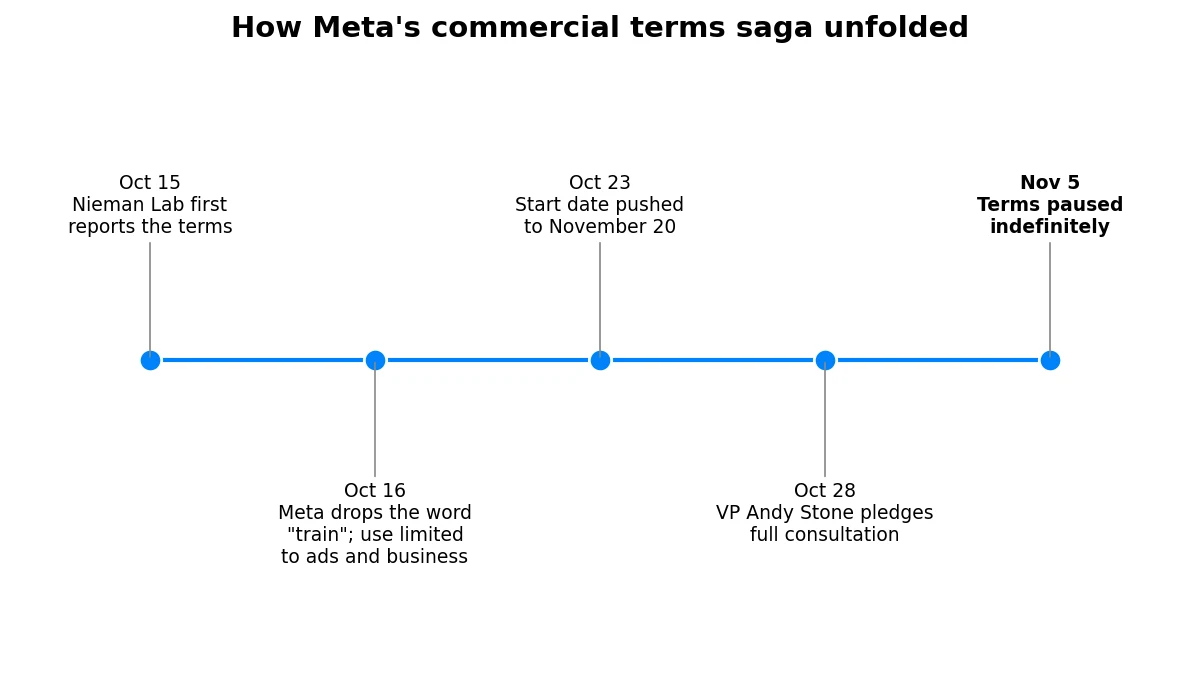
The proposed terms would have permitted Meta to scrape the websites of businesses that hold Meta Business accounts, with the harvested content feeding the company’s advertising and business products. The original draft went further, explicitly covering AI training, and it was that prospect that set off the outcry. On October 16, Meta removed the word “train” from the terms and limited the use of future scraped content to “advertising and business products,” but the change did not calm publishers, who noted that the underlying scraping permission remained.
Three weeks of retreats
The pause is the latest in a series of retreats since Nieman Lab first reported the terms on October 15. They were first set to take effect on October 30, a date that drew a global outcry from news publishers, politicians, and trade organizations. On October 23, Meta pushed the effective date back three weeks to November 20. Then, on October 28, Andy Stone, Meta’s vice president of communications, pledged that the company would not make policy changes “without a full consultation with industry groups and leaders,” and warned the consultation could run past November 20, in which case implementation would be delayed.
Courts and regulators piled on
While Meta was consulting, the legal pressure kept building. Courts in Norway and Brazil have issued preliminary injunctions blocking the terms from taking effect, following lawsuits filed by media organizations in both countries. In the United Kingdom, the Competition and Markets Authority has opened a formal investigation into whether Meta was “abusing a dominant position by imposing exploitative terms on publishers and advertisers.” In the United States, the proposal drew bipartisan concern: at the end of October, Senators Adam Schiff and Marsha Blackburn wrote to Meta chief executive Mark Zuckerberg asking him to withdraw the terms.
What happens now
For now, Meta’s existing terms remain in effect, and the company says it will provide a further update when it has more to share. There is no new effective date, and the pause is open-ended. The consultation Meta promised publishers continues, but the company has not said what a revised version of the terms would look like, or when one might appear.
Why it matters
Meta owns Facebook, Messenger, Instagram, WhatsApp, and Threads, which makes its commercial terms a de facto condition of doing business online for countless publishers and advertisers. The episode shows how quickly that leverage can turn into a liability: within three weeks, a routine terms update drew court injunctions on two continents, a formal competition investigation, and a bipartisan letter from the US Senate. The pause is a win for publishers, but it is not a settlement. The underlying question, how much of the web a platform can claim the right to scrape, is still open, and it sits at the center of the wider fight over AI training data. Every other platform watching this outcome will now think twice before writing similar terms.