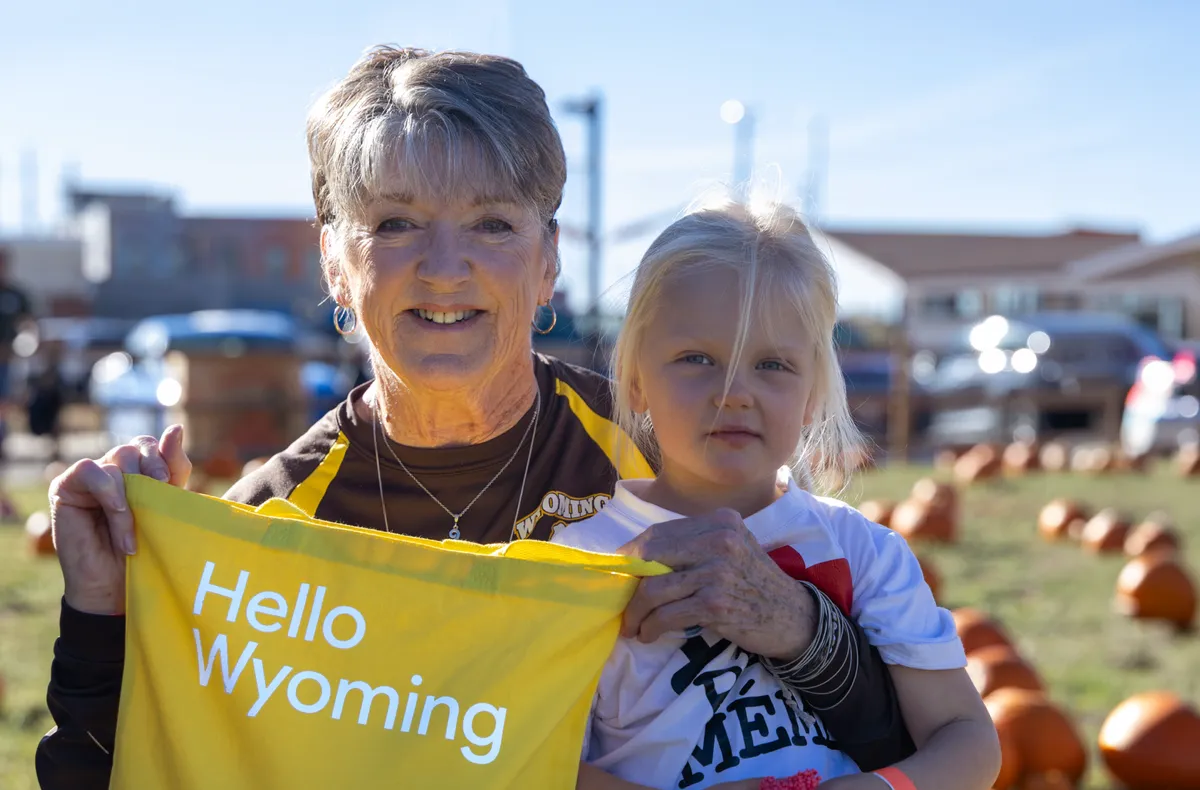
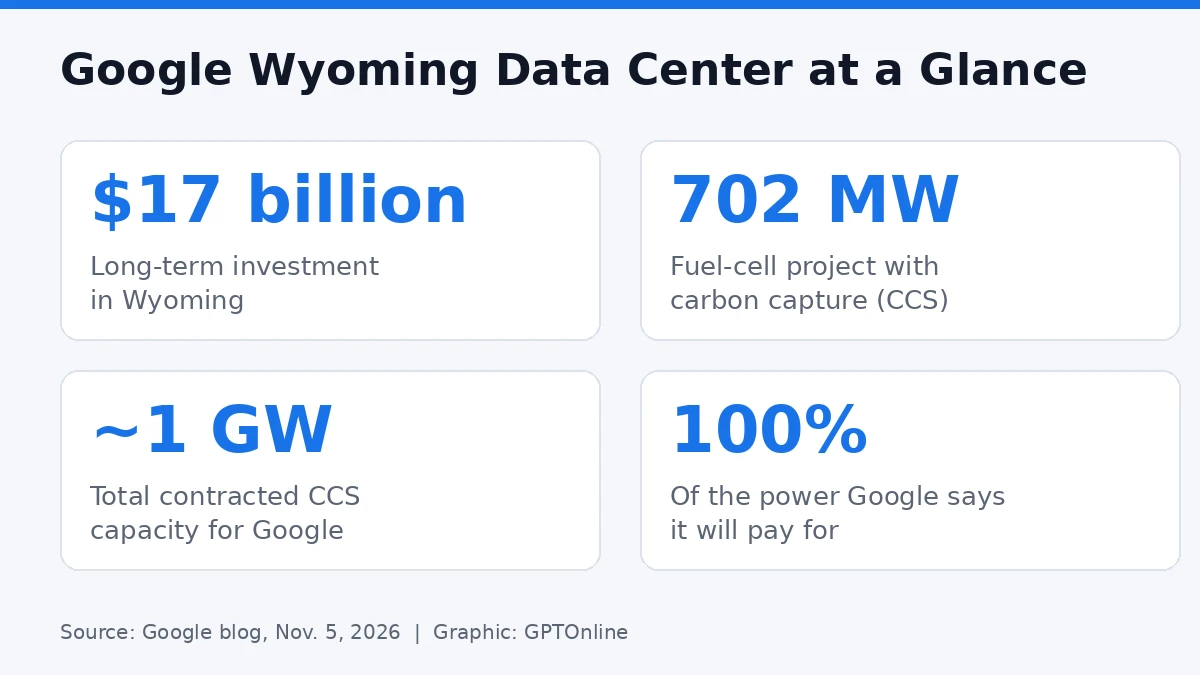
Google is putting down roots in the Cowboy State. The company announced on November 5 that it will build its first data center in Wyoming, a long-term $17 billion investment in Laramie County that pairs a massive new campus with one of the most unusual power setups in the industry: a 702 MW fuel-cell development with carbon capture and storage.
“We’re building our first data center in Wyoming, representing a $17 billion investment in the Cowboy State,” Steve Walter, Google’s vice president of global infrastructure and energy, wrote in the announcement. The Google Wyoming data center will be developed with Tallgrass Energy, Black Hills Energy, American Electric Power (AEP) and Related Digital.
What Was Announced?
The campus will be Google’s first data center in Wyoming. Google has not given a construction timetable or an opening date for the facility, so the announcement sets out the investment and the power arrangements rather than a delivery schedule.
What Google did spell out is the money flowing to the local community. The company expects the project to generate hundreds of millions of dollars in local property taxes for Laramie County and School District 1, on top of community investment plans focused on K-12 education, workforce development and skilled trades training.
Google also said it has been meeting with local stakeholders for months, including a community meeting in downtown Cheyenne attended by more than 200 residents. Together with Tallgrass, Black Hills Energy, Related Digital, AEP and Bloom Energy, the company is setting up a Community Council to work on shared concerns as data center growth accelerates in the Cheyenne area.
Powering the Campus
The energy plan is the most distinctive part of the announcement. The project is contracted with AEP to feature a first-of-its-kind, commercial-scale, 702 MW fuel-cell development with carbon capture and storage (CCS), which Google calls the largest planned development of its kind to date.
The fuel cells will run on natural gas and will be made in America by Bloom Energy. The CCS technology is designed to capture and permanently store a large majority of the project’s carbon emissions in geologic formations at Tallgrass’s nearby Eastern Wyoming Sequestration Hub. Google says the project builds on its first CCS project in the United States, announced last fall, and brings its total contracted CCS capacity to nearly 1 gigawatt.
Google is also sourcing power from gas generators operated by Tallgrass Energy and Black Hills Energy, and it is running a technical study on fitting Tallgrass’s combined cycle turbines with carbon capture. The campus itself will be air-cooled to limit strain on local water supplies, a direct response to one of the most common objections to new data centers.
American Electric Power disclosed last month that it plans to invest about $4 billion in the fuel-cell project under a 20-year power purchase agreement with Google, according to reports of the utility’s filing. Google says it will pay for 100% of the power the data center uses. “We will pay for 100% of the power we use, and when we build data centers, we’ll cover the infrastructure needs directly driven by our growth,” Walter wrote.
Why It Matters
The timing is hard to ignore. The announcement landed two days after U.S. midterm elections in which voters approved limits on data center projects in 40 of 41 local ballot measures, according to Ballotpedia figures cited by Bloomberg. Across the country, communities are pushing back against the water use, power demand and noise of the AI buildout, and hyperscalers are under growing pressure to show their projects pay their own way.
Google’s Wyoming package reads as a direct answer to that pressure: locally built fuel cells with carbon capture, air cooling instead of water cooling, a pledge to pay for all of its power, and a community council with a seat at the table. Whether that formula wins over skeptical residents in Cheyenne will be a test case for the industry’s next wave of data center siting.
“Data centers power the technology America relies on, everything from online banking, to digital maps and wayfinding, to hospitals and 911 systems,” Walter wrote. “Building on Google’s 20-year track record of data center development, our promise is to show up today and tomorrow for Cowboy State residents.”