OpenAI has posted a new preprint claiming to settle one of the oldest open problems in theoretical computer science: the exact value of the matrix multiplication exponent, known as omega. The 111-page paper, dated November 24, 2026, argues that the exponent is exactly 9/4, or 2.25, over every field. If the proof holds up, it would close a question that has stood since Volker Strassen’s breakthrough in 1969. The paper is a preprint, not a peer reviewed result, and the mathematical community has only just begun to examine it.
The claim surfaced publicly on November 24, when OpenAI added the manuscript to its public math repository. The preprint is titled “The matrix multiplication exponent is nine fourths,” and its abstract states the result plainly: “We prove that the exponent of square matrix multiplication is 9/4 over every field.”
What was announced
The paper’s central result, Theorem 1.1, states that over every field F, the exponent of square matrix multiplication is omega = 9/4. That is an exact value, not just an upper bound. It pairs two claims. First, matrices can be multiplied with an exponent of 9/4, a bound OpenAI had already proposed in October over the complex numbers. Second, and new in this paper, no algorithm can do better: for every matrix size n of at least 2, any formal arithmetic circuit multiplying two n by n matrices needs at least ⌈n^(9/4)/2⌉ multiplication or division gates, even if additions are free.
A companion paper posted the same day supplies the geometric framework behind the lower bound, and the paper says the result refutes a 1994 prediction by Strassen about “tight” tensors.
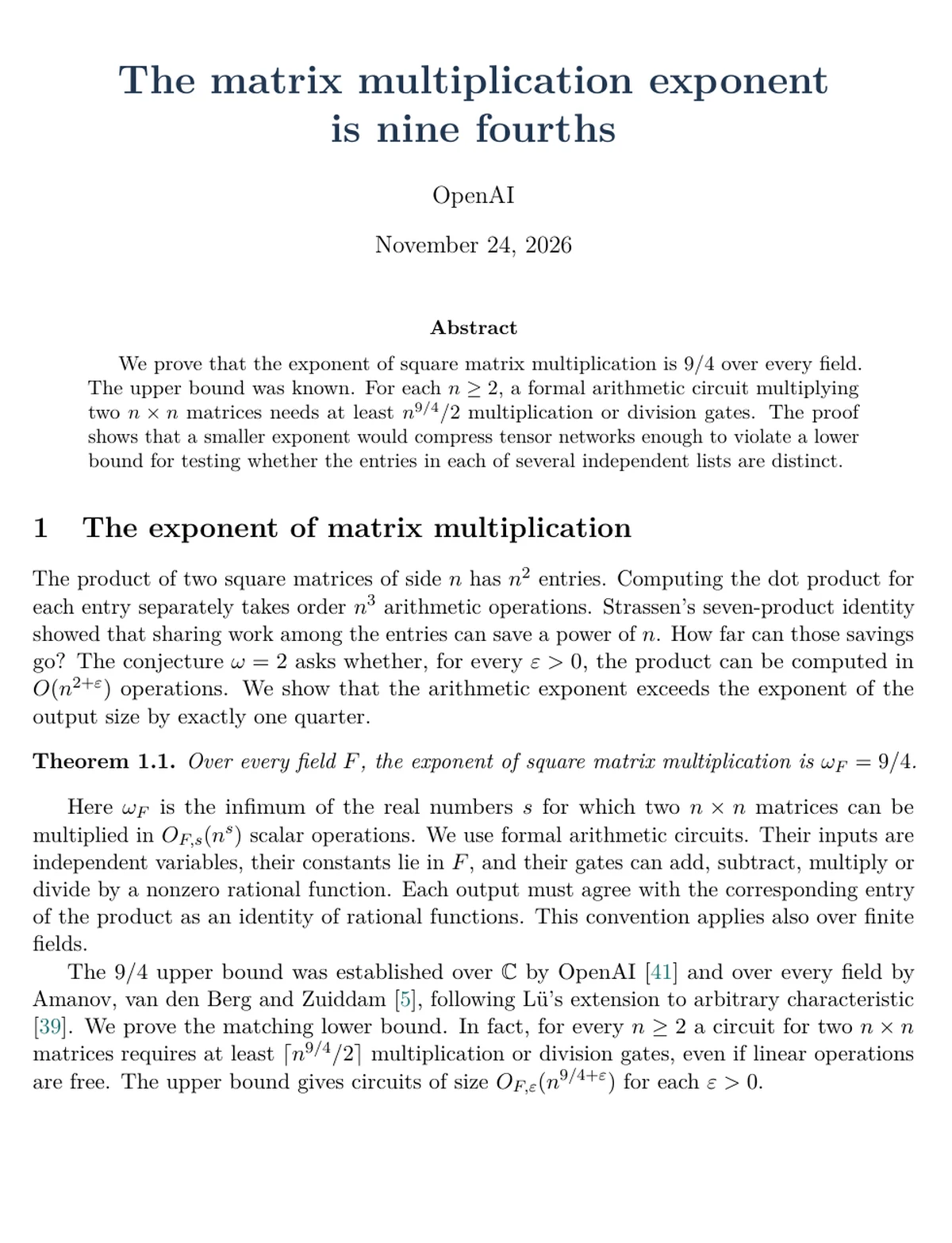
The preprint’s first page states the result as Theorem 1.1. Image: OpenAI
Why 9/4 matters
Matrix multiplication is one of the most basic operations in computing, and omega measures how fast it can possibly be done as matrices grow. Computing each entry separately takes on the order of n^3 operations. Strassen showed in 1969 that sharing work between entries beats that, and decades of work since then have chipped the bound down through the laser method, a framework Strassen introduced and Coppersmith and Winograd refined. The best published bound along that line was about 2.371177, set in August 2026, and researchers had shown the laser method applied to the usual tensors could never beat 2.3078.
OpenAI’s claimed value of 2.25 jumps past that ceiling entirely. It would also rule out the long standing conjecture that omega equals 2, the idea that matrix multiplication could eventually be done in nearly quadratic time. The paper puts it this way: “We show that the arithmetic exponent exceeds the exponent of the output size by exactly one quarter.”
None of this means faster matrix multiplication on real hardware. The result counts arithmetic operations in formal circuits, not wall clock time on GPUs, and the algorithms behind the bound carry enormous hidden constants. Rafael Pass, who independently proved the 9/4 upper bound in a separate arXiv paper, notes the same limitation: “The algorithm remains ‘galactic’: the constants hidden in the O(.) notation are enormous.”
How the proof works
The argument turns on a piece of geometry the paper calls a tripod: three sites joined at a central point, each arm of unit length, so the distance between any two tips is 2 and the total perimeter is 6. Dividing that perimeter by a “shared-label rate” of 8/3 gives exactly 9/4. The paper argues by contradiction: if some algorithm beat 9/4, it could compress a certain kind of tensor network further than a counting lower bound allows.
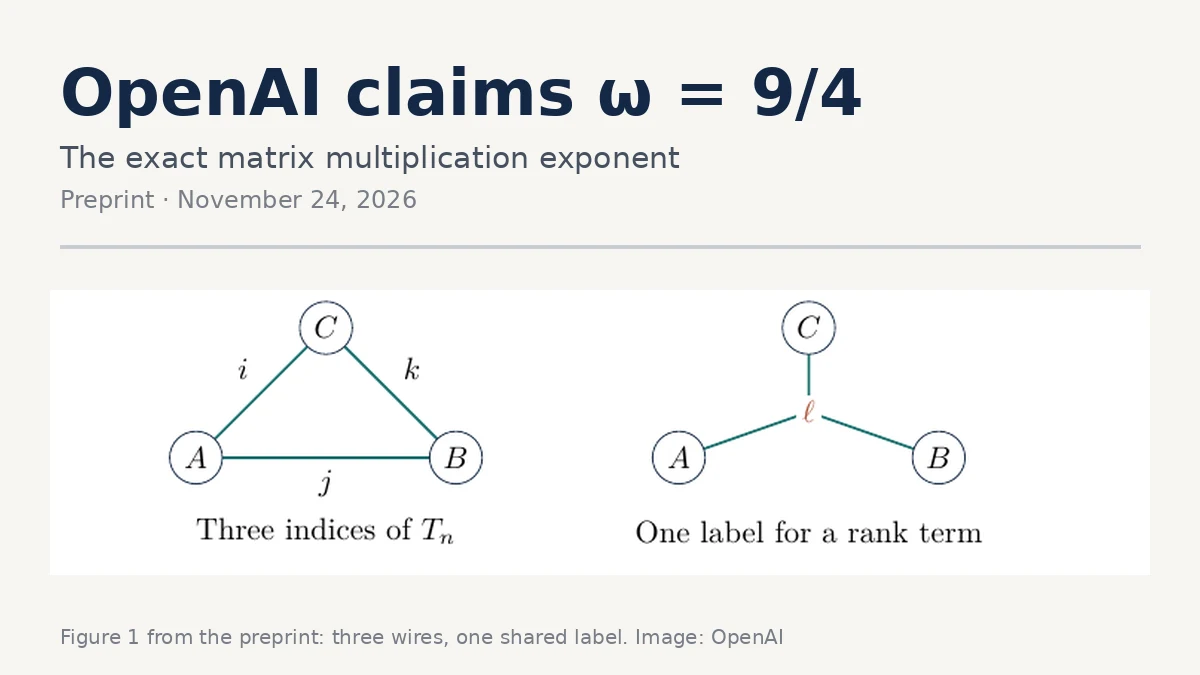
Figure 1 of the preprint illustrates the idea with three wires and a shared label. On the left, three tensor factors each see two of the three indices. On the right, all three see the same label, which is what a rank decomposition must pay for.
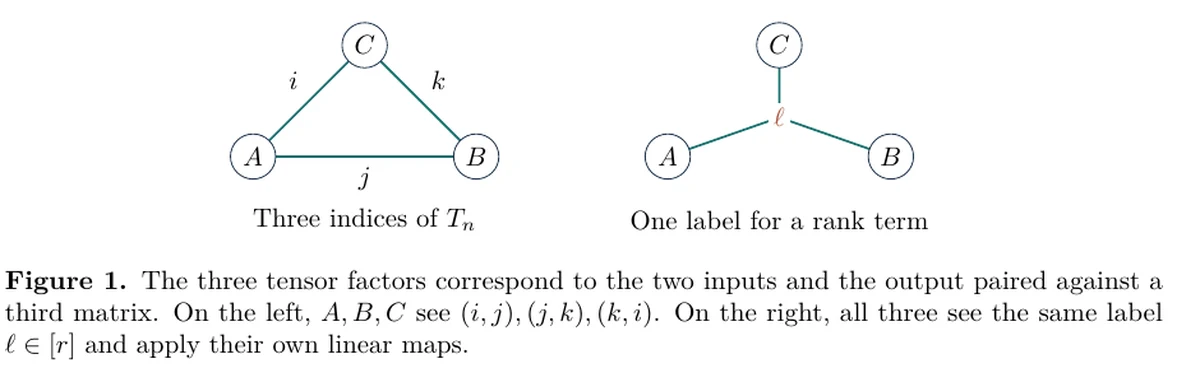
Figure 1 from the preprint: three tensor factors share indices on the left, and a single shared label on the right. Image: OpenAI
What is verified and what is not
The upper bound half of the claim, omega no greater than 9/4, already has independent support. Rafael Pass published a self contained constructive proof of it on arXiv on October 30, writing: “We give a self-contained constructive proof that the matrix multiplication exponent satisfies omega ≤ 9/4.” Expositions by independent researchers have since reworked the argument and extended it to every field. That part of the story is no longer resting on OpenAI’s word alone.
The new part, the matching lower bound that would make 9/4 exact rather than merely an upper limit, rests so far on OpenAI’s preprint and its accompanying Lean formalization. OpenAI says the Lean development proves the 9/4 exponent for division-free circuits computing formal polynomial identities over every field, a setting slightly narrower than the paper’s main theorem, which also covers circuits allowed to divide. The preprint itself has not been peer reviewed, and OpenAI’s repository carries a clear warning about the whole collection: “These manuscripts are best understood as a form of raw research data, rather than polished academic papers.”
That framing is the right way to read this news. What is established is that OpenAI has published a serious, detailed claim to an exact answer, with machine checked support for part of it and independent confirmation of the upper bound. What is not established is whether the lower bound proof survives scrutiny.
Why it matters
Beyond the mathematics, the episode is a marker for how AI is changing research itself. The manuscript comes from OpenAI’s public math collection, 730 manuscripts produced by an unnamed internal model as part of an evaluation on open research problems. Whether or not this particular proof stands, the pipeline that produced it, and the speed with which independent researchers verified and extended the upper bound, shows a new pattern: AI systems proposing results on open problems, and human mathematicians checking and building on them within weeks.
For now, the claim stands as a preprint with strong partial support and an open question mark over its most ambitious half.
Sources
- OpenAI, “The matrix multiplication exponent is nine fourths,” preprint, November 24, 2026 (PDF)
- OpenAI Math repository (GitHub)
- Rafael Pass, “Matrix Multiplication from Polynomial Packings: A Constructive and Elementary Proof of omega ≤ 9/4,” arXiv, October 30, 2026
- Baitian Li, “Semidirect sums of tensors and the matrix multiplication exponent,” arXiv, November 2026
- M. Levent Dogan et al., “Tensor value and the 9/4 bound for matrix multiplication,” arXiv, November 6, 2026
- Interesting Engineering, “OpenAI establishes exact 2.25 exponent for matrix multiplication”