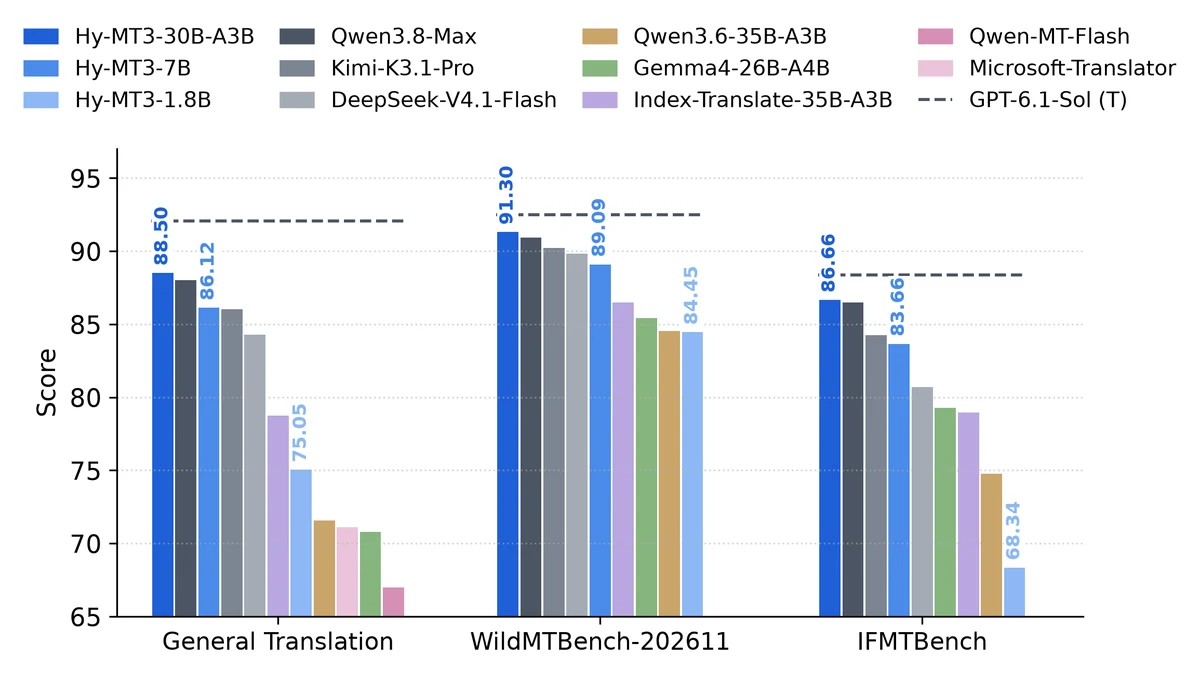
Tencent’s Hunyuan team has open-sourced Hy-MT3, a new family of translation models covering 102 languages, the company said on November 24. The release includes three model sizes under the Apache 2.0 license, with the largest version, Hy-MT3-30B-A3B, posting scores that Tencent says rival flagship closed-source models while using far less computing power.
The models are available now on Hugging Face and ModelScope, with code and a technical report on GitHub. The paper is also published on arXiv.
What Was Announced?
Hy-MT3 is the third generation of Tencent’s Hunyuan translation family. It comes in three sizes: Hy-MT3-1.8B, Hy-MT3-7B and Hy-MT3-30B-A3B, a mixture-of-experts model that activates only 3 billion parameters during inference. Language coverage has grown from 38 languages in the previous generation, Hy-MT2, to 102.
The release also includes FP8 and GGUF builds for local and on-device use, alongside the full weights for server deployment. Tencent says the models are designed for real-world translation work, not only benchmark tests, with specific tuning for game localization and for translating text inside images.
Benchmark Results
On Tencent’s reported benchmarks, Hy-MT3-30B-A3B scored 88.50 on general translation, 91.30 on WildMTBench-202611 and 86.66 on IFMTBench, the best overall result among all evaluated models in non-thinking mode. The company says the model outperformed Qwen3.8-Max, Kimi-K3.1-Pro and DeepSeek-V4.1-Flash, and approached the strongest closed-source thinking models, GPT-6.1-Sol and Gemini-4-Argon.
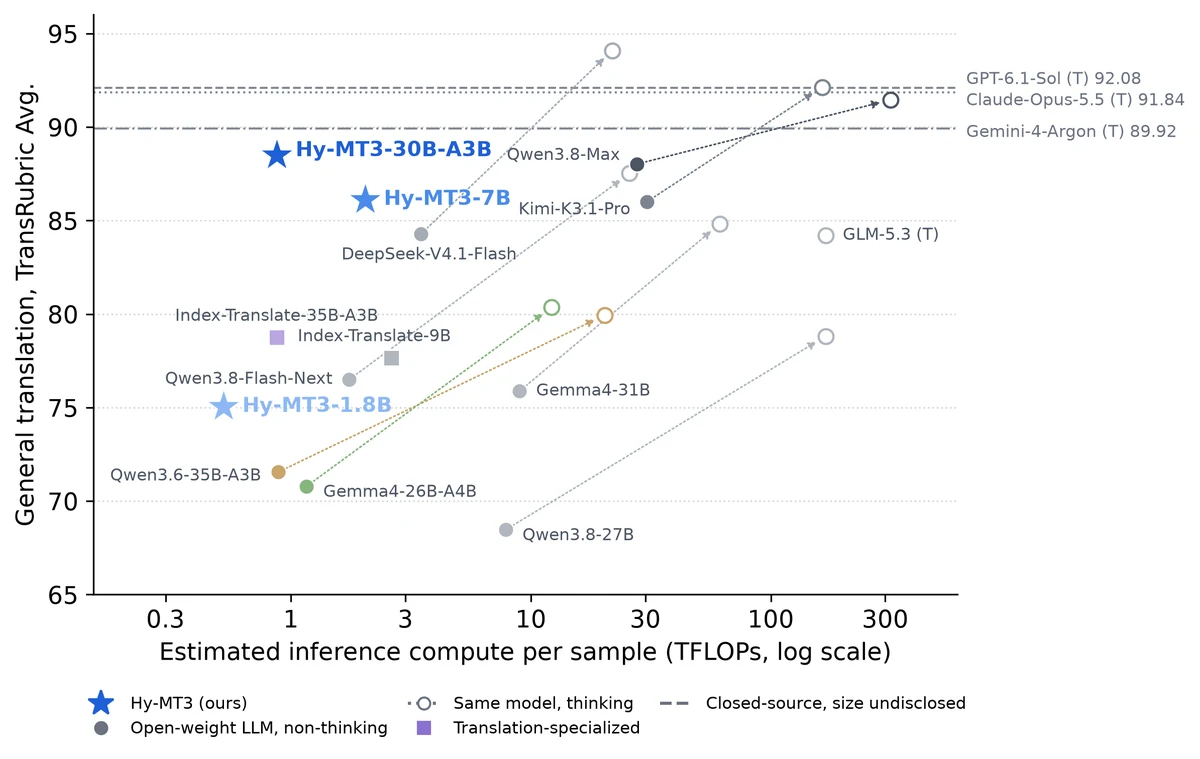
Hy-MT3-30B-A3B reaches near-top scores at a fraction of the inference compute of larger rivals. Chart: Tencent Hunyuan
The efficiency gap is the headline claim. Tencent’s chart shows Hy-MT3-30B-A3B reaching near-top quality while using more than 30 times less inference compute than the models it is compared against. The smaller Hy-MT3-7B and Hy-MT3-1.8B also sit well above their size class on the same quality-versus-compute plot.
Compared with Hy-MT2, the new models cut mistranslations by 43 percent, omissions or additions by 74 percent, and instruction-following errors by 40 percent on real-world scenario data, according to the technical report. The figures are Tencent’s own results and have not yet been independently reproduced.
Built for Game Localization
One of the two industrial scenarios Tencent tuned Hy-MT3 for is game localization. The team used high-quality game-domain data and the professional evaluation system of its Honor of Kings team, and says Hy-MT3-30B-A3B matches or exceeds strong closed-source models such as Gemini 3.1 Pro on all core metrics for that task. The models can be plugged into game development pipelines through open-source tooling.
The second scenario is OCR-cascaded image translation, where text is read from an image and then translated, a common need for comics, screenshots and scanned documents.
TransRubric Evaluation Suite
Alongside the models, Tencent open-sourced TransRubric, a rubric-based automatic evaluation suite for translation. The company says it outperformed other evaluation schemes on the WMT26 metrics shared task test set and proved more stable than human evaluation. The suite is included in the Hy-MT3 GitHub repository.
Why It Matters
Translation has become a quiet battleground for open models. General-purpose chatbots translate well, but they are expensive to run and often unreliable on long documents, low-resource languages and domain-specific text. A specialized open family that covers 102 languages and runs cheaply gives developers a practical alternative, especially for products that translate at scale, such as games, customer support and content platforms.
Hy-MT3 also continues a pattern from Chinese labs in 2026: open-weight releases aimed squarely at beating closed models on cost-adjusted quality, not just raw scores. If the efficiency claims hold up in independent testing, the 30B-A3B version could become a default choice for teams that need near-frontier translation without paying frontier prices.