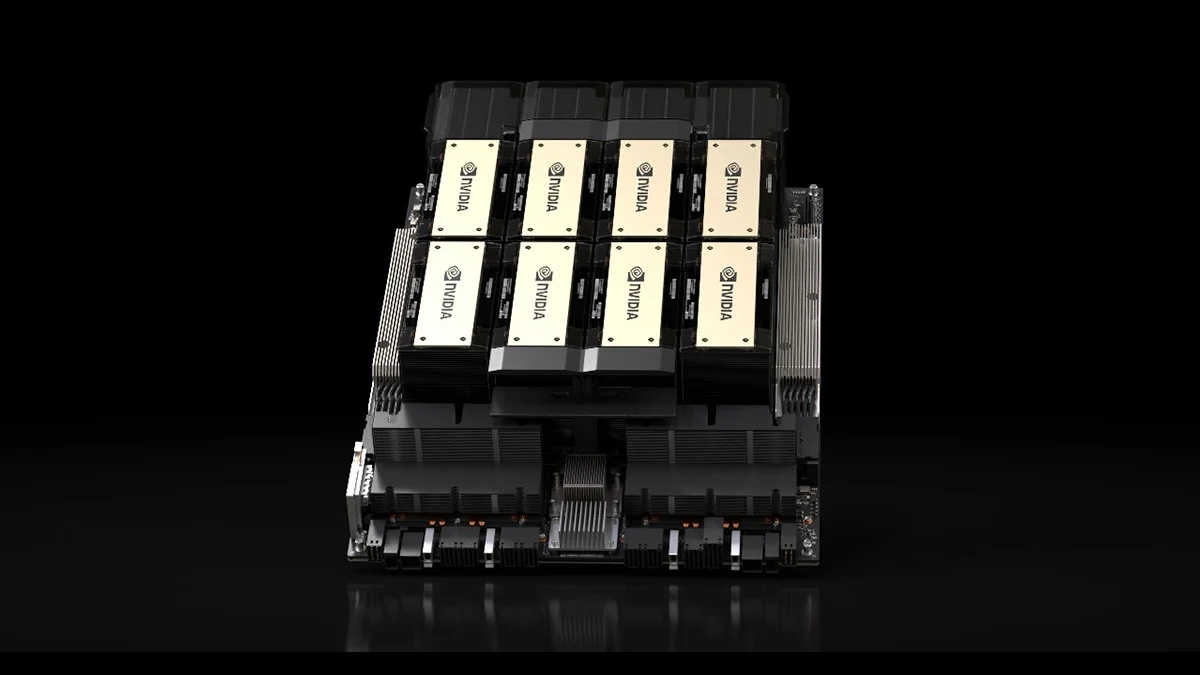
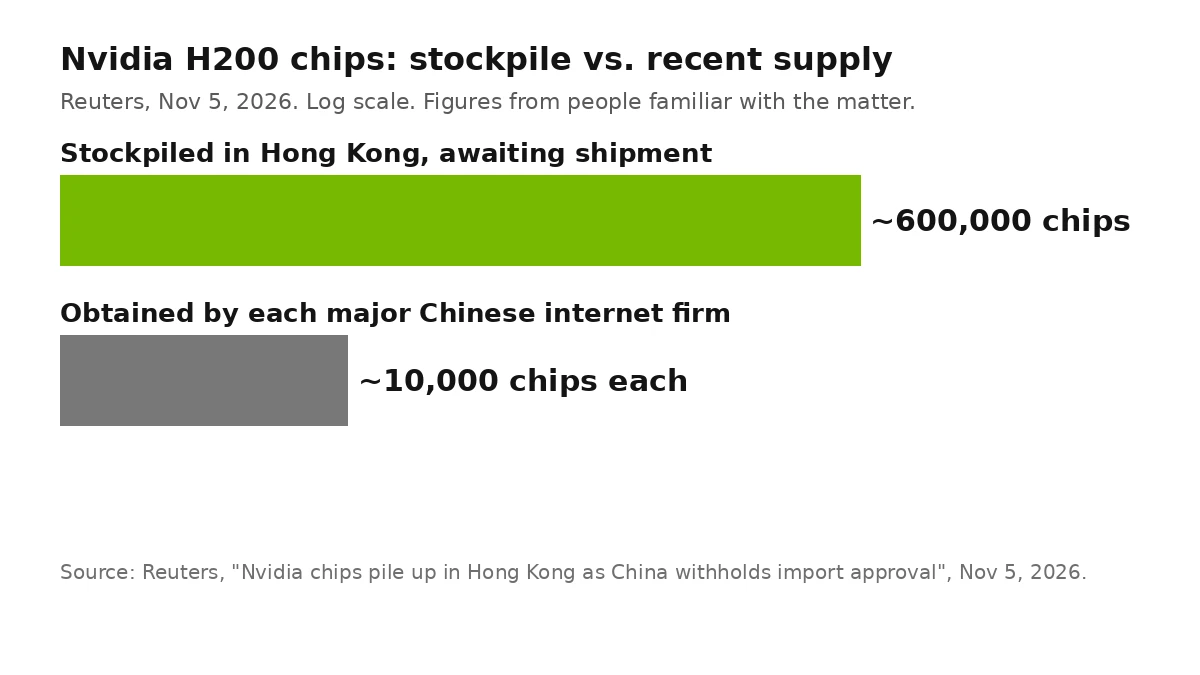
About 600,000 of Nvidia’s advanced artificial intelligence chips are stored in Hong Kong, waiting for shipment to mainland China, as Beijing withholds approval for large-scale imports despite strong demand from Chinese technology firms. Reuters reported the previously undisclosed stockpile on November 5, citing people familiar with the matter.
The pile-up captures a strange standoff. Chinese companies need Nvidia’s computing power to meet surging AI demand, yet Beijing is reluctant to deepen reliance on American technology. The result is a bottleneck that neither side has moved to clear, and a grey market where prices have soared.
What Reuters Found
China has allowed some H200 chips into the country in recent months, according to three people familiar with the matter cited by Reuters. Several major Chinese internet companies have each obtained about 10,000 H200 chips in the past few months. Small quantities have also moved through intermediaries and indirect routes. But Beijing has yet to approve large-volume imports into mainland China.
The H200 is not Nvidia’s newest AI processor, but it has capabilities that Chinese alternatives have yet to match, making it useful for training AI models, particularly when combined with Nvidia’s software. With authorised supply constrained, Chinese buyers have turned to intermediaries, pushing up prices in the unofficial market.
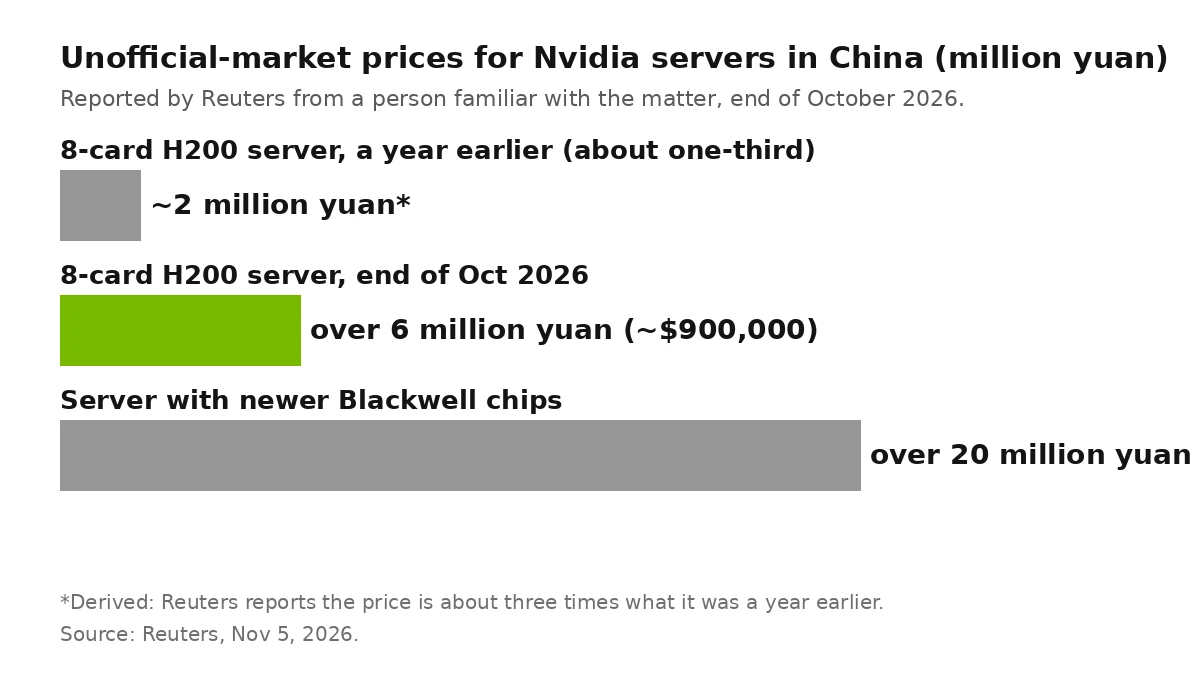
An eight-card H200 server was offered for more than 6 million yuan (about $900,000) in mainland China by the end of October, about three times its price a year earlier, one person familiar with the matter told Reuters. Servers using Nvidia’s newer Blackwell chips, which fall under US export controls, were offered for more than 20 million yuan apiece.
How the Chips Got Stuck
US export controls since 2022 have sought to restrict China’s access to advanced Nvidia chips and the equipment needed to make them. Washington barred exports of the H200 to China before the Trump administration gave Nvidia permission last year to sell the chips to approved Chinese customers, a shift that followed US-China trade negotiations.
Beijing has since imposed its own constraints. The Information reported in July that Chinese officials had told companies including Alibaba, ByteDance and DeepSeek that they could receive permission to buy limited quantities of H200 chips for training AI models. It reported that total approvals could amount to fewer than 200,000 chips, and that Beijing wanted firms to prioritise Chinese processors for inference, the task of running AI models.
China’s Ministry of Industry and Information Technology and the National Development and Reform Commission did not respond to requests for comment, Reuters said. Neither did Nvidia or Chinese tech companies Alibaba, ByteDance, DeepSeek and Tencent.
Why It Matters
The stockpile shows how export controls and industrial policy are now colliding from both directions. Washington spent years limiting what Nvidia could sell to China. Now Beijing is limiting what China will buy, even as its own AI industry clamours for more computing power.
Chinese firms are adapting. Reuters reported last month that ByteDance, Alibaba and Tencent had ordered more than 3 million Nvidia RTX Pro 5500 graphics cards, a less powerful export-compliant product, with a combined sticker price exceeding $35 billion. The H200 pile-up in Hong Kong suggests the workaround is only partial: for the most demanding training work, Chinese labs still want the chips they cannot easily get.
For Nvidia, the episode is a reminder that geopolitics now shapes demand as much as technology does. Six hundred thousand of its most sought-after AI chips are sitting in a warehouse, not in data centres, because the politics of who gets to use them remains unresolved.