Baidu has released the weights of a large new base model for researchers to build on. The company’s ERNIE team announced ERNIE-5.5-Flash-Base on November 5, 2026, an open-weight mixture-of-experts model with 280 billion total parameters, of which 14 billion are activated per token. The checkpoint is the model exactly as it stood at the end of pre-training, before any mid-training or post-training, giving developers a fixed starting point for fine-tuning, instruction tuning and reinforcement learning research.
“ERNIE 5.5 Flash Base is an open-source, large-scale MoE base model with 280B total parameters and 14B activated parameters,” Baidu wrote in its release notes.
Built for Efficient Further Training
The model was pre-trained from scratch on 33.5 trillion tokens, using the Muon optimizer and FP8 mixed precision, with a training context of up to 128,000 tokens that extends to 1 million tokens for fine-tuning and inference. Baidu says efficiency shaped every design choice, because further training and long-context agentic use both multiply compute costs.
Under the hood, ERNIE 5.5 Flash Base has 43 Transformer layers, a hidden size of 4,096 and 64 attention heads. It uses a hybrid attention design that mixes full attention, sliding window attention and linear attention, and a sparse MoE with 512 routed experts plus one shared expert, activating 10 routed experts per token. The pre-training corpus covers web, code and long-context material, including synthetic data for long-context retrieval and question answering.
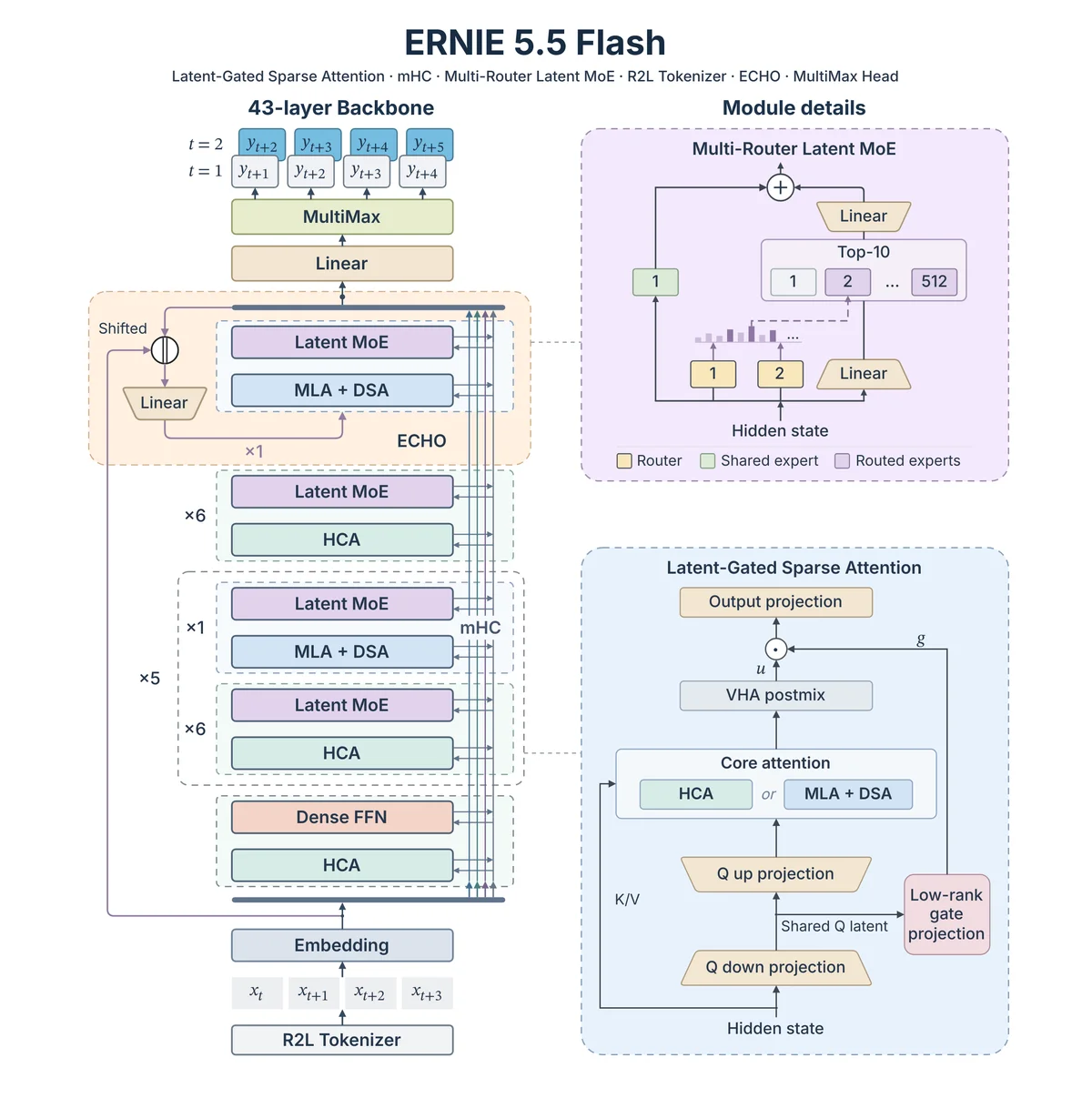
The ERNIE 5.5 Flash architecture: 43 layers with hybrid sparse attention and a Multi-Router Latent MoE. Image: Baidu
Benchmarks: Leading on Most, Not All
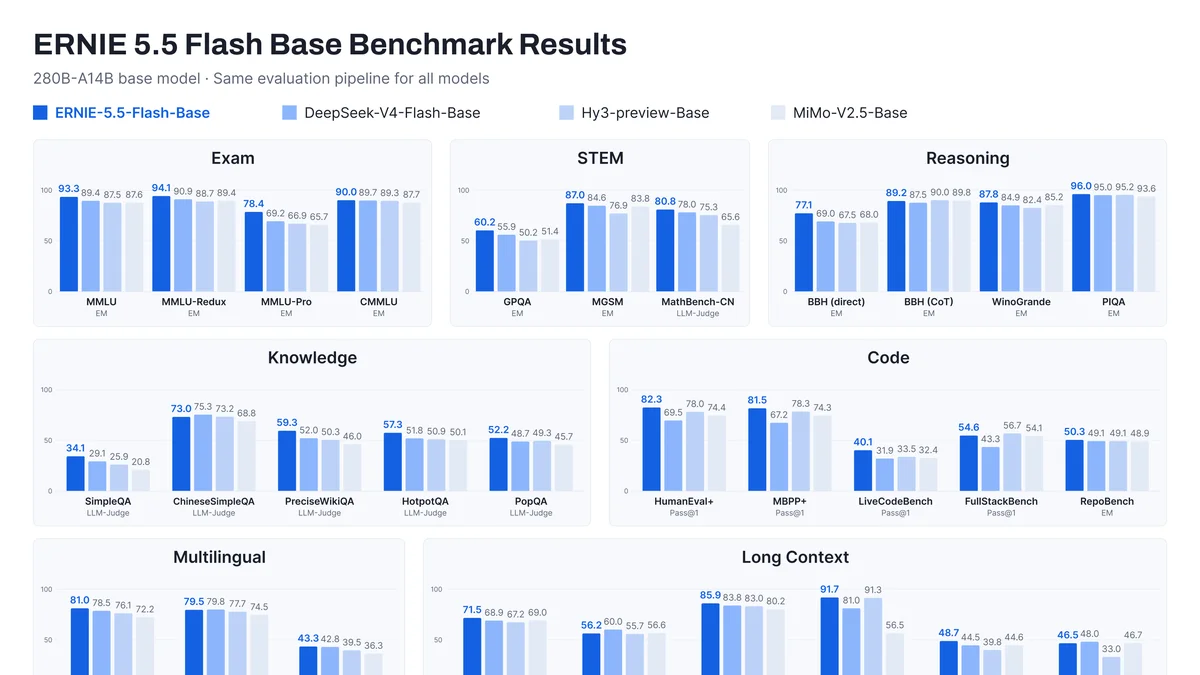
Baidu published results across 30 benchmarks in seven categories, comparing ERNIE 5.5 Flash Base against other openly released base checkpoints under the same harness, prompts and few-shot examples. On MMLU (5-shot) it scored 93.3, ahead of DeepSeek V4 Flash Base at 89.4, Hy3-preview-Base at 87.5 and MiMo-V2.5-Base at 87.6. It also led on MMLU-Pro (78.4), GPQA (60.2), HumanEval+ (82.3), MBPP+ (81.5) and CMMLU (90.0).
The lead is not universal. On BBH with chain-of-thought prompting, Hy3-preview-Base scored 90.0 against ERNIE’s 89.2; on ChineseSimpleQA, DeepSeek V4 Flash Base led with 75.3 against 73.0; and on InfiniteBench, DeepSeek led 48.0 to 46.5. Baidu’s own figures show ERNIE ahead on most rows of the table, but the comparison is task dependent and rivals lead on several benchmarks.
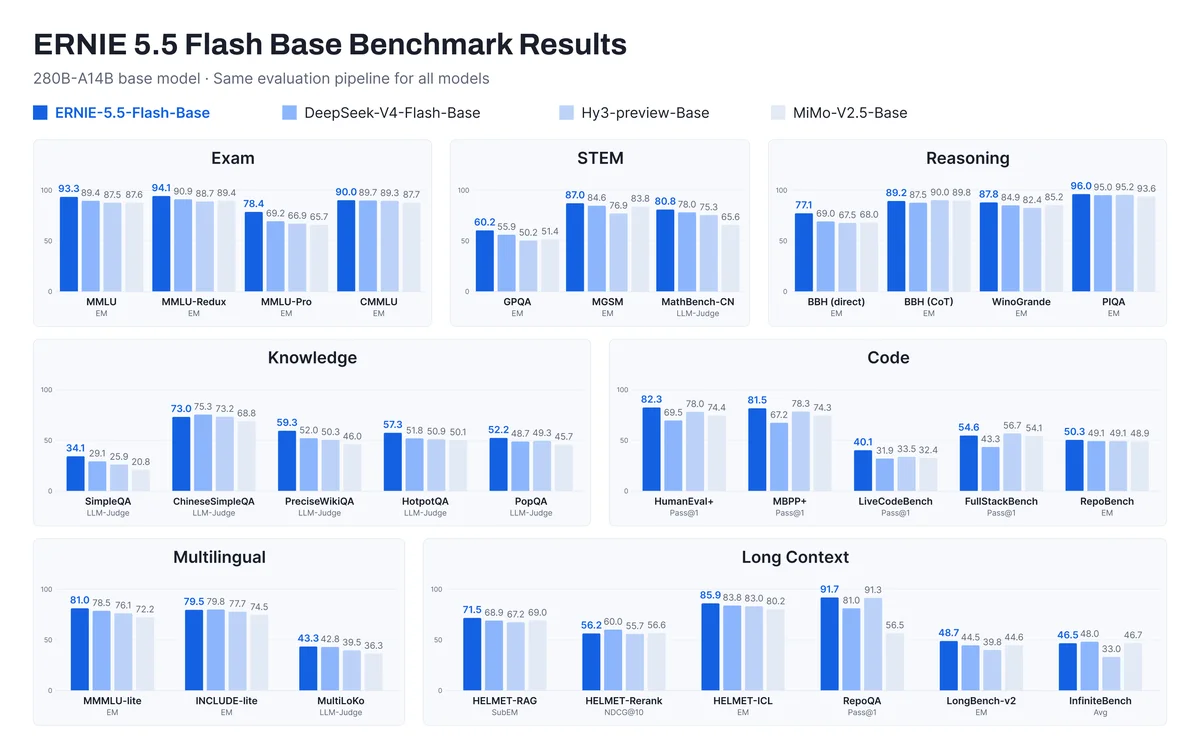
Baidu’s benchmark comparison of ERNIE 5.5 Flash Base against DeepSeek V4 Flash Base, Hy3-preview-Base and MiMo-V2.5-Base. Image: Baidu
Downloads and a Restrictive License
The weights are available on Hugging Face in FP8 and BF16 safetensors formats, with the FP8 download totaling about 288 GB across 128 shards. A post-trained ERNIE 5.5 Flash model will follow, Baidu said.
The license deserves a close read. The ERNIE 5.5 Flash Base Model License Agreement v1.0 covers the whole world except the European Union, the United Kingdom and South Korea. Non-commercial use is free, and commercial use is free when related annual revenue is 50 million US dollars or less, with a one-time notification to Baidu. Above that threshold, written permission from Baidu is required, and commercial products must carry a “Powered by ERNIE” credit. The agreement is governed by Hong Kong law.
Why It Matters
Base models are the raw material of AI research, and a 280-billion-parameter checkpoint released at the end of pre-training is a substantial one. For labs that cannot afford a run of 33.5 trillion tokens, ERNIE 5.5 Flash Base offers a controlled baseline for testing new training methods without repeating the pre-training itself. The license limits, especially the territorial exclusions and the revenue threshold, will shape who can actually use it, but for researchers in the covered regions it is one of the largest open starting points released this year.