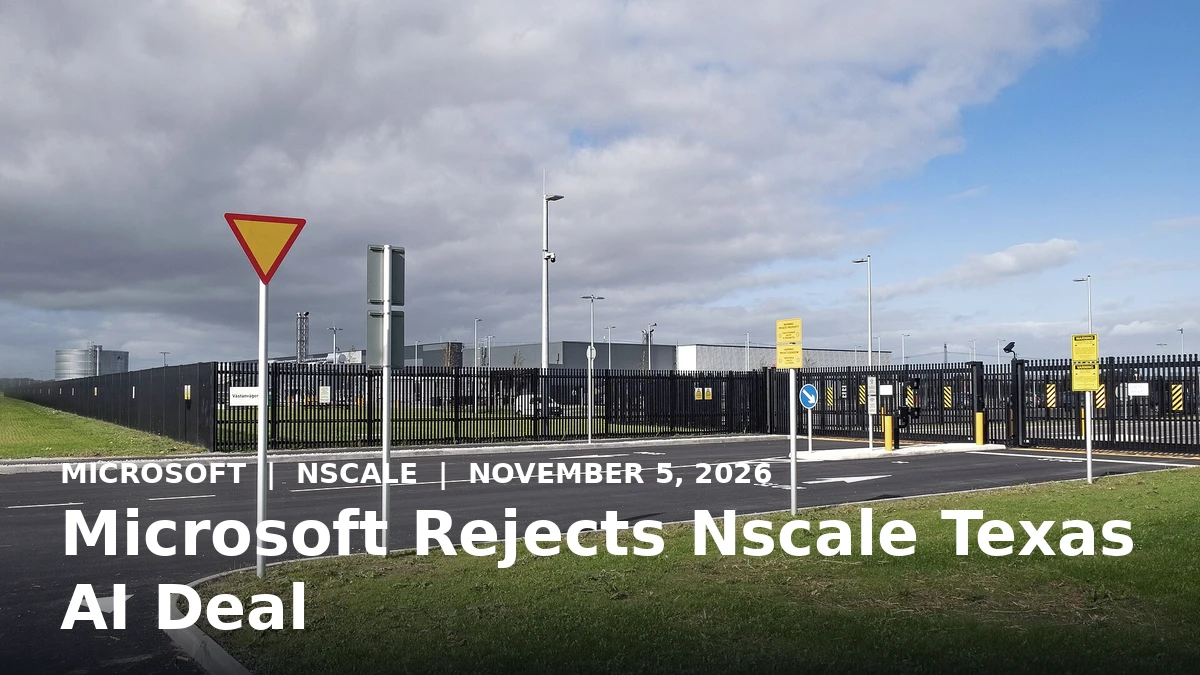
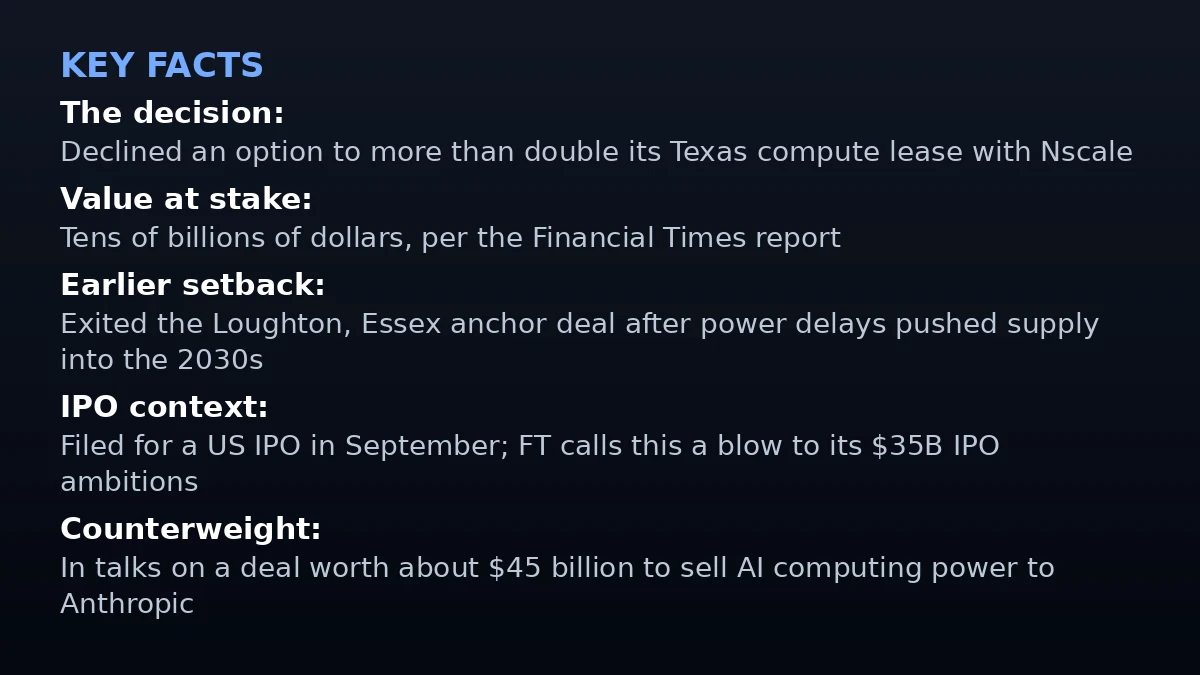
Microsoft has rejected an option to more than double its agreement with Nscale to rent computing power at a Texas data center, walking away from a potential expansion worth tens of billions of dollars, the Financial Times reported on Thursday. The report, relayed by Reuters, is the second setback Microsoft has dealt the British AI cloud provider in a matter of weeks, and it lands just as Nscale is preparing a US stock market listing.
According to the Financial Times, citing people familiar with the matter, Microsoft declined to exercise an option that would have more than doubled the size of its existing Texas computing agreement with Nscale. The Microsoft Nscale deal would have expanded one of the largest AI infrastructure relationships between a hyperscaler and a so-called neocloud provider, a class of specialist firms that rent out GPU capacity to AI labs. Reuters said it could not immediately verify the report, and Microsoft and Nscale did not immediately respond to requests for comment.
What Was Reported
The Texas option was an expansion of an existing lease, not a new contract, which makes the rejection a decision about growth rather than an exit. Microsoft already rents computing power from Nscale at the Texas site. Doubling that footprint would have committed Microsoft to a far larger share of Nscale’s capacity for years, at a moment when the biggest AI buyers are under growing pressure from investors to show that their infrastructure spending is disciplined.
The report did not say why Microsoft passed on the option. It also did not say whether the option could be revived later or whether the existing Texas agreement is affected. Neither company has commented on the record, so the reasons remain a matter for the report’s sources rather than confirmed fact.
A Second Setback in Weeks
The Texas decision follows a similar pullback in the United Kingdom. Weeks earlier, Microsoft withdrew from a deal to anchor Nscale’s flagship data center project in Loughton, Essex, after delays to its power connection pushed the expected supply date into the 2030s. Losing Microsoft as the anchor customer called the viability of that project into question.
Two rejections in quick succession paint a consistent picture. Microsoft, one of the world’s largest buyers of AI computing capacity, is becoming more selective about which third-party data center projects it backs, and power availability has become a decisive factor. Grid connection delays have emerged as one of the main bottlenecks for AI infrastructure in both the United States and Europe.
Why It Matters for Nscale
Nscale, backed by Nvidia, filed for a US initial public offering in September, with Microsoft and Anthropic expected to be among its major customers. The Financial Times framed the Texas rejection as a fresh blow to Nscale’s ambitions for a $35 billion IPO, since a marquee customer scaling back raises questions about the demand underpinning the listing.
The company still has a powerful counterweight. Reuters reported last month that Nscale was in talks to sell AI computing power to Claude maker Anthropic in a deal that could be worth about $45 billion. If that agreement closes, it would give Nscale a second anchor customer at a scale comparable to the Microsoft business it has now lost the chance to expand.
The episode also matters beyond Nscale. Neocloud providers have raised enormous sums on the promise that hyperscalers and AI labs will keep renting their GPU capacity faster than they can build it. A decision by Microsoft to turn down tens of billions of dollars of additional capacity is an early signal that the largest buyers are starting to pick their projects more carefully, and that the market for AI infrastructure is entering a more selective phase.

What Remains Unconfirmed
For now, the core of the story rests on a single report. The Financial Times cited people familiar with the matter, Reuters could not immediately verify it, and neither Microsoft nor Nscale has commented. The size of the rejected expansion has been described only as tens of billions of dollars, with no precise figure. Until one of the companies speaks, the Texas decision should be treated as reported, not confirmed, and the effect on Nscale’s IPO plans as a market judgement rather than an established fact.