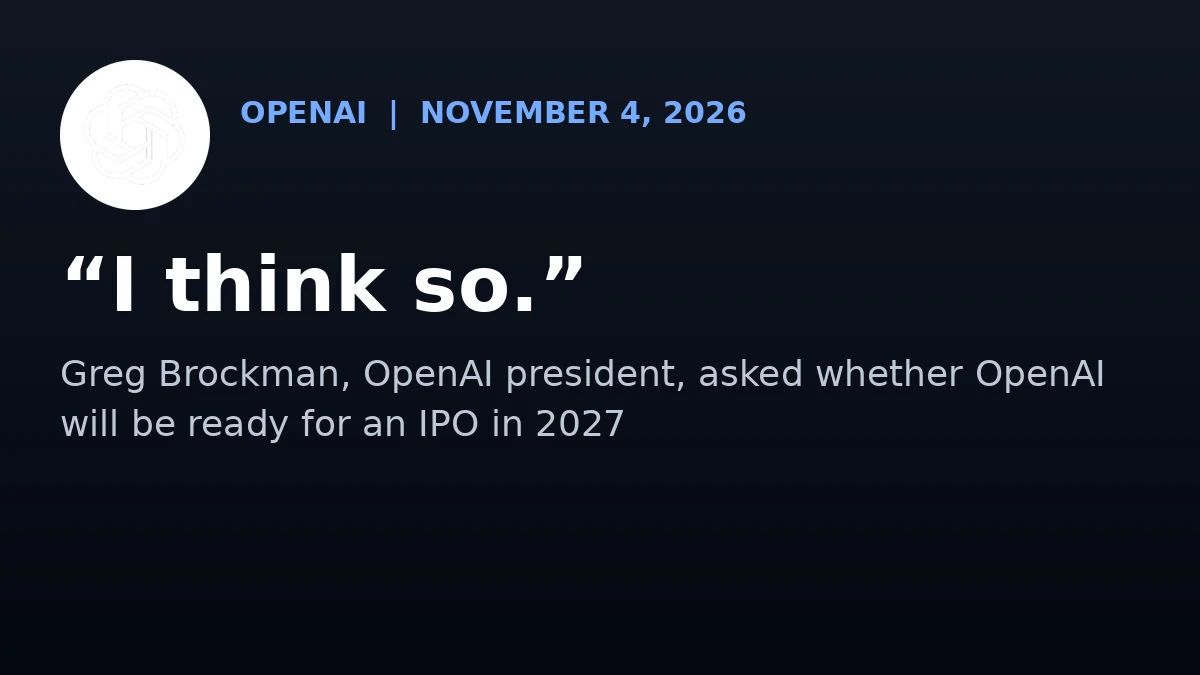
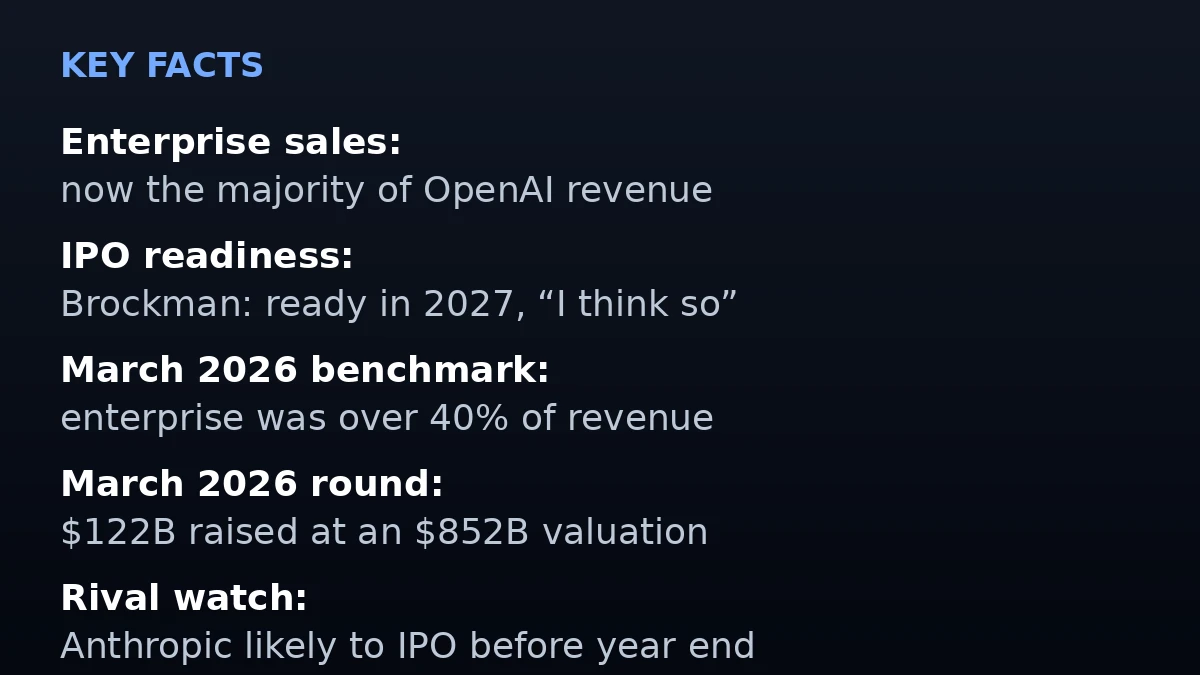
OpenAI president Greg Brockman says enterprise sales now generate the majority of the company’s revenue, and he believes the ChatGPT maker could be ready for an OpenAI IPO 2027. Brockman made the remarks on November 4 at a Wall Street Journal tech conference in Napa, California, in what amounts to the clearest public signal yet about the timing of one of the most anticipated listings in technology.
Asked on stage whether OpenAI will be ready for an initial public offering next year, Brockman answered, “I think so,” Reuters reported. The answer was confidence, not a commitment: Brockman described readiness, not a filed prospectus or a confirmed listing date. But it is the first time a senior OpenAI executive has publicly attached a year to the company’s IPO ambitions since OpenAI delayed its listing plans and accelerated private fundraising instead.
What Brockman Said
Brockman, OpenAI’s co-founder and president, spoke in a session titled “OpenAI’s Race to Scale” with Wall Street Journal reporter Keach Hagey, framed around AI infrastructure, ChatGPT’s business evolution, safety and cybersecurity. The revenue disclosure was the headline: enterprise customers, not individual subscribers, now bring in most of OpenAI’s money.
That shift matters because it changes the business a future public offering would present to investors. OpenAI built its fame on a consumer product, ChatGPT, but Brockman said the company has been ramping up sales to businesses in competition with rival Anthropic, including by pushing its Codex coding agent. Reuters noted that Anthropic is likely to go public before the end of 2026, putting the rival’s listing timetable directly in the background of Brockman’s answer.
From 40 Percent to a Majority
The new disclosure moves well past OpenAI’s last public benchmark. When the company closed a funding round on March 31, 2026, it said enterprise accounted for more than 40% of revenue and was on track to reach parity with consumer revenue by the end of 2026, while the business overall was generating $2 billion in revenue per month, PYMNTS reported at the time. Brockman’s statement that enterprise has now passed the halfway mark means that target was beaten, not merely met.
The March round itself set the scale of the private market bet on OpenAI: $122 billion in committed capital at an $852 billion post-money valuation, anchored by Amazon, NVIDIA and SoftBank with continued participation from Microsoft, Unite.AI noted. Reuters reported that OpenAI has been racing to ramp up fundraising to capitalize on recent growth after delaying its IPO plans, which makes Brockman’s 2027 remark read as a reopening of the public-market path rather than a new idea.
Why It Matters
An enterprise-led revenue mix tells a different story to public investors than a consumer subscription story. Business contracts, especially for coding agents like Codex and for workplace deployments of ChatGPT, tend to be larger, stickier and easier to forecast than individual subscriptions. That is exactly the profile a company wants to show when it starts talking about IPO readiness, and it helps explain why Brockman framed the enterprise push as a competitive race with Anthropic rather than as a side business.
The caveats still matter. OpenAI is private and publishes no audited accounts, so the revenue mix is a company statement relayed by Reuters, not a filing. Brockman’s “I think so” is a judgment about readiness, and market conditions, regulatory scrutiny and the outcome of Anthropic’s expected listing could all move the timetable. What is confirmed is narrower and still significant: OpenAI’s president now says the business side of the company outweighs the consumer side, and he believes a 2027 listing is within reach.
The next signals to watch are any formal IPO filing, updated revenue figures from the company, and whether Anthropic’s expected listing before year end sets a valuation benchmark that OpenAI must answer.