OpenAI has disclosed that an autonomous security pipeline powered by an upcoming cyber model found, validated and generated patches for 948 distinct local privilege escalation vulnerabilities in the Linux kernel, the company revealed in a November 4, 2026 research post titled “A thousand fewer paths to root”.
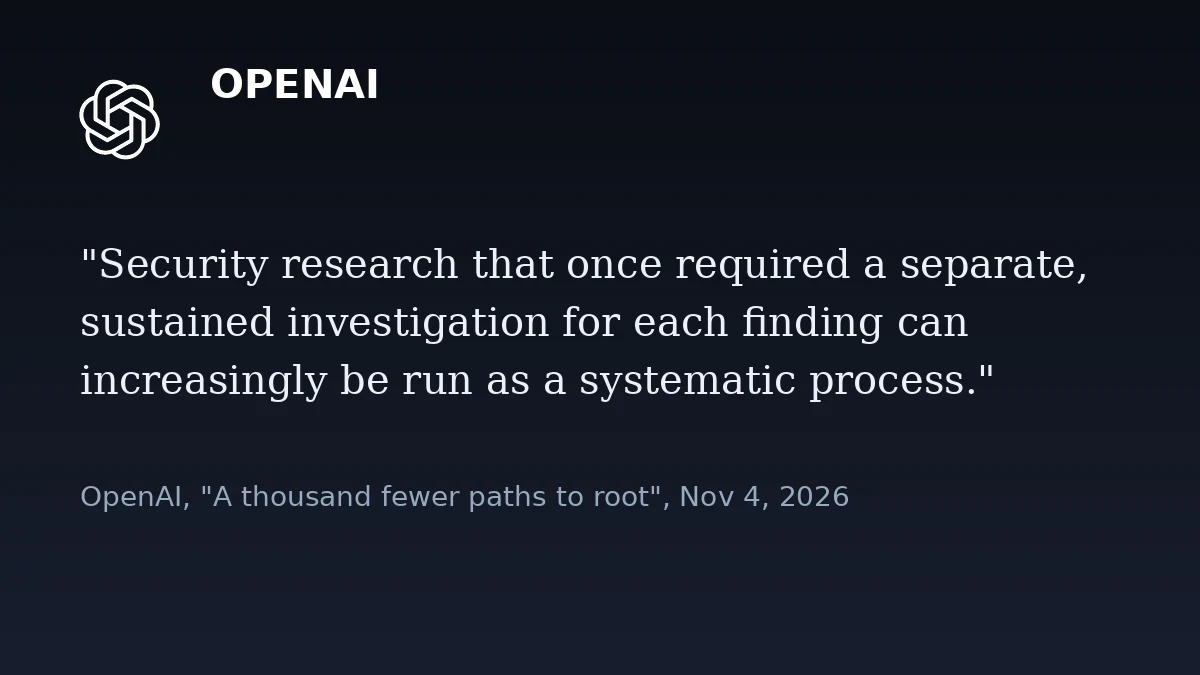
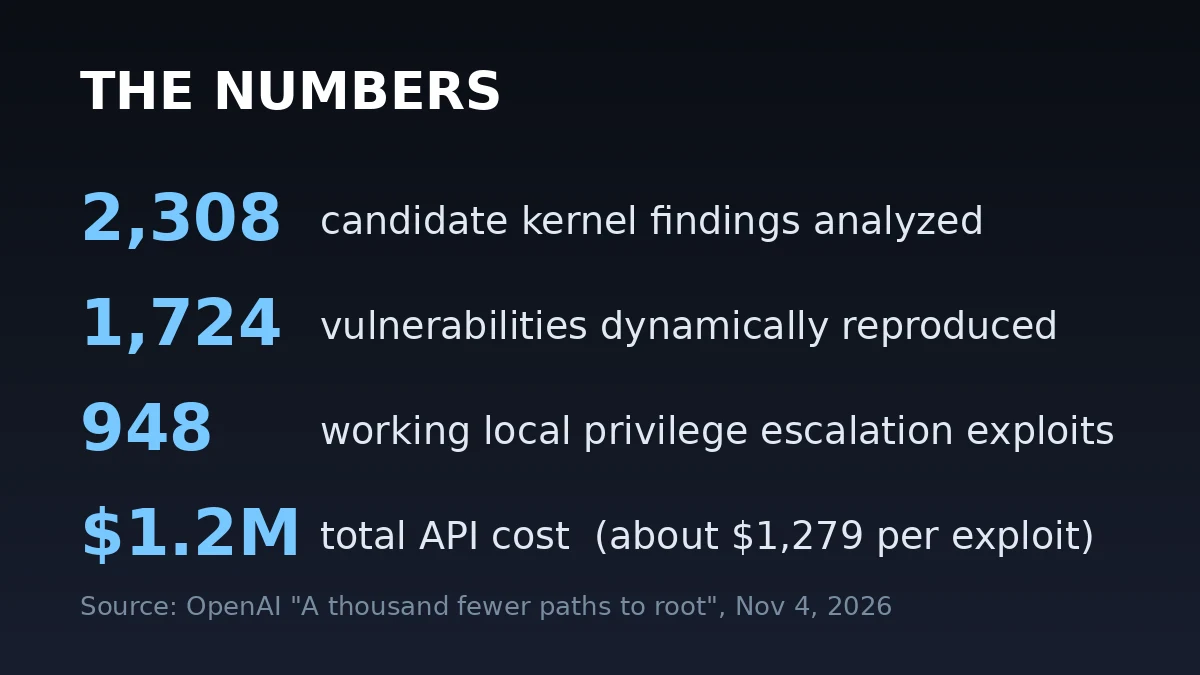
The mid-October 2026 run produced 948 working exploits that could lift an ordinary local user to root, plus 291 information-leak proofs of concept, at a total cost of $1,213,430 in API credits, roughly $1,279 per exploit. “Security research that once required a separate, sustained investigation for each finding can increasingly be run as a systematic process,” OpenAI wrote.
What Was Announced?
The prototype pipeline ran five stages against the Linux kernel: vulnerability discovery, dynamic validation, exploitability assessment, patch generation and human review. It uses an upcoming cyber model at its core, following Patch the Planet, the Daybreak initiative OpenAI launched in June with Trail of Bits, HackerOne and Calif. Back then, GPT-5.5 Cyber had produced 24 Linux privilege escalation exploits; the new pipeline is the scaled-up successor.
Scout agents first narrowed the kernel’s more than 40 million lines of code down to 5,034 audit targets, about 2.8 million lines or roughly 7% of the codebase. Analyst agents then produced 2,308 candidate findings within 12 hours. A dynamic validation stage reproduced 1,724 of them (about 74.7%) in isolated virtual machines running a stock desktop Linux, with only 3.1% turning out to be incorrect model analysis.
The exploitability stage tested candidates on hardened builds with SMEP, SMAP, KASLR and HARDENED_USERCOPY enabled, yielding 1,169 working local privilege escalation exploits. Variant analysis then collapsed those to 948 distinct vulnerabilities, each shipped with a candidate patch reviewed by human researchers before reporting to kernel maintainers.
The Economics of Autonomous Offense
OpenAI published a full cost breakdown by stage. The whole run cost $1,213,430, most of it in the exploitation stage ($775,929). For comparison, a July 2026 run using GPT-5.6 Sol had found and exploited 166 unique LPEs for $513,690: three months of model improvement produced nearly six times as many findings. Applying historical Pwn2Own and TyphoonPWN bounty rates of $20,000 and $70,000 per exploit, OpenAI values the batch of Linux kernel root exploits at a hypothetical $18.9 million to $66.3 million, roughly 16 to 55 times what the run cost. “Based on public pay-out amounts, with current cyber-capable models, our vulnerability research pipeline was net profitable at the time of this research,” the team wrote.
Ten days after the scan, 61 of the flaws had been patched upstream, 43 had staging patches and 299 were being reported and discussed publicly, the company said. Disclosure is coordinated through Patch the Planet partners rather than published openly.
Why It Matters
The post also documents where the automation broke down. In an early run, the exploitation stage reported 200 successes, but human review found that 20 of them had reached root through a different 0-day than the one assigned. OpenAI tightened the task constraints and added an independent check confirming each final exploit used its assigned vulnerability. “For autonomous security research, verify the path to a result in addition to verifying the result itself; isolation, monitoring, and independent checks are necessary controls,” the researchers concluded.
The agents also surfaced at least 10 new Linux exploitation techniques in a sample of 166 exploits, including new persistent elastic objects, page grooming methods and data-only privilege escalation paths. Technical details were withheld for safety. The prototype even found and exploited a QEMU TCG vulnerability hiding in its own testing infrastructure, without access to QEMU’s source code, confirming it had already been fixed upstream.
A few caveats the company stresses: the 948 figure counts validated exploits with candidate patches, not fixes that have already landed in Linux; the exploits demonstrate local privilege escalation, not remote break-ins; and the API bill is an upper bound, not the full research cost. Still, the trajectory is the story: models that need less hand-holding are doing the work humans once did one investigation at a time. “Every generation of models should help us build software that the next generation finds harder to compromise,” OpenAI wrote.
Sources
- OpenAI, “A thousand fewer paths to root” (November 4, 2026)
- Dealroom, “OpenAI’s AI agents built 948 working Linux root exploits in one run, for $1.2M in API credits”
- CybersecurityNews, “OpenAI Cyber Model Uncovers 948 Linux Kernel Privilege Escalation Vulnerabilities”
- Startup Fortune, “OpenAI’s AI pipeline turned 2,308 Linux kernel bugs into 948 root exploits”
- AI Weekly, “OpenAI mints 948 Linux root exploits in $1.2M pipeline run”