OpenAI has launched Images 2.6, an upgrade to its image generation stack that brings native animated GIF creation to ChatGPT and Codex and promises 50% faster image generation, the company announced on November 4, 2026.
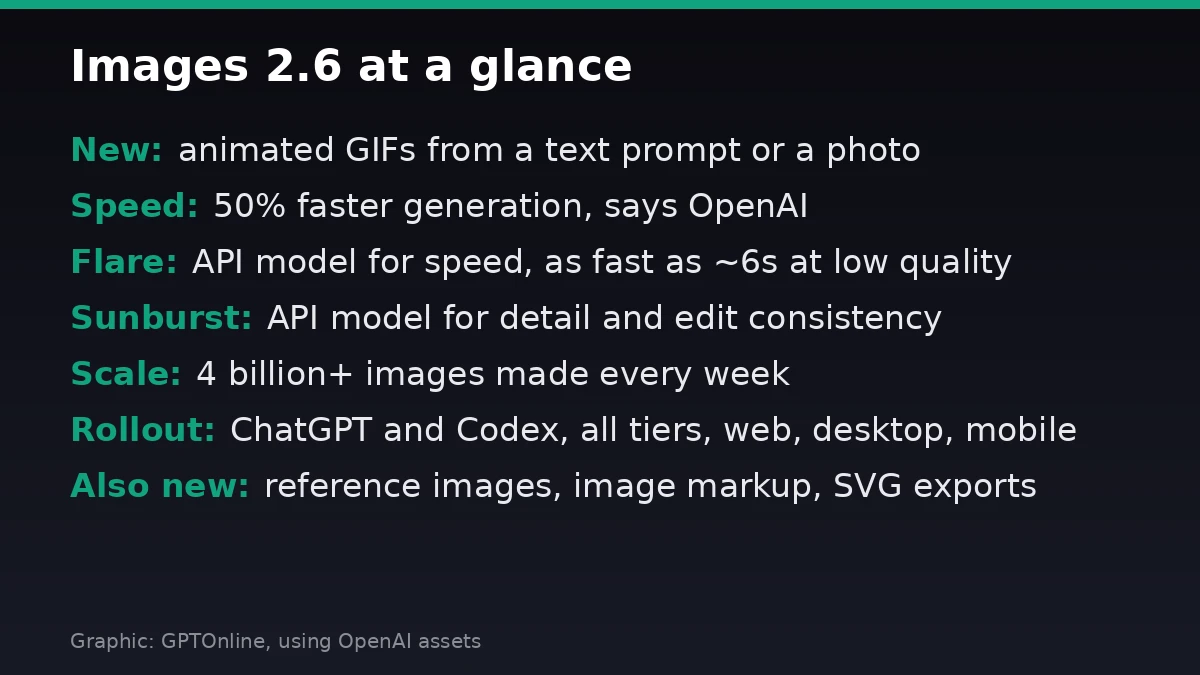
The update is rolling out globally across ChatGPT and Codex on web, desktop and mobile, covering every subscription tier, while developers get two new API models: GPT-Image-2.6 Flare for speed and GPT-Image-2.6 Sunburst for quality. OpenAI says total image volume across ChatGPT and the API now exceeds 4 billion images per week, up from 3 billion in September.
What Was Announced?
The headline feature is one-step animated GIF creation. Users can turn a written prompt or an uploaded photo into a looping animation directly inside ChatGPT, then change the playback speed, edit individual frames, inspect frames one by one, and share the finished GIF. “Images, upgraded, introducing ChatGPT Images 2.6. Now with GIFs and reference images,” OpenAI said in its announcement.
Images 2.6 also adds reusable reference images. Users can save a character, pet or themselves once and reuse it across new creations without uploading it again. “Keep reference images of yourself, pets, and characters ready to reuse in new creations, no need to upload them again,” the company said.
On the developer side, GPT-Image-2.6 Flare targets speed and latency-sensitive workloads, producing an image in as little as six seconds at low quality settings. GPT-Image-2.6 Sunburst is tuned for detail and edit consistency at medium or high quality. “Image-2.6 Flare and Sunburst, our two new API image models, generate images 50% faster than before,” OpenAI’s developer team said. “At medium or high quality, Sunburst keeps details more consistent from one edit to the next.”
Graphic: GPTOnline, using OpenAI assets
The API gains several new controls: ChatGPT’s image markup arrives in the API so teams can point at precise areas for changes, alongside SVG exports for use on websites, apps and print, and a new complexity parameter that controls how much planning the model applies to a scene. OpenAI recommends low complexity for quick edits and reserves higher settings for scenes with many elements or constraints.
Why It Matters
The release extends OpenAI’s image line from still pictures into animation, and it lands at remarkable scale: crossing 4 billion images per week makes image generation one of the heaviest workloads in OpenAI’s product line. That growth is exactly what the company has been optimizing for. Images 2.5, released on September 8, 2026, also promised generation up to 50% faster, and Images 2.6 continues the cadence of speed-first upgrades.
The two-model split also mirrors the strategy OpenAI used in Images 2.5: make speed and consistency an explicit choice for developers rather than a single tradeoff. For product teams, Flare’s six-second turnaround opens up interactive and high-volume use cases, while Sunburst targets work that needs a character, product or brand to survive many revision rounds intact.
A few caveats: OpenAI has not published a new price sheet alongside the release, so developers will need current API pricing before estimating production costs. The rollout is gradual, and some users may not see the GIF tools immediately. Existing account-level usage caps still apply, and Codex now shares usage limits with ChatGPT.
Graphic: GPTOnline, using OpenAI assets
Sources
- TestingCatalog, “OpenAI launches Images 2.6 with GIFs and image reference”
- Unite.ai, “ChatGPT Adds Animated GIF Creation and Editing with Images 2.6”
- AI News Daily, “OpenAI launches ChatGPT Images 2.6 with GIFs and 50% faster generation”
- Decrypt, “ChatGPT Is Getting a GIF Maker Powered by OpenAI’s Unannounced Images 2.6 Model”
- AlphaSignal, “OpenAI’s Images 2.6 Generates 4B Weekly Images 32% Faster With Native GIFs”
Note: this article cites OpenAI’s own November 4, 2026 announcement posts (@OpenAI and @OpenAIDevs on X) as quoted in the sources above. Exact post URLs could not be confirmed, so no social embed is included.