LiberAI has introduced Liber-0, a “world action model” that learns robot manipulation from human experience instead of robot-specific demonstrations. The Beijing-based startup says the LiberAI Liber-0 model was pretrained on more than 2.2 million hours of human experience and achieved 36.0% overall success on a suite of 60 manipulation tasks proposed by GPT-6, without training on robot demonstrations collected for those tasks.
The announcement, made via an official LiberAI press release on November 4, 2026, also launched an interactive simulation where users can upload their own objects and watch Liber-0 manipulate them in a virtual environment.
What Was Announced?
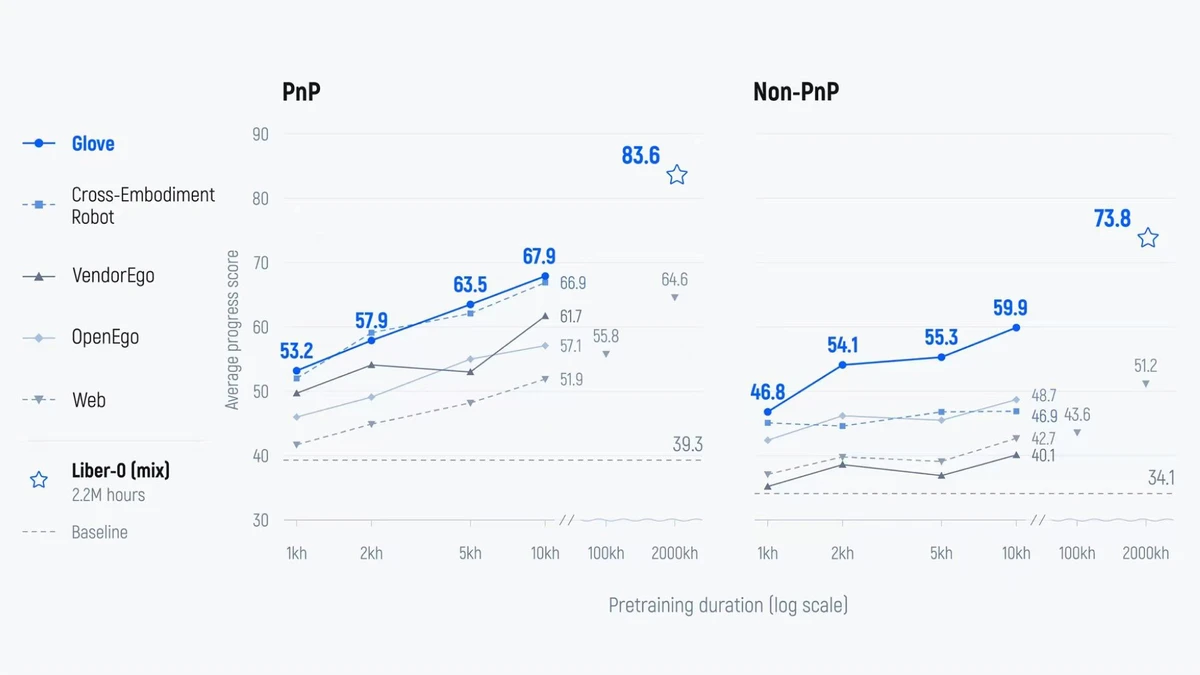
Liber-0 is what LiberAI calls a World Action Model (WAM). It combines large-scale human video with hand motions recorded by the company’s LiberSense Glove, plus embodiment-conditioned learning, to transfer human manipulation experience to robots. The model jointly predicts future video frames and actions, which lets it learn from ordinary videos that carry no action labels alongside glove and robot recordings that include measured motion.
The idea addresses a real bottleneck. Robot manipulation has traditionally depended on demonstrations recorded on a specific robot for a specific task, usually by a human teleoperating the machine. That data matches deployment closely, but collecting it is slow and expensive. Human activity, by contrast, is abundant and already on video. The catch, as LiberAI frames it, is that human video does not translate directly into robot commands: cameras sit in different places, hand poses estimated from video are noisy, and human bodies move differently from robots.
The Evaluation
The headline test is task-level zero-shot generalization: can the model perform tasks it was never given robot demonstrations for? LiberAI evaluated Liber-0 on 60 GPT-6-proposed tasks, distinct from its internal scaling benchmarks: 20 pick-and-place tasks, 20 non-pick-and-place manipulation tasks, and 20 challenging long-horizon tasks, each run 10 times for 600 trials total.
The company reported success rates of 63.5% on pick-and-place, 34.0% on other manipulation tasks, and 10.5% on the challenging multi-step set, for an overall 36.0%. Example tasks ranged from placing a pen in a pencil case to pushing a drawer closed to a longer sequence of putting a pen in a pouch and storing the pouch in a drawer.
Two details matter for interpreting the numbers. First, “zero-shot” here is task-level: the evaluated checkpoint was not trained on robot demonstrations for these tasks, but pretraining did include robot data. Second, a separate experiment showed glove data doing real work: a policy whose robot demonstrations covered only pick-and-place scored a progress rating of 2.2 on non-pick-and-place tasks with robot data alone, rising to 47.5 when glove demonstrations of folding, pressing and opening were added, close to the 56.3 scored by a policy trained on robot demonstrations of every action.
Why It Matters
The most practical claim is about data efficiency. In an eight-task evaluation on LiberAI’s robot platform, a policy trained on just 25% of the robot demonstrations plus the full glove pool reached a progress score of 75.6, edging out the 72.8 scored with 100% of the robot pool. Because glove collection does not require a robot at each site, LiberAI says experience can be gathered from more people, in more places, and potentially at lower cost.
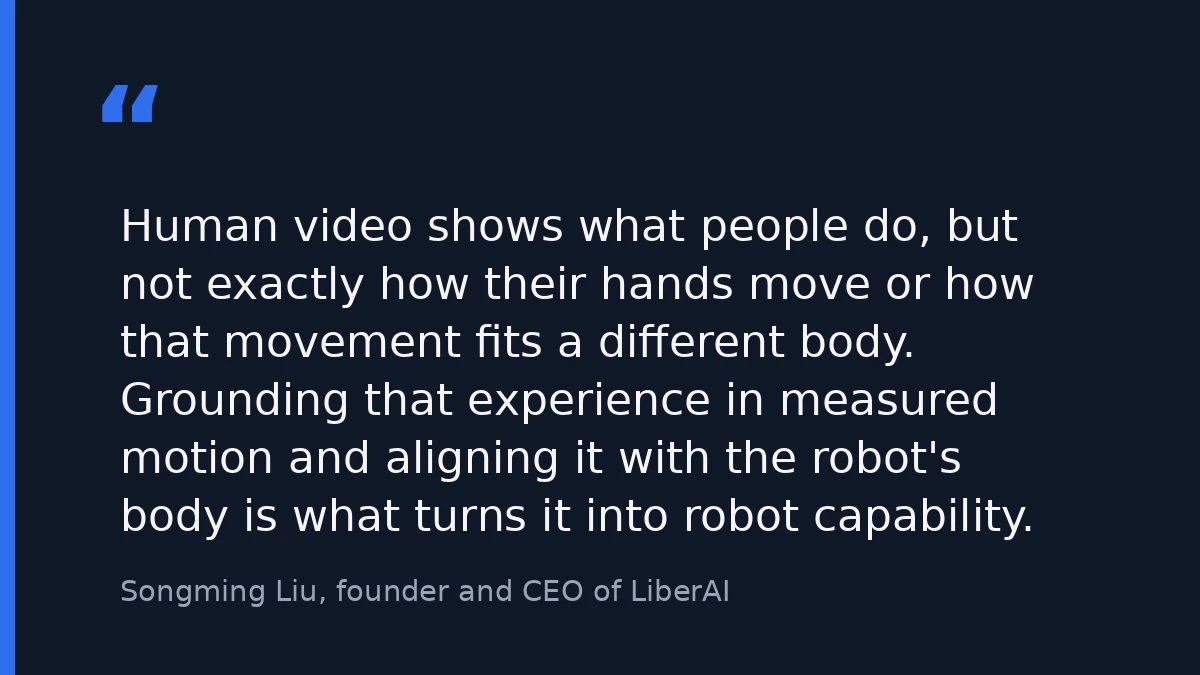
“Human video shows what people do, but not exactly how their hands move or how that movement fits a different body,” said Songming Liu, LiberAI’s founder and CEO. “Grounding that experience in measured motion and aligning it with the robot’s body is what turns it into robot capability.”
LiberAI also demoed application workflows, including autonomous boba tea preparation, and said its robot platform, LEO, uses dexterous hands, articulated wrists and waist, and camera configurations aligned with human data collection. On the roadmap: tactile and force sensing for the LiberSense Glove, which currently records hand poses and trajectories but not contact or force, plus data collection across more homes.
All figures are company-reported, and the ambitious part of the claim, that 2.2 million hours of human experience transfers usefully to robots, will need independent replication. But if glove-grounded pretraining keeps delivering these data savings, the economics of teaching robots new tasks could shift substantially.
Sources
- ACCESS Newswire: LiberAI Introduces Liber-0 for Zero-Shot Robot Manipulation (official company press release, November 4, 2026)
- LiberAI: official website
- The Robot Report: LiberAI Unveils Liber-0, a World Action Model That Grounds Human Experience in Robot Action (sponsored content by LiberAI)