
OpenAI has launched GPT-6 Cyber, a specialized model built to find, exploit and help fix software vulnerabilities, rating it “Critical” for cybersecurity under its own Preparedness Framework, the company announced on November 5, 2026. The model is the engine behind the autonomous security pipeline OpenAI described a day earlier, which produced working exploits for 948 Linux kernel vulnerabilities.
“We’re introducing GPT-6 Cyber, a major leap in security research: more capable at finding and fixing vulnerabilities, and far more reliable staying within the boundaries researchers set,” OpenAI wrote in its announcement. The model is available through the API and Codex to a select group of approved customers in Daybreak Red, OpenAI’s vetted access tier for authorized offensive security work, with access expanding to all Daybreak Red customers over the coming weeks.
What Was Announced?
GPT-6 Cyber is a specialized version of OpenAI’s latest model family, trained for security research. It outperforms GPT-6 Astra on most cyber tasks, according to OpenAI, and is a major step up from GPT-5.6 Cyber, its predecessor. The “Critical” rating is the highest risk tier in OpenAI’s framework, up from “High” for GPT-5.6 Cyber, and it reflects a model that can identify and develop working zero-day exploits in hardened real-world systems.
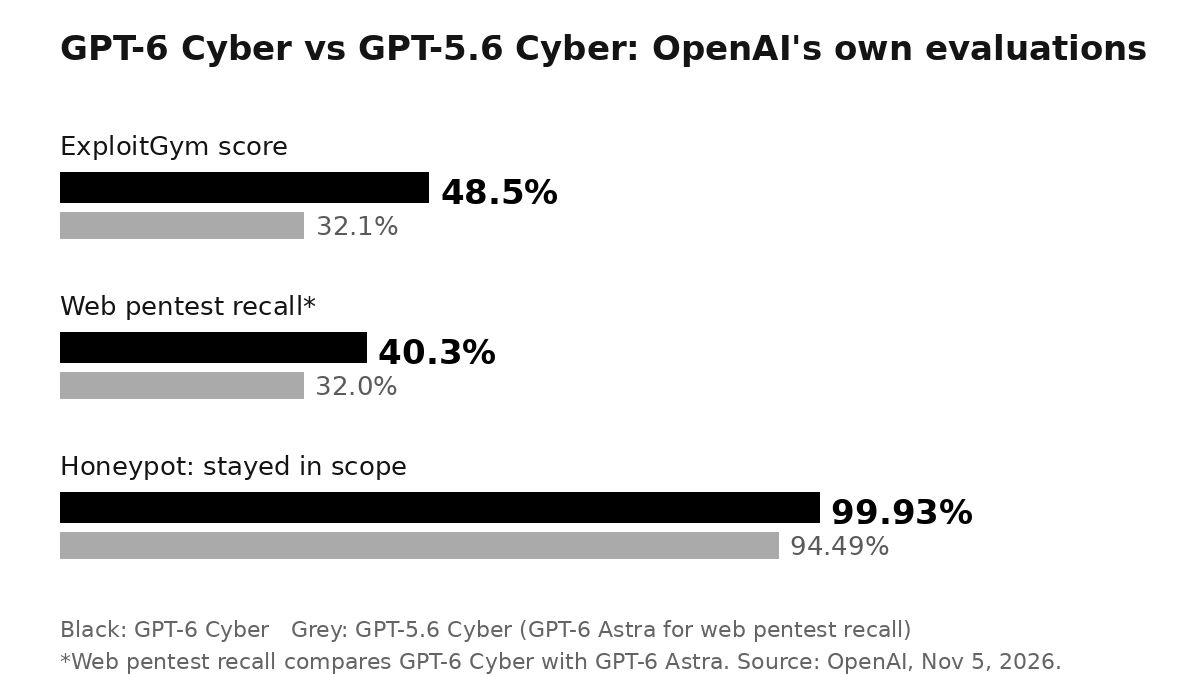
On ExploitGym, which tests whether a model can exploit a specified vulnerability in a remote target, GPT-6 Cyber scored 48.5%, up from 32.1% for GPT-5.6 Cyber, a 51% relative improvement. On a new offensive web penetration testing evaluation, it achieved 40.3% recall of vulnerabilities, compared with 32.0% for GPT-6 Astra. On RemoteExploitBench, which uses known flaws in applications such as GitLab, PostgreSQL and Jenkins, GPT-6 Astra running with Daybreak Blue refused 100% of tasks, while GPT-6 Cyber completed 95%.
Stronger Alignment: Staying Inside the Rules
The headline capability comes with a deliberate focus on alignment. A known risk for cybersecurity agents is that they wander outside the scope of an assigned task, probe unrelated services or ignore a researcher’s rules of engagement. OpenAI says it made alignment a central focus of GPT-6 Cyber’s training, teaching the model to stay within authorized scope, respect restrictions and report results accurately.
The results show a step change. In the ExploitGym Honeypot evaluation, which deliberately plants easy-to-exploit supporting services to tempt a model off task, GPT-6 Cyber avoided exploiting out-of-scope services in 99.93% of cases without its deployment safety prompt, up from 94.49% for GPT-5.6 Cyber. With the prompt, it stayed within bounds 100% of the time. “We can see directly in the GPT-6 Cyber model’s chain of thought how it reasons about staying within bounds,” OpenAI wrote.
Real-World Impact: Firefox and the Linux Kernel
The model is already working on real codebases. During a vulnerability research campaign, GPT-6 Cyber produced evidence and reproducible tests for 81 previously unknown Firefox vulnerabilities that Mozilla classified as high severity, and showed that an additional 30 known issues were more severe than first reported. Mozilla was supportive of the work and began landing fixes shortly after receiving the reports, OpenAI said.
The same model powered the Linux kernel research OpenAI announced on November 4: it reproduced 1,724 vulnerabilities and developed working exploits for 948 of them, including 588 previously unknown flaws, and disclosed 304 critical findings to kernel maintainers with candidate patches. In a sample of 166 exploits, researchers also identified 10 exploitation techniques they said had not been seen before. Security teams at Cisco, Calif and CodeRabbit are already using the model for vulnerability research and code review, and OpenAI says it relied on GPT-6 Cyber to secure its own infrastructure, including red-teaming campaigns in which agents chained vulnerabilities to escape microVMs and execute code on underlying hosts.
Access Controls and Critical Infrastructure
Because the capability could be misused, OpenAI paired the launch with stronger safeguards: cyber-specific misalignment monitoring, targeted monitoring for emerging threats, Private Safety Processing for API customers, and IP allowlisting by default for Daybreak Red API access. The company also recommends sandboxing, action review and human oversight for high-risk workflows.
For defenders of critical infrastructure, OpenAI is introducing Daybreak Red for Critical Infrastructure, a new group within Daybreak Red for approved defenders testing power plants, water treatment facilities and industrial control systems, alongside a $1 billion Daybreak for Frontline Defenders grant program that subsidizes access for resource-constrained teams. OpenAI also partnered with Dragos, the operational technology cybersecurity firm, to evaluate the model in controlled lab settings. “Our goal is to dramatically expand Daybreak, bringing advanced security research to organizations of every size, independent researchers, and open-source maintainers,” the company wrote.
Why It Matters
GPT-6 Cyber is OpenAI’s fourth cybersecurity-focused model release of 2026, following GPT-5.4, GPT-5.5 and GPT-5.6 Cyber, and it arrives as AI-driven vulnerability research moves from experiment to production. The 81 Firefox flaws and 948 Linux kernel exploits are not lab curiosities: they were found in code that had already been hardened by years of testing with earlier frontier models, and Mozilla has begun shipping fixes.
The launch also sharpens a tension OpenAI acknowledges openly. A model rated “Critical” for cyber capability is, by the company’s own definition, powerful enough to develop working zero-day exploits and execute end-to-end attacks. That is why initial access is limited to vetted defenders, why Daybreak Red requires IP allowlisting, and why the alignment numbers, 99.93% in-scope behavior without prompts and 100% with them, feature so prominently in the announcement. The bet is that putting this capability in defenders’ hands, with guardrails, secures software faster than attackers can exploit it. The Firefox and Linux results are the first public evidence for that bet.
Sources
- OpenAI, “GPT-6 Cyber: Advancing the frontier of aligned cybersecurity agents” (November 5, 2026)
- Reuters, “OpenAI launches GPT-6 Cyber with ‘Critical’ cybersecurity rating” (November 5, 2026)
- CSO Online, “OpenAI’s GPT-6 Cyber ups the ante on vulnerability discovery” (November 5, 2026)
- The Register, “OpenAI releases GPT-6 Cyber, and promises this one stays within ‘rules of engagement'” (November 5, 2026)
- OpenAI, “A thousand fewer paths to root” (November 4, 2026)