The U.S. Department of Justice is examining whether the Nvidia Hugging Face acquisition, valued at $12.93 billion, would give the chipmaker unfair control over a critical distribution point for artificial intelligence, Reuters reported on Wednesday, citing two people familiar with the matter.
According to the report, DOJ officials have asked whether the deal would let Nvidia “capture a fundamental distribution point for AI,” putting the industry’s central hub for open-source models at the center of an antitrust inquiry that has been building for years.
What the DOJ Is Asking
The department’s recent questioning covers Nvidia’s acquisitions, investments and sales practices, and whether the chip designer has exerted pressure on its customers, the two sources told Reuters. On Hugging Face specifically, officials want to know whether Nvidia could use the platform to disadvantage rivals, or wield it as leverage in negotiations. Officials also asked about Hugging Face’s competitors.
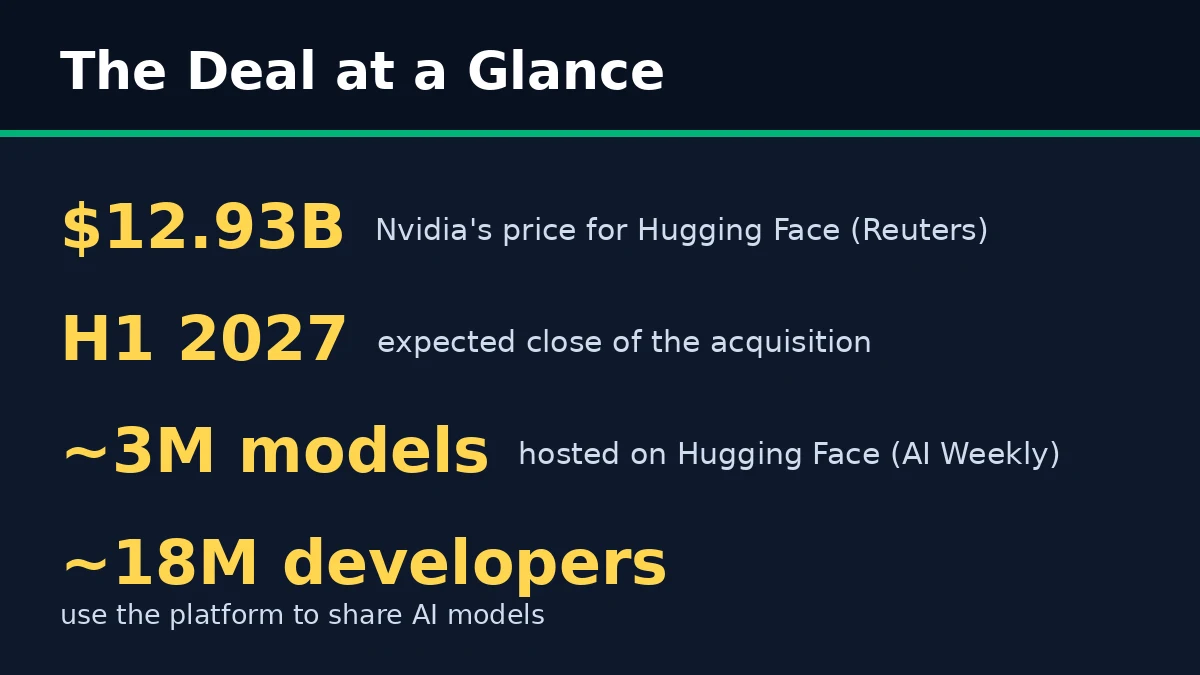
The scrutiny lands on a platform of enormous scale: Hugging Face hosts roughly 3 million open-source models used by about 18 million developers, according to AI Weekly’s summary of the reporting, making it the de facto distribution layer where AI models from rival companies reach the world.
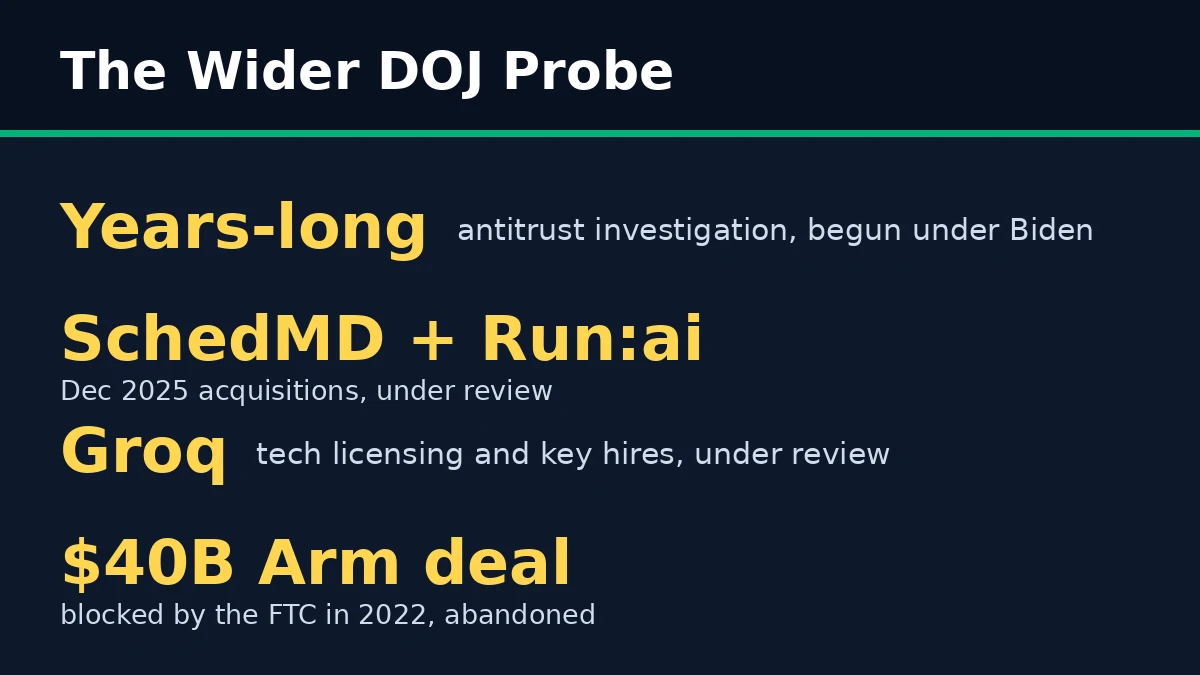
The review is broader than the single deal. Per Reuters and the Seoul Economic Daily, DOJ staff are also looking at whether Nvidia allocated more AI chips to customers that bought networking equipment together with Groq processors, following a 2025 arrangement in which Nvidia licensed Groq’s technology and hired its key engineers rather than buying the company outright. Nvidia’s December 2025 acquisitions of supercomputing software firm SchedMD and Run:ai are under review as well.
How Nvidia and the DOJ Responded
A DOJ spokesperson declined to comment on any matters before the department, citing longstanding policy, while adding that the department under President Trump’s leadership “will continue to prioritize advancement of Super Intelligence for the betterment of the American people.” Nvidia declined to comment, and Hugging Face representatives did not respond to Reuters’ request for comment.
When Nvidia announced the acquisition, it said Hugging Face would continue to support work with a range of chip, cloud and AI providers and would remain open to the entire AI ecosystem. Nvidia has said the deal is expected to close in the first half of 2027.
Reuters noted that the inquiry extends an investigation that began under former President Joe Biden and has carried into the Trump administration, with no indication that Trump intervened. CNBC also corroborated the reporting with its own source.
Why It Matters
Nvidia has become the cornerstone of the AI economy, supplying the chips that train and run the world’s leading AI systems while investing across the sector, backing players such as Anthropic and OpenAI. Any DOJ action could ripple through the chip industry and challenge the investing and acquisition strategy that has extended Nvidia’s influence from hardware into software distribution.
The market noticed: Nvidia shares slipped 0.7% in premarket trading on Thursday, extending a 1.2% drop on Wednesday, Barron’s reported, as investors weighed regulatory risk on top of existing worries about AI spending and debt.
There is precedent for Nvidia’s ambitions running into antitrust walls: the FTC sued in December 2021 to block its $40 billion deal for Arm, and Nvidia abandoned the acquisition in 2022. Reuters emphasized that government investigations are not evidence of wrongdoing and do not necessarily result in lawsuits.
Sources
- Reuters: US DOJ is inquiring about Nvidia’s purchase of Hugging Face, sources say
- Seoul Economic Daily: U.S. Justice Department Probes Nvidia’s Hugging Face Deal Over AI Competition
- Barron’s: Nvidia Stock Slips as Competition Probe Presents New AI Concern
- AI Weekly: Nvidia’s $12.93B Hugging Face Deal Draws DOJ Antitrust Probe