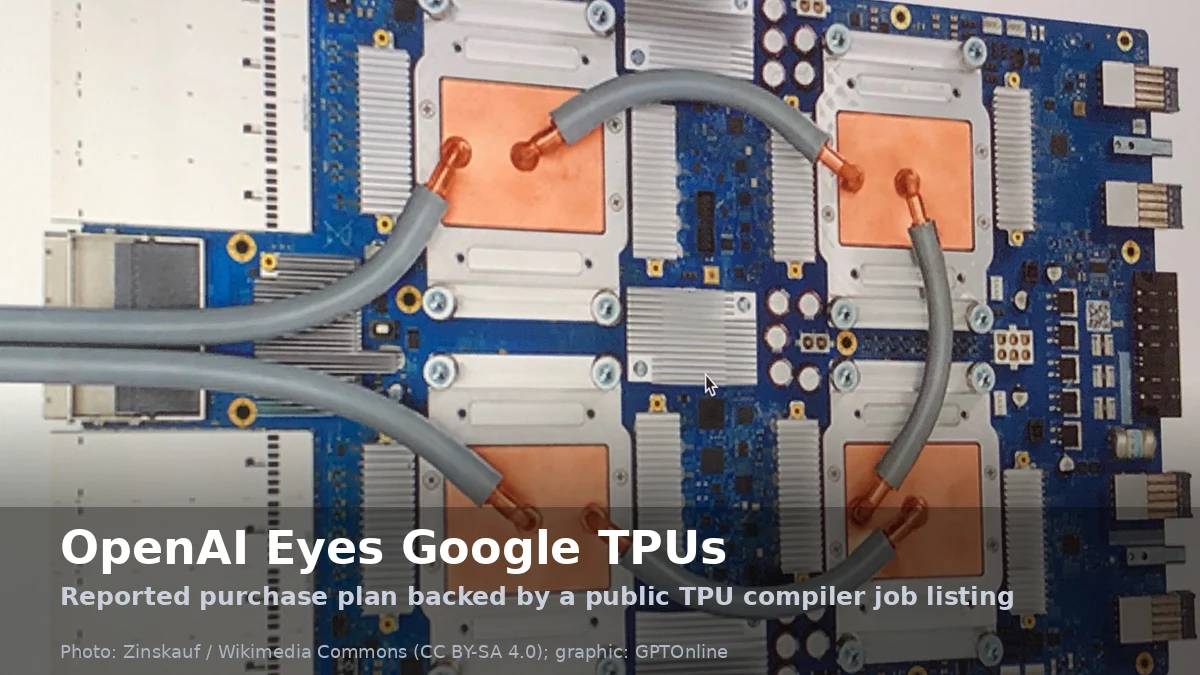
OpenAI plans to buy artificial intelligence chips directly from Google, moving from renting its rival’s tensor processing units to owning them, The Information reported on Oct 27, 2026, citing a person familiar with the matter.
The report, also carried by Reuters, says OpenAI wants to diversify its chip supply beyond Nvidia, which has long been its most important silicon supplier. Neither OpenAI nor Google has confirmed the plan; OpenAI declined to comment and Google did not respond, according to the coverage. Financial terms, chip quantities and delivery dates remain unknown.
The Job Listing That Backs the Report
The clearest public evidence sits on OpenAI’s own careers page, which carries an open role for a “Software Engineer, TPU Compilers” in San Francisco, posted on Oct 20, 2026. The listing states: “We’re looking for an engineer to lead the optimization of OpenAI’s state-of-the-art frontier models on TPUs.”
The role covers performance “across the full forward pass, from model code through kernels to execution on the hardware,” and calls out quantization as one lever for inference efficiency. That is the language of a structural investment, not a test drive.
From Renting to Buying
The move would escalate a relationship that only became public last year. Reuters reported in June 2025 that OpenAI had begun renting Google’s TPUs through Google Cloud to run ChatGPT and other products, its first meaningful use of non-Nvidia hardware. At the time, OpenAI said it had no specific plans to use TPUs at scale, and Google was not renting its most powerful TPUs to OpenAI.
Buying outright would give OpenAI direct control over a slice of its compute capacity instead of a short-term patch for peak demand. Google has meanwhile started selling TPUs directly to some customers this year, turning a technology long kept in-house into a product line. Seoul Economic Daily also reported that Oracle would become the first major cloud provider outside Google to lease TPUs to customers.
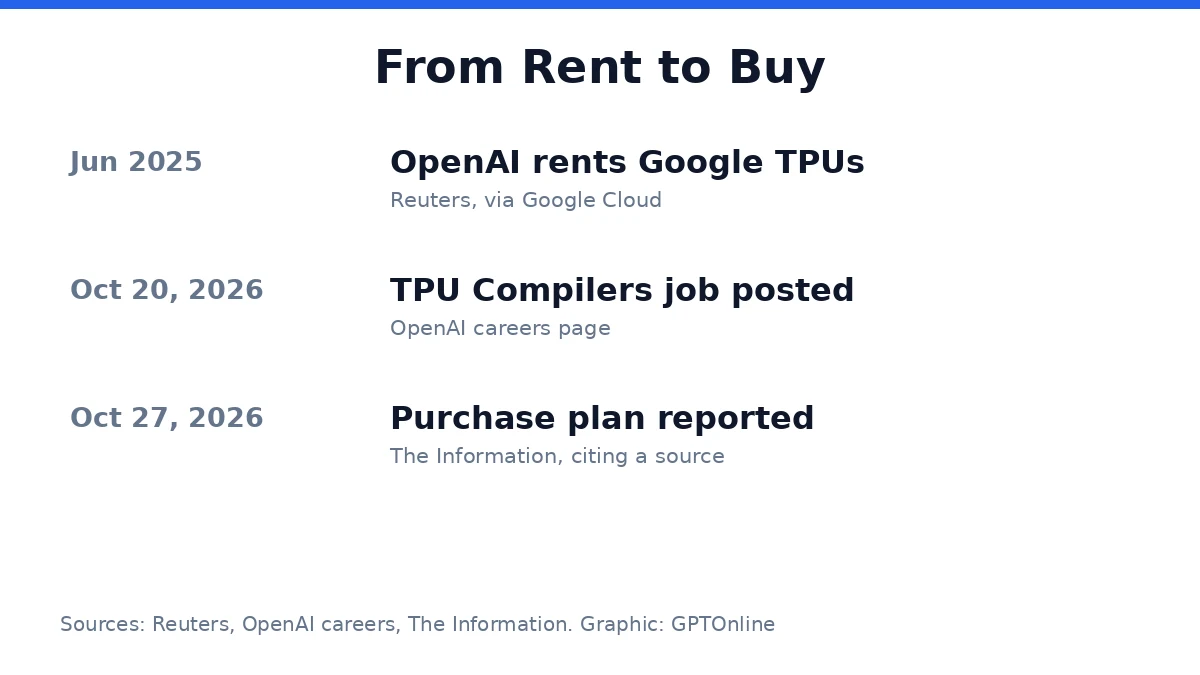
Timeline: from TPU rental to a reported purchase plan. Sources: Reuters, OpenAI careers, The Information. Graphic: GPTOnline
Why It Matters
The hiring pattern points the same way. OpenAI appointed Richard Ho, who spent nearly nine years at Google and led development of its Cloud TPUs, to run its hardware division. A compiler team for TPU optimization would presumably sit inside that organization, building the software bridge between OpenAI’s models and Google’s silicon.
The TPU plan is the latest piece of a broader multi-chip strategy. OpenAI already rents Google TPUs, has a custom chip effort with Broadcom reportedly targeting deployment by the end of 2026, and an AMD deal. Nvidia remains a key partner: in September 2025 it signed a letter of intent to invest up to $100 billion as OpenAI deployed at least 10 gigawatts of Nvidia systems. But inference, the everyday computing used to answer user prompts, is where efficiency matters as much as raw speed, and it is where OpenAI’s costs are most sensitive to volume.
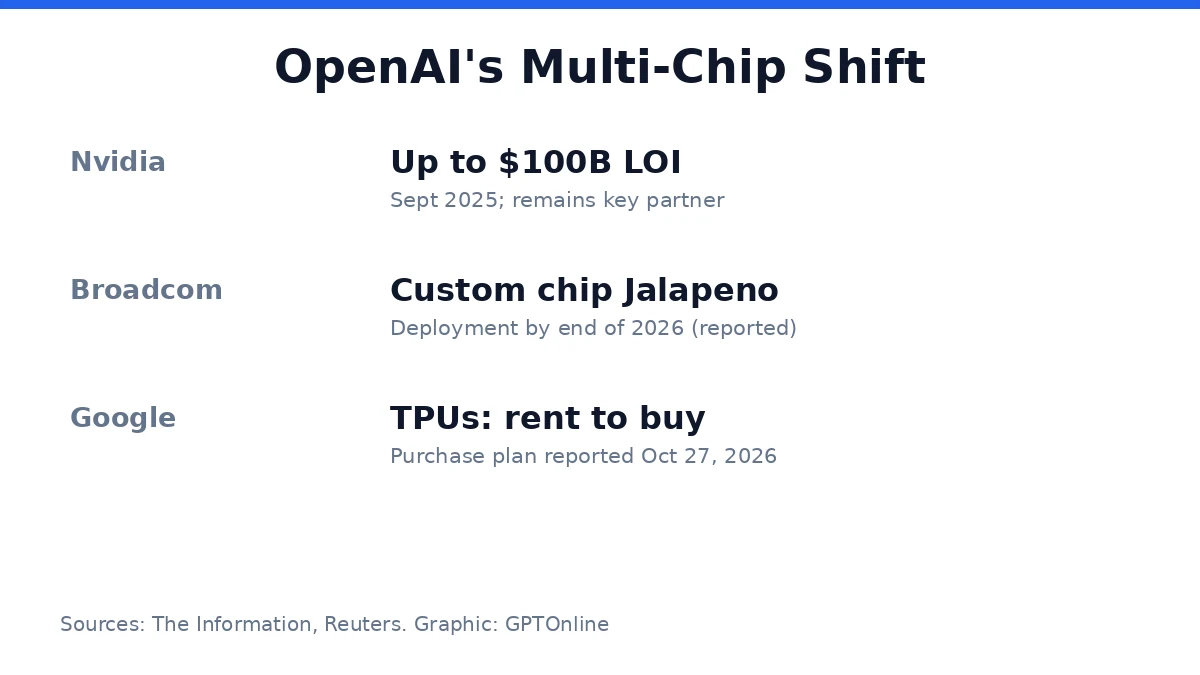
OpenAI’s multi-chip strategy is widening beyond Nvidia. Sources: The Information, Reuters. Graphic: GPTOnline