Nvidia is in advanced talks to acquire Inception, the startup behind the Mercury family of diffusion language models, in a deal worth more than $500 million plus performance based earnouts. The Information reported the talks on November 19, citing three people familiar with the matter.
The report lands at a turbulent moment for Nvidia. The talks began before Jensen Huang resigned as chief executive, according to The Information, and the company is now led on an interim basis by Colette Kress. Buying Inception would give Nvidia a team and a technology built for speed at a time when inference costs, not just training scale, decide who wins enterprise AI workloads.
What Inception Builds
Inception develops diffusion large language models, a different architecture from the autoregressive models behind ChatGPT and Claude. Instead of generating text one token at a time from left to right, a diffusion model refines many tokens in parallel over several passes, which can make it much faster for many tasks.
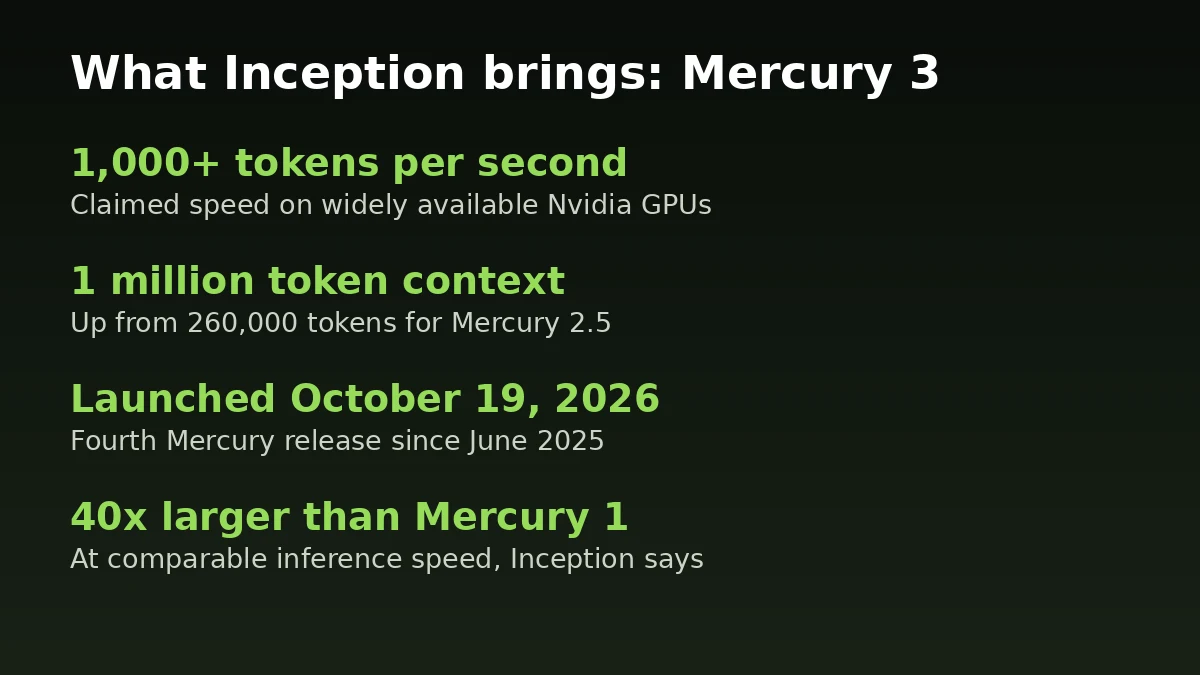
Its latest model, Mercury 3, launched on October 19. Inception says the model generates more than 1,000 tokens per second on widely available Nvidia GPUs, supports a 1 million token context window, and is more than 40 times larger than the original Mercury 1 while running at comparable speed. The company also claims Mercury 3 matches or beats frontier speed optimized models such as GPT-6 Luna and Claude Haiku 5.5 on quality. Those benchmark claims come from Inception itself and have not been independently verified.
What We Know About the Talks
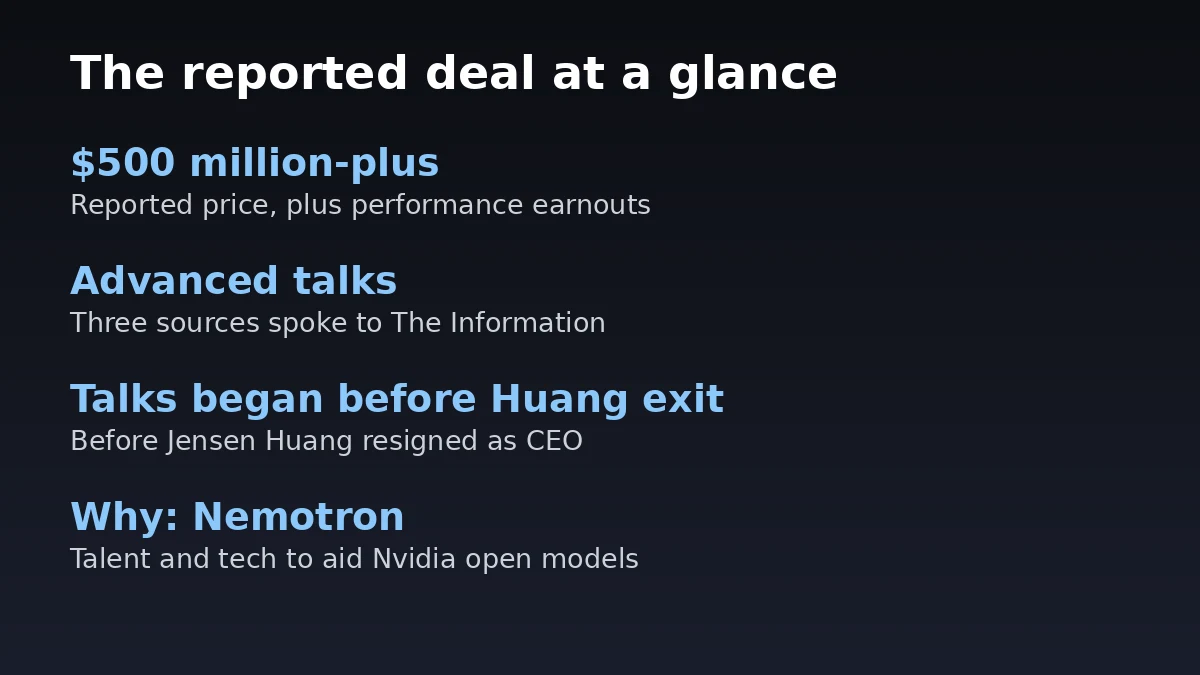
The deal under discussion is valued at at least $500 million, with additional performance based bonuses for new employees tied to meeting specific targets, according to the report. Reuters carried the same headline on November 19, confirming the story had reached the wires within hours.
One person familiar with the matter told The Information that Inception’s diffusion model and the technical talent behind it could help Nvidia develop its Nemotron family of open source models. Nemotron is Nvidia’s open model line, and adding diffusion expertise would give it a speed story that its current autoregressive models do not have on their own.
The report describes talks, not a signed deal. No announcement has followed from either company, and advanced talks can still fall apart over price, terms, or regulatory review. Inception was founded about two years ago, which makes a $500 million plus exit a fast one for a startup whose first commercial model only arrived in 2025.
Why It Matters
For Nvidia, the logic is about owning more of the AI stack. The company already sells the GPUs that run almost every large model, and it has been investing in and acquiring AI startups at a rapid pace. Owning a diffusion model team would let it pair its hardware with a model architecture designed to run fast on that hardware, and to offer customers an alternative to the autoregressive models built by OpenAI, Anthropic, and Google.
For the wider market, the talks are another sign that diffusion models have moved from research curiosity to acquisition target. Google previewed Gemini Diffusion in 2025, and several labs are now exploring the approach. If Nvidia closes the deal, diffusion could become a standard option in enterprise AI deployments rather than a niche for speed obsessed developers.
The open question is what Nvidia would do with Mercury once it owns it. Keeping it open and available through existing channels would strengthen Nemotron, while folding it into Nvidia’s own inference products could make the technology harder for rivals to use. Either way, a deal at this price would confirm that inference speed is now worth paying for.
Sources
- The Information, “Nvidia Nears Acquisition of Diffusion AI Developer for More Than $500 Million,” November 19, 2026
- Reuters via TradingView, “Nvidia Nears Acquisition Of Diffusion AI Developer Inception For More Than $500 Million,” November 19, 2026
- Business Wire, “Inception Launches Mercury 3, Setting a New Pareto Frontier in Speed and Intelligence,” October 19, 2026