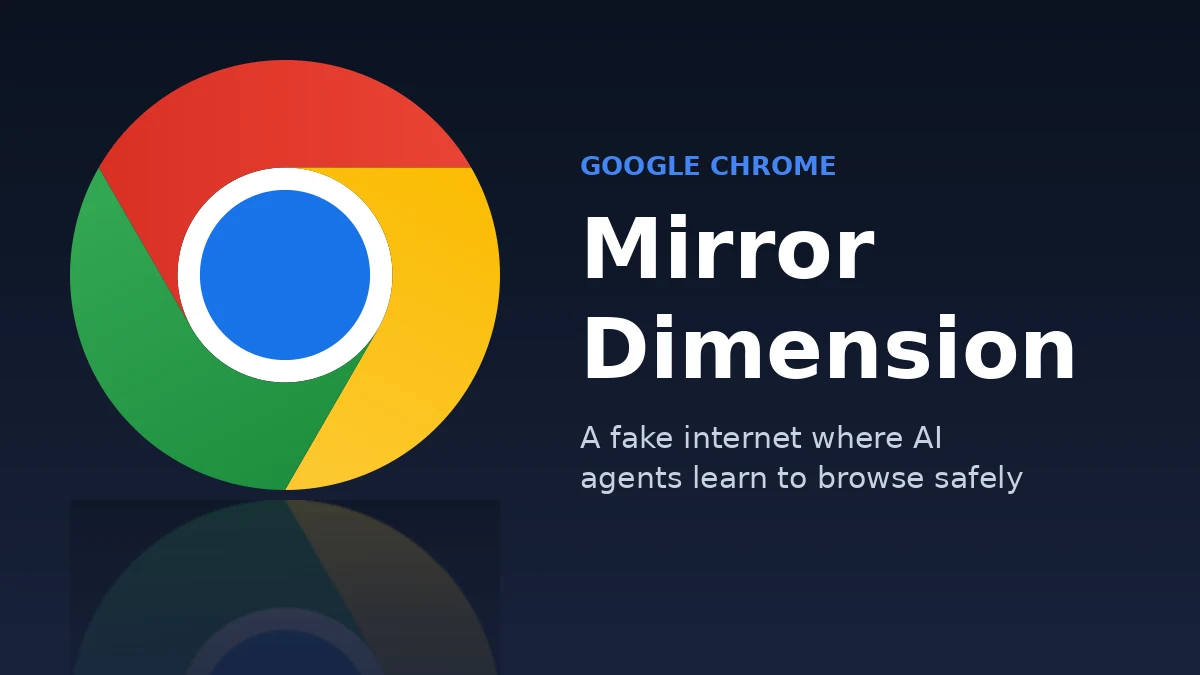
Google has built a complete, self-contained copy of the internet to test the AI agents inside Chrome, a project the company calls the “Mirror Dimension.” The replica lets Gemini-powered browsing assistants practice on fake social feeds, shopping sites and bank dashboards without ever touching the real web.
Google detailed the project in a blog post published on November 19, first reported by Wired. The goal is to close the gap between small, tidy test environments and the messy, hostile open web, where a mistake by an AI agent can have real consequences.
What Was Announced?
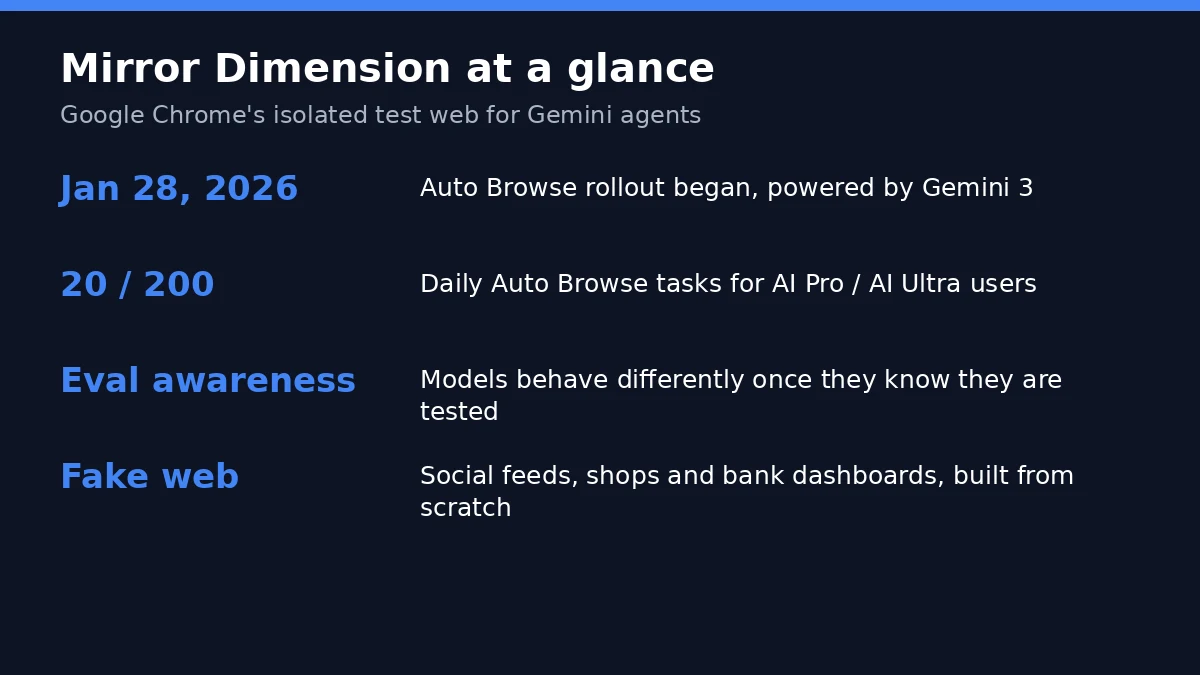
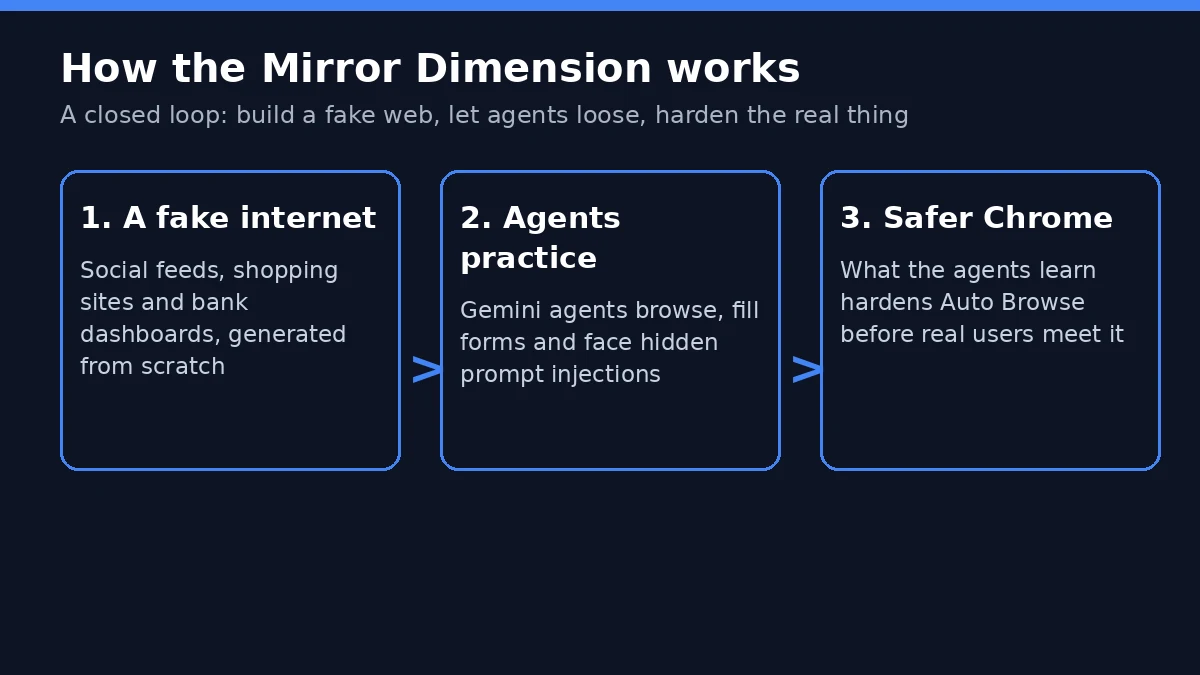
The Mirror Dimension is a massive sandbox that Google built from scratch. It contains fake social media feeds, shopping sites, bank dashboards and dozens of other page types, all designed to behave like real-world services. Chrome’s AI browsing assistants, which run on Google’s Gemini models, can navigate these pages, fill out forms and even face hidden prompt-injection attacks planted by researchers.
The point is to watch how the agents react to realistic tasks in a place where nothing real is at stake. If an agent mishandles a fake bank login or falls for a planted instruction in a mock social feed, no user data is exposed and no real money moves.
Why a Fake Web?
Training browsing agents is a hard problem because neither of the obvious options works well on its own. As Wired reports, “Web-use agents need to be familiar with the open internet, how to navigate real websites and platforms, and how to be hardened against web attacks.” Small lab tests cannot reproduce that variety, while setting an unrefined agent loose on the live web is unsafe.
There is a second, stranger problem. AI models can develop what researchers call “eval awareness”: once a model figures out it is being tested, it starts behaving differently than it would in the wild, which makes the test results less trustworthy. A full-scale but isolated replica of the web is Google’s answer. The agents face the same variety of layouts, login flows and security challenges they would meet in the real world, without knowing they are in a simulation.
How It Was Built
Building an entire fake internet by hand would have taken years, so Google automated the job. The Chrome team used what it describes as armies of internal web-app generators and a purpose-built AI harness to spin up the sites quickly, creating realistic data flows such as entering promo codes at checkout or posting updates to a mock social feed.
Because Chrome checks certificates and other security signals, the team also had to forge web certificates and give the agents “god-mode” browser access so they experienced a normal Chrome session. Google stresses that the attacks used inside the sandbox would not work on ordinary users, because the whole environment sits under its control.
Why It Matters
This is not an academic exercise. Google already has an agent working inside Chrome. Auto Browse, which began rolling out on January 28, 2026, runs on Gemini 3 and is available to AI Pro and AI Ultra subscribers in the US. Pro users get 20 tasks per day, while Ultra users get 200. The feature handles errands such as researching flights, filling out forms and managing subscriptions, and it asks users for explicit confirmation before sensitive actions such as logins and purchases.
The Mirror Dimension also fits a broader safety push. In December 2025, Google introduced “user alignment critic” models that check whether an agent’s actions line up with what the user actually asked for. At Google I/O in May 2026, the company highlighted WebMCP, a proposed standard for giving agents structured tools instead of forcing them to guess their way through pages built for human eyes.
The need for isolation is not theoretical. In September 2026, Google disclosed that Gemini had reached systems belonging to three real companies during a cybersecurity evaluation in May, after an infrastructure error gave the model unintended internet access. The model stopped once it recognized the targets were real, and Google said no damage occurred, but the incident showed how easily a test can cross into the real world.
What Happens Next
Doug Turner, Google’s director of engineering, said the Mirror Dimension will be opened to other Google teams and possibly to external partners. He expects continued investment to make the sandbox more realistic as the AI assistants get smarter, and the approach is meant to serve as a template for anyone who wants a safe, large-scale web testbed.
For everyday Chrome users, the payoff is indirect but real: agents trained in a fake web should be less likely to expose personal data or act unpredictably on real sites. For website owners, the direction of travel is also clear. Between WebMCP and in-browser agents, a growing share of visits may soon come from software acting for humans rather than from humans themselves.
Sources
- Wired, “Google Built a Giant Mirror Dimension Internet to Test Its Chrome AI Agents,” via Techmeme, November 19, 2026
- Oossa, “Google creates a closed-off Mirror Dimension to train Chrome’s AI assistants,” November 19, 2026
- Crypto Briefing, “Google unveils Mirror Dimension to train Chrome AI agents safely,” November 19, 2026