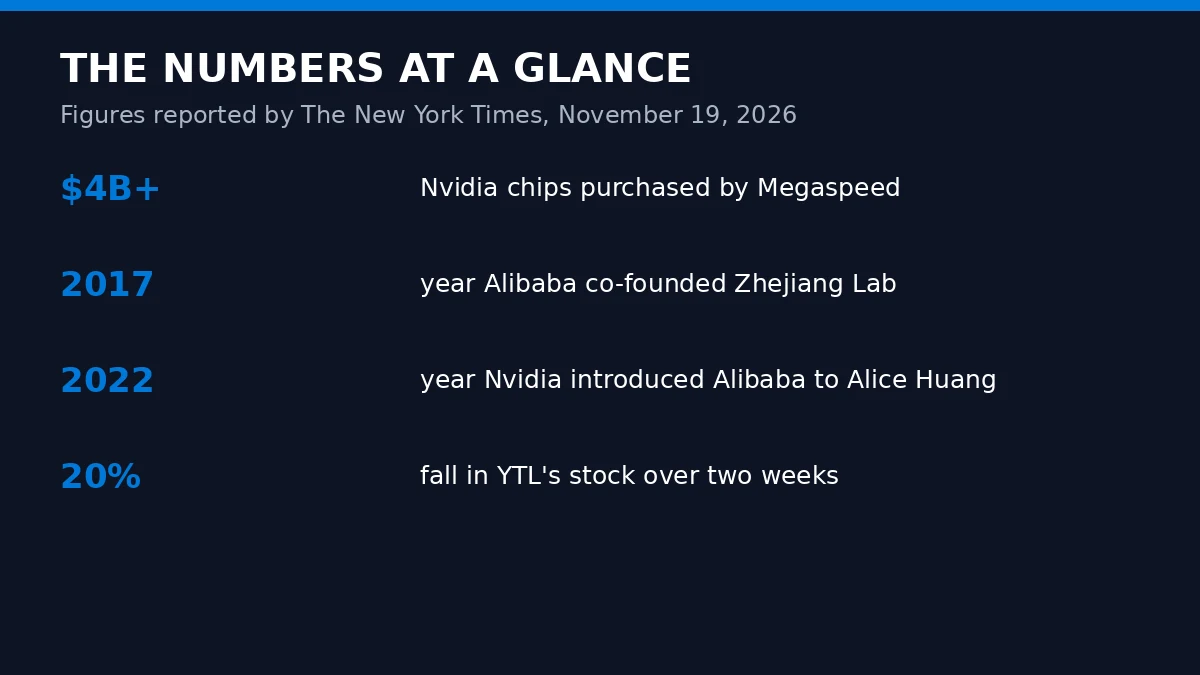
Alibaba was the customer and financial backer behind Megaspeed, the Singapore firm that bought more than $4 billion in Nvidia chips, according to a New York Times investigation published November 19. The arrangement put some of the world’s most powerful AI chips within reach of Zhejiang Lab, a military-linked AI lab Alibaba co-founded, in a supply chain that often circumvents US efforts to keep those chips out of China’s reach.
The story starts in 2023, when Alice Huang and her husband, Kang Wei, pitched investors in Shanghai on building an AI business in Southeast Asia. The couple boasted about Ms. Huang’s relationship with Jensen Huang, then Nvidia’s chief executive, saying it would guarantee a supply of powerful chips, and hinted at a deep-pocketed customer that would pay for access. The company created after those pitch sessions was Megaspeed. Its customer and financial backer turned out to be Alibaba, according to three people familiar with the relationship, the Times reported.
One step from a military-linked lab
Alibaba co-founded Zhejiang Lab in 2017, an AI lab with strong ties to China’s military, where researchers have worked on automating cyberattacks and simulating war games. The lab’s current director, Wang Jian, was Alibaba’s chief technology officer and has had a long friendship with Jensen Huang. In 2025, Huang spoke onstage with Wang in Beijing and called him “an incredible hero,” weeks after Wang became an expert adviser to the People’s Liberation Army’s National University of Defense Technology, an institute blacklisted by the United States in 2015.
The Times was careful about what it could not prove. Whether Nvidia chips supplied by Megaspeed went from Alibaba to the lab is unclear, the paper wrote. But the ties show how advanced computing reaches sensitive Chinese institutions through layers of contractors and resellers. The Times said the arrangement raises the possibility that Megaspeed is providing Nvidia chips to support research for China’s military, which would violate US law.
Zhejiang Lab’s work illustrates the stakes. One area of focus was combining AI with hacking techniques, according to a job posting, and other topics included remote sensing, automated cyberdefense and vulnerability identification, and information campaigns. A postdoctoral researcher affiliated with the lab co-wrote a paper with scientists at a Chinese air force academy on war-gaming attacks against a foreign aircraft carrier group. Some of the lab’s work has run on Nvidia chips, and Nvidia researchers have even copublished studies with Zhejiang Lab authors.
Alibaba pushed back. “Any suggestions that Alibaba provides services to the military is groundless. Alibaba Cloud’s service agreement strictly prohibits the use of our products and services for any military purpose,” an Alibaba spokeswoman wrote. In June, the company sued the US government after the Pentagon put it on a list of companies it said are contributing to China’s military. The case is ongoing.
How the chips flowed. Graphic: GPTOnline
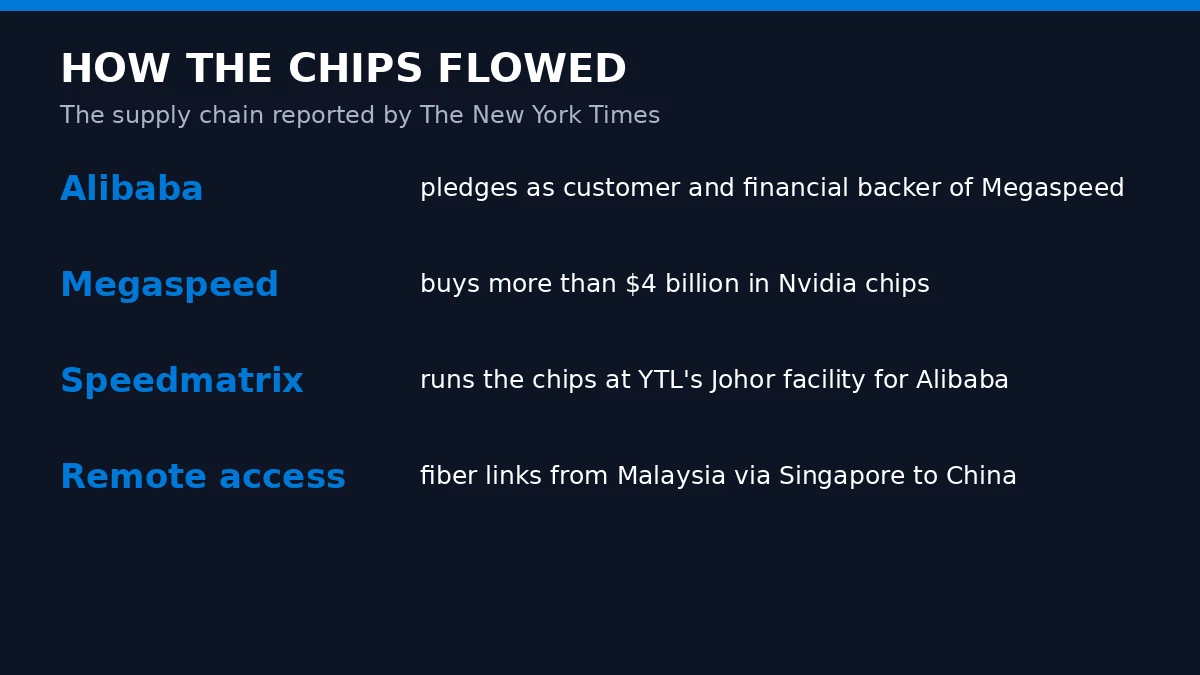
How the chips flowed
The mechanism, as described by people familiar with the development, was straightforward. First, Alibaba would pledge to be a customer of a regional company like Megaspeed. Then Megaspeed would use that agreement to raise money from investors to buy Nvidia chips. After securing the chips, Megaspeed struck deals with companies like YTL that built data centers to operate them. Sometimes, the people said, chips bound for the data center were smuggled into China. Once the facilities were running, Alibaba and its customers could access the Nvidia chips remotely, with fiber optic cables sending data from the Malaysian data center to an internet hub in Singapore, which then links to China through undersea cables.
At the YTL facility in Johor, Malaysia, Megaspeed’s subsidiary Speedmatrix operated Nvidia chips on behalf of Alibaba, according to five people familiar with the project. Computer systems running on YTL’s network at the facility also bear Alibaba’s name, according to an infrastructure analysis by InfraWatch, an intelligence firm. YTL did not respond to requests for comment.
The pattern extends beyond one company. Other Chinese tech giants have created similar arrangements, and data center companies including DayOne, Bridge Data Centers and Aolani provide computing power to customers based in China.
Fallout for Nvidia and the export rules
The investigation lands as Nvidia is convulsed by the scandal. Jensen Huang resigned last week after revelations of an affair with an employee, weeks after reports emerged of his relationship with Alice Huang, whom US officials describe as an asset for Chinese intelligence, and the US government is investigating whether Megaspeed smuggled chips into China. In 2022, Nvidia’s sales team introduced Alibaba to Alice Huang, according to a person familiar with the relationship, an introduction first reported by The Information. Nvidia spokesman John Rizzo said the company works “to comply with the evolving rules regarding cloud services.” Megaspeed chief executive James Tan declined to comment on the connections, saying the matter remains under independent review.
Washington has already moved to close the loophole. American officials recently strengthened export rules to prevent companies like Alibaba from remotely accessing Nvidia’s chips, and the Commerce Department issued a rule requiring licenses for data centers that rent large amounts of advanced computing power to Chinese firms. The scrutiny is already biting: YTL’s stock price fell about 20 percent over two weeks. And if things go bad for Megaspeed, Alibaba put a contingency in place: a business agreement between an Alibaba subsidiary and Megaspeed pledges all servers, chips, intellectual property and other equipment back to Alibaba if Megaspeed fails to meet its contractual obligations.
The numbers at a glance. Graphic: GPTOnline
Why it matters
The investigation matters because it shows the export-control regime’s weakest point is not the border but the billing. Chips that cannot legally be sold to China can still be bought by a Singapore company, installed in a Malaysian data center and rented back to a Chinese customer by the hour, and the customer can be one step removed from a lab that war-games attacks on aircraft carriers. The Times based its reporting on hundreds of Chinese records and a dozen interviews with people close to the process.
Sources
- The New York Times, “How Nvidia Chips Ended Up Within Reach of China’s Military,” November 19, 2026 (full text via DNYUZ)
- Zubiqo, “Alibaba Backed Megaspeed’s Over $4B Nvidia Chip Buys Near China Military Lab, NYT Reports,” November 19, 2026
- Asian Value Investor, “U.S. Moves to Close Backdoor That Let China Use Top Nvidia Chips,” November 2026
- GPTOnline, “US Agencies Say Megaspeed Investigation Began in 2024 as Nvidia Chip Export Probe Widens,” November 17, 2026
- GPTOnline, “US Issues Rule to Block Remote Access to Advanced AI Chips,” November 16, 2026