

The Trump administration approved shipments of nearly 900,000 advanced AI chips made by Nvidia and AMD for Chinese companies over six months, the House Foreign Affairs Committee said on November 19. Reuters reported the disclosure, which puts rare public numbers on a licensing system that usually operates behind closed doors.
The approvals of AI chips for China covered December 2025 through May 2026. In that period, companies requested sales of 3.4 million AI chips to China, and the Commerce Department’s Bureau of Industry and Security approved more than 879,000 of them, according to the committee. The figures were released by the committee’s chair, Brian Mast, who said he had exercised his authorities under the Export Control Reform Act to make the license application information public.
Who Received the Chips
The committee broke out approvals for four of China’s largest buyers. Tencent received 150,000 semiconductors, Alibaba received 75,000, Baidu received 43,000, and BYD received 4,000. The four named companies account for 272,000 of the approved chips, with the rest going to other Chinese buyers the committee did not name.
The committee framed the disclosure as a transparency measure, but its statement carried a pointed charge. It said the findings included approvals for AI chip exports to “Department of War-designated Chinese Military Companies like Alibaba and Tencent,” using the administration’s new name for the Pentagon. The label puts the approvals in a sharper light: chips licensed for sale to companies the US government itself designates as military linked.
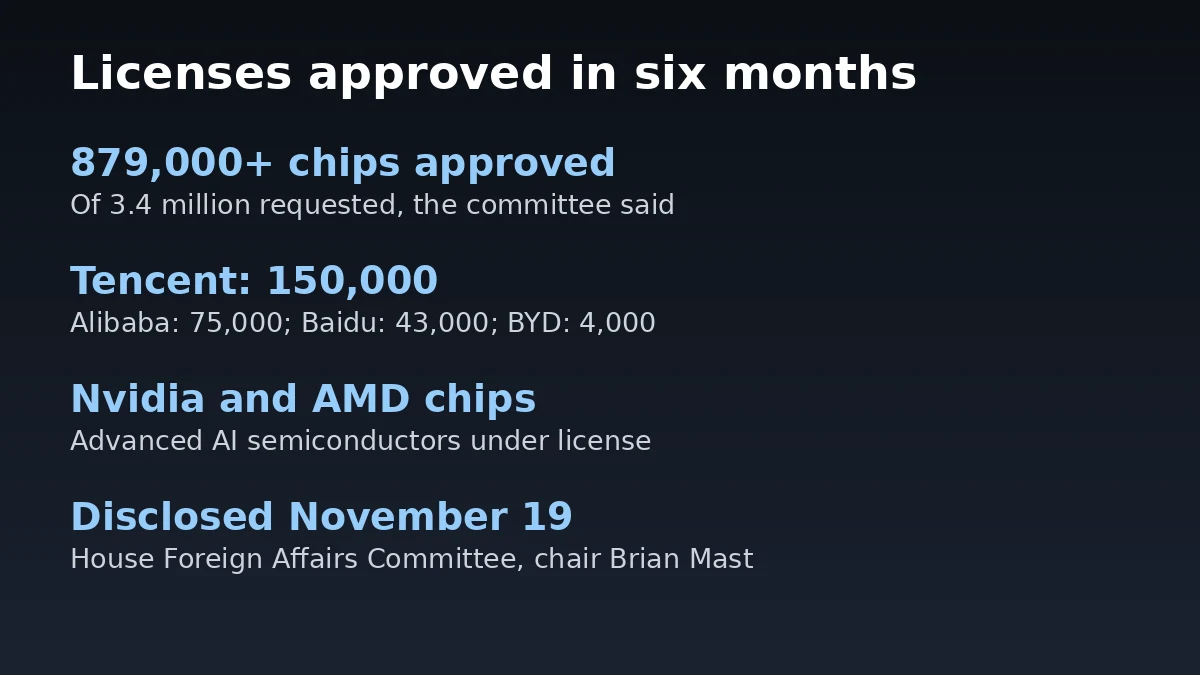
Graphic: GPTOnline. Licenses approved in six months, as disclosed by the House Foreign Affairs Committee.
Why the Disclosure Matters Now
The numbers arrive in the middle of a fast moving reversal in US chip policy toward China. Nvidia has already halted licensed Hopper chip shipments to China, a move disclosed on its November 17 earnings call, and new rules issued on November 16 tightened controls on remote access to advanced chips. The committee’s disclosure covers an earlier window, when the licensing tap was still open, and it shows how much hardware flowed through before the policy tightened.
Scrutiny of those sales is also rising in Congress. House Democrats opened an investigation into Nvidia’s China chip sales on November 13, and the committee’s release gives investigators and the public a concrete baseline: nearly 900,000 approved chips in six months, against 3.4 million requested. The gap between requests and approvals shows the system did refuse most applications, but the scale of what was approved is now on the record.
The disclosure does not say which Nvidia or AMD chip models were licensed, or how the approved chips were ultimately used. That leaves the central policy question open: whether licensed sales to large Chinese technology firms, including ones designated as military companies, advanced China’s AI capabilities in ways the export control system was meant to prevent. The committee’s numbers give that debate its first solid footing.

Graphic: GPTOnline. Why the disclosure matters now



[…] December 2025 and May 2026, although it was unclear how many were ultimately shipped. GPTOnline reported on that disclosure […]