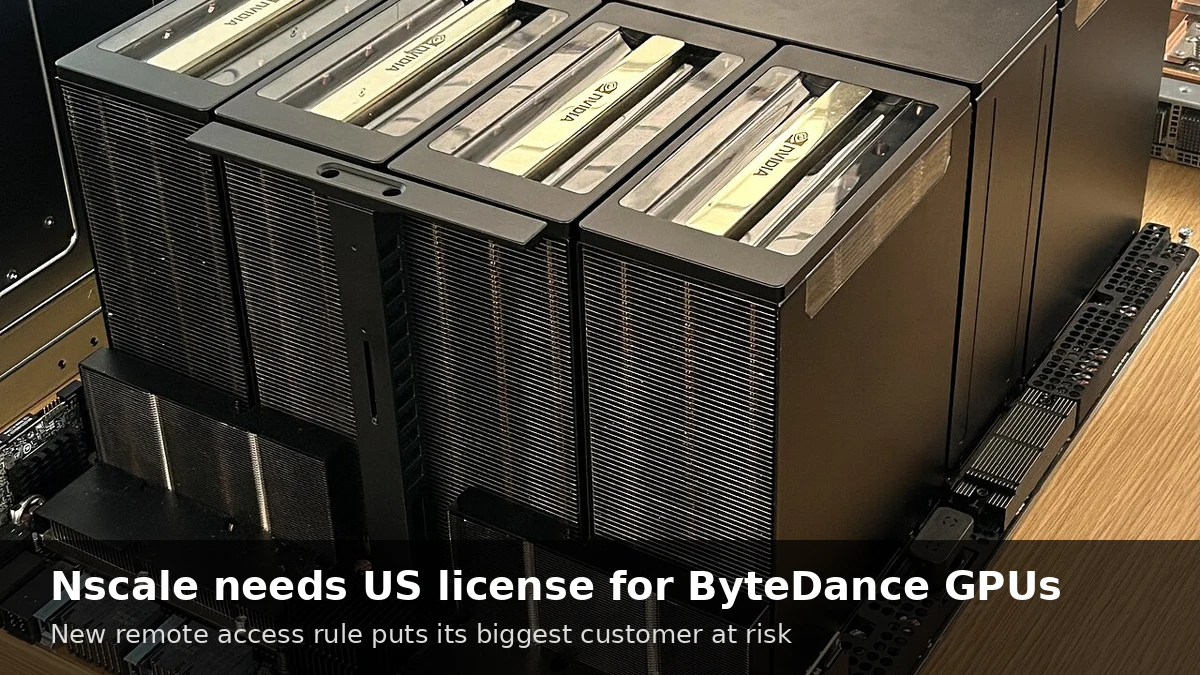
Nscale ByteDance GPU access is now subject to a US license requirement, after Washington’s new rule on remote access to advanced chips took effect this week. Bloomberg reported that Nscale, a UK cloud provider preparing for a New York listing, has 90 days to apply for a license to keep letting ByteDance use Nvidia GPUs in data centers in Iceland and Norway. The stakes are high: ByteDance accounted for about 73% of Nscale’s revenue in 2025.
The case is the first named test of a rule that closes one of the main routes Chinese companies have used to reach American AI chips without buying them. Instead of shipping hardware to China, a provider can rent computing power from a data center in a third country. Washington now says that arrangement needs a license too.
What the new rule requires
The US Commerce Department’s Bureau of Industry and Security announced the interim final rule, titled “Addressing Remote Access to Advanced Semiconductors,” on November 16. It was published in the Federal Register and took effect on November 19. Under the rule, a license is required when a data center gives a company headquartered in China or Macau access to more than 12 million aggregate TPP, a measure of total processing performance, at one site or across connected sites.
Data centers already providing that level of computing power to such customers must obtain a license within 90 days of the effective date to keep doing so, which puts the deadline at February 17, 2027. The rule also requires a license to export advanced AI chips to Malaysia, Singapore, Indonesia, Thailand and Brazil, which the bureau says present a higher than normal risk of diversion.
Why Nscale is exposed
Nscale signed an agreement in May 2025 that lets a ByteDance subsidiary in Singapore use 2,304 Nvidia B200 GPUs housed at Nscale’s data center in Glomfjord, Norway, according to reports on the Bloomberg story. The hardware stays in Norway while ByteDance taps the computing power remotely, which is exactly the setup the new rule targets.
Nscale generated $33 million in revenue in 2025, and the ByteDance unit accounted for about $24 million of it, the reports said. That concentration is the core of the problem: losing the customer, or failing to win a license, would remove most of the company’s revenue. Nscale declined to comment on the Bloomberg report and has said it is preparing for an initial public offering, having filed for a New York listing in September.
Nscale is also reviewing potential supply chain exposure to companies linked to the Entity List, the US trade blacklist, according to the same reporting.
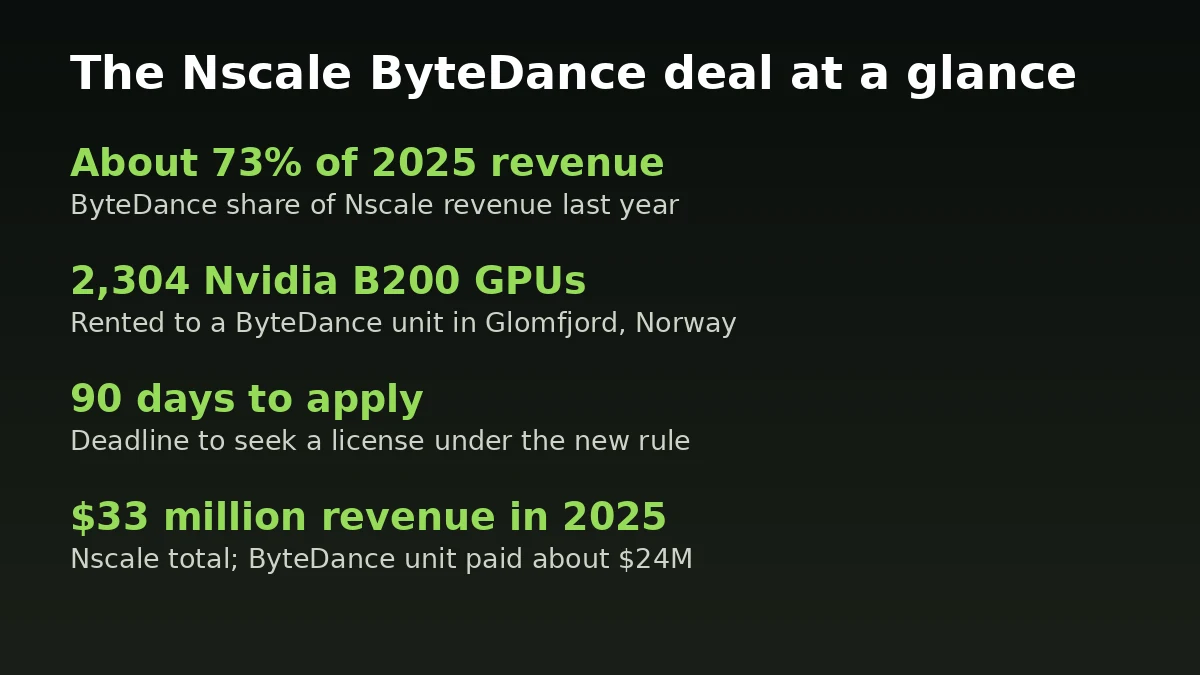
Graphic: GPTOnline. Figures from Bloomberg reports on the Nscale ByteDance arrangement.
A wider crackdown on remote access
Nscale is not the only company caught by the rule. Lenders have paused work on a $480 million loan to buy Nvidia GPUs that Singapore based Aolani Cloud planned to install in a data center in Malaysia for ByteDance to use remotely, Bloomberg reported earlier this week. Aolani said it is talking with regulators and financial partners so it can proceed in compliance with the new rule.
The rule landed in the same week that Nvidia itself pulled back from China. Interim chief executive Colette Kress told analysts on the company’s November 17 earnings call that Nvidia is no longer shipping licensed Hopper data center products to China, even though it sold $2.4 billion of those products to Chinese customers in the quarter ended October 25. “Our guidance does not have any licensed Hopper data centre products included, and we are no longer shipping licenced Hopper data centre products to China,” Kress said. She did not explain the decision or say whether it is permanent.
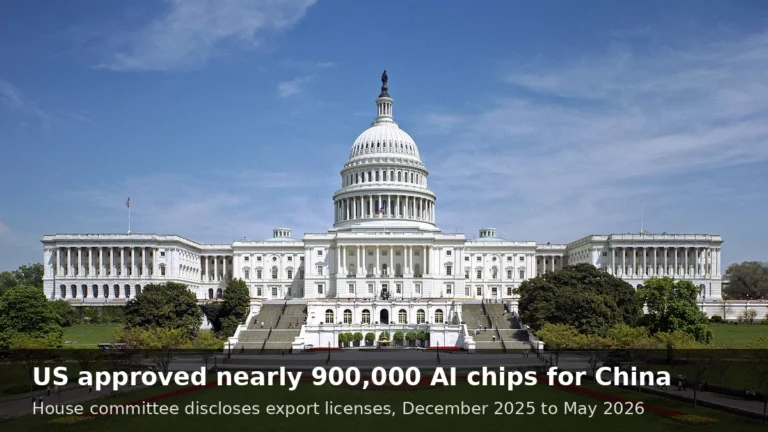
The pullback follows months of pressure over chip flows to China. A House committee disclosed this week that the Commerce Department approved sales of nearly 900,000 AI chips to Chinese companies between December 2025 and May 2026, as GPTOnline reported. Reuters has also reported that around 600,000 H200 chips are stored in Hong Kong while Beijing withholds approval for large scale imports.
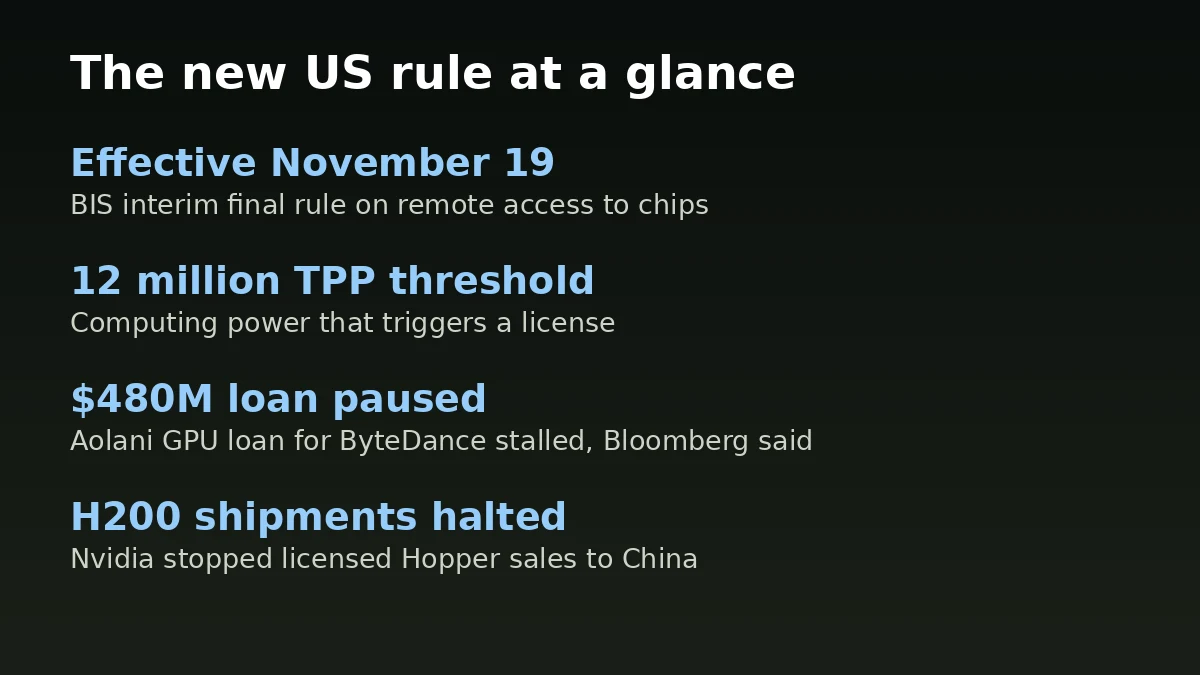
Graphic: GPTOnline. Key facts about the US remote access rule and related developments.
Why it matters
The remote access rule changes the economics for the neocloud providers that grew by renting Nvidia hardware to customers who cannot buy it directly. A license application is not a guarantee: the bureau says it will review applications case by case, and the 90 day clock is already running. For Nscale, which is asking public market investors to value it ahead of a listing, the ByteDance question is now a disclosure issue as well as a revenue one.
For ByteDance, the squeeze is tightening from two directions at once. Direct chip shipments are halting, and the remote route through third country data centers now needs Washington’s permission. The next test will be whether Nscale files for a license, and whether the bureau grants it.
Sources
- TechInAsia: US rule puts Nscale’s ByteDance business under scrutiny (reporting Bloomberg)
- KuCoin: Nscale may need a license to continue providing Nvidia chip computing power to ByteDance (citing Bloomberg)
- AI Stock Wire: ByteDance $480M Nvidia chip loan paused over US remote-access rule
- Business Standard: Nvidia stops shipping Hopper AI chips to China despite US approval
- TechCrunch: Nvidia is abandoning China after Jensen Huang’s ouster