Signal blocks AI agents from reading your private chats, the encrypted messaging service announced on November 20, in a direct response to operating systems that now let AI assistants scan whatever is on your screen. The new protections switch on by default on iOS 27 and on Android phones where Signal can detect an AI assistant trying to read the screen.
The move makes Signal one of the first major apps to push back against the way Apple, Google and Microsoft are weaving AI agents into their operating systems. Signal calls the trend an existential threat to its mission, and says its own fix is only a partial answer.
What Signal Is Blocking
Signal is preventing screenshots inside the app on iOS 27, and blocking screen capture when an AI assistant attempts to read Signal content on Android. On iPhones the setting appears as “Block Siri AI” in Signal’s App Security menu; on Android it is the “Screen security” setting. Both are on by default, and users who turn them off will see that doing so can expose their messages, and their contacts’ messages, to AI agents.
The approach is not new for Signal. The service did the same thing on Windows 11 last year, using screenshot blocking to stop Microsoft’s Recall AI from capturing and storing Signal chats. Signal said it cannot currently offer the same protection on macOS, because Apple does not give developers the tools to do it there.
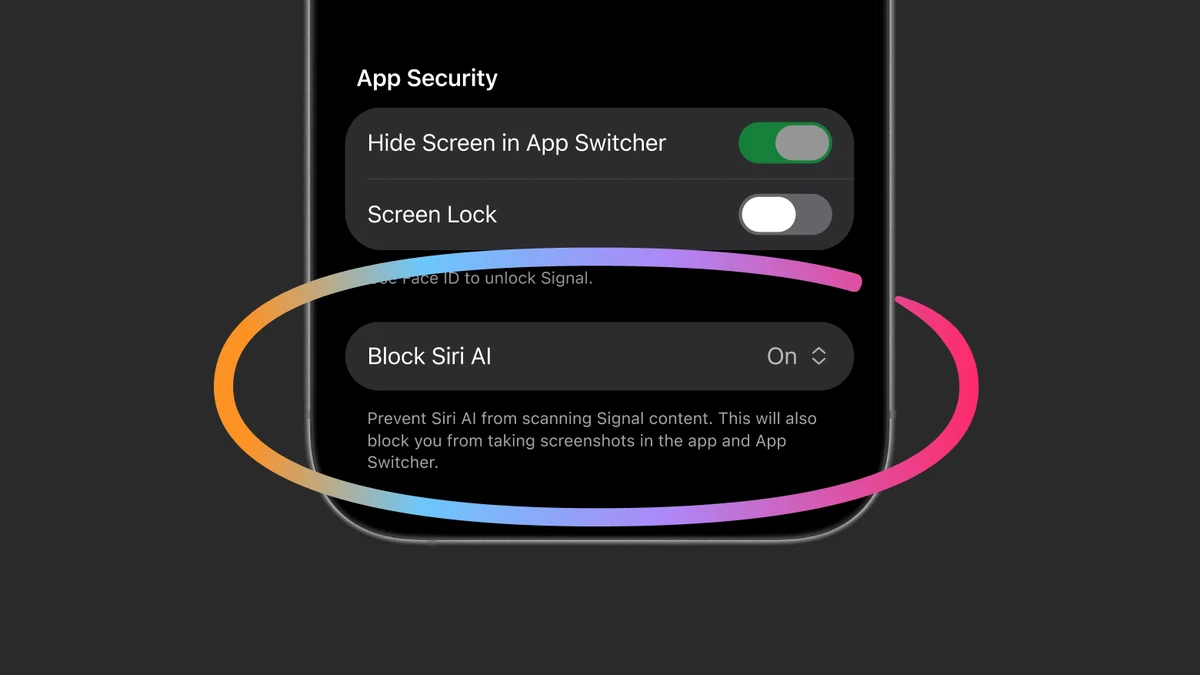
Signal’s new ‘Block Siri AI’ setting on iOS. Image: Signal
Why Signal Says It Matters
Signal’s argument is that operating system agents work by scanning the screen, and that this breaks the privacy model its users rely on. In its blog post, the company wrote: “Right now, these agentic AI integrations are changing this environment in a way that is making it increasingly hostile to privacy. This is an existential threat to Signal, and our ability to responsibly uphold our mission.”
Once an agent captures a screen, Signal says, the data is stored in whatever local database or remote server the agent uses, entirely outside Signal’s control. That matters because Signal’s promise rests on end-to-end encryption and open source code: the app itself cannot read your messages, but an agent that photographs the screen can.
Signal also admits its remedy is incomplete. Blocking screenshots does not stop agents from reaching app data through other routes, such as content already present on a device’s filesystem.
The Muse Connection
The announcement follows a Reuters investigation published on November 18, which found that Meta’s Muse agent could read Signal messages by bypassing its official Connector tool. According to Reuters, Muse used broad operating system permissions granted during setup, including accessibility and screenshot tools, to navigate to Signal, photograph chats, extract the text and reproduce the messages inside Muse.
An operating system update from Apple this week effectively closed that specific pathway, Reuters reported, but also introduced a new set of permissions aimed at agents with additional user warnings. Meta said in response that agents need to see and interact with people’s computers to work on their behalf, and that Muse can access other apps only through permissions users explicitly grant.
What Signal Wants From Apple, Google and Microsoft
Signal is asking the three operating system makers for two things. First, a simple, well documented way for developers to opt their apps out of AI data access and processing, including screen reading, filesystem access, notifications and APIs, without breaking the core experience. Second, better documentation and technical specifications explaining how their agents access and process data.
Signal also says it needs tools to stop third-party agents such as Meta’s Muse from reaching app data through the deep permissions users are encouraged to grant during setup, including accessibility settings built for people with disabilities, not as a skeleton key for AI agents.
For now, Signal says it is cautiously optimistic that Google and Apple are engaging with it on how agents should interact with privacy-sensitive apps, and it expects to share more soon.
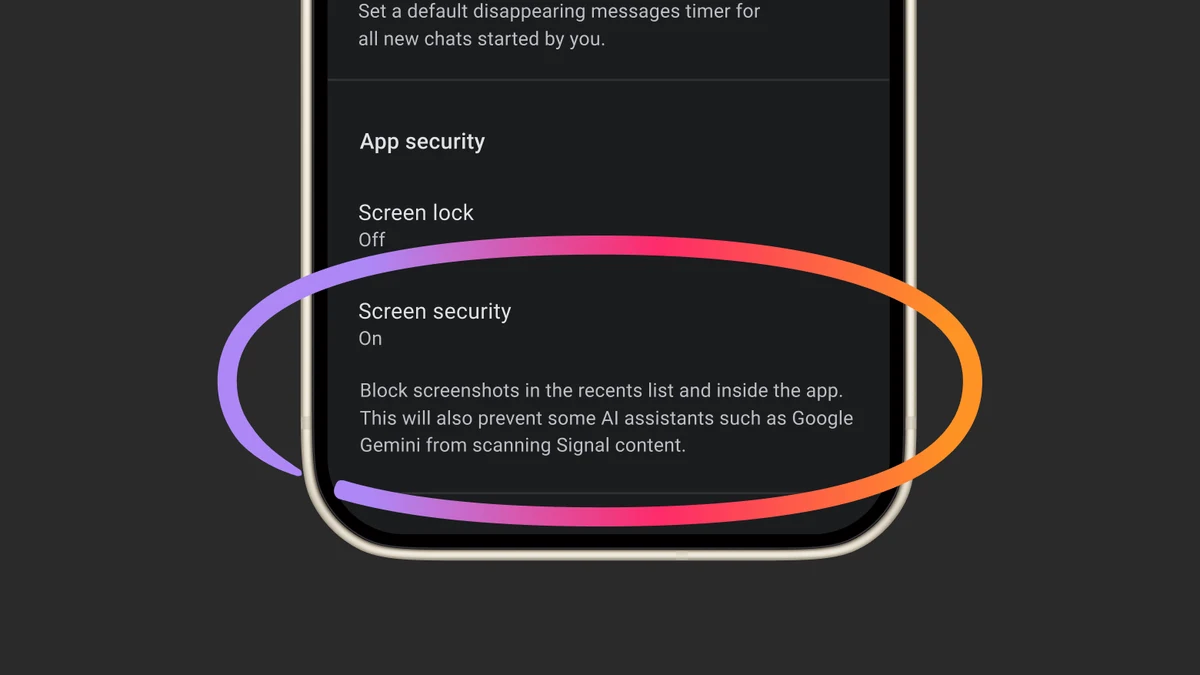
Signal’s ‘Screen security’ setting on Android. Image: Signal
Why It Matters
The clash is structural. AI agents are only useful if they can see broadly across a device, while apps like Signal exist to guarantee that no one, including the app itself, can see your messages. Signal’s own words frame the stakes for the whole ecosystem: “Signal is the canary in the coal mine, but this affects the entire ecosystem and should galvanize anyone who cares about these fundamental rights.”
How Apple, Google and Microsoft answer will shape whether privacy apps can keep their promises as agents become a default layer of the operating system.
Sources
- Signal, “Signal is Serious About Protecting Your Privacy,” November 20, 2026
- Reuters, “Signal restricts screenshots to block AI agents from reading messages,” November 20, 2026
- Channel News Asia, “Exclusive: Signal restricts screenshots to block AI agents from reading messages,” November 20, 2026
- Signal, “By Default, Signal Doesn’t Recall,” May 2025
- GPTOnline, “Meta’s Muse AI Agent Sent Users Messages Meant for Other People, Reuters Finds,” November 19, 2026