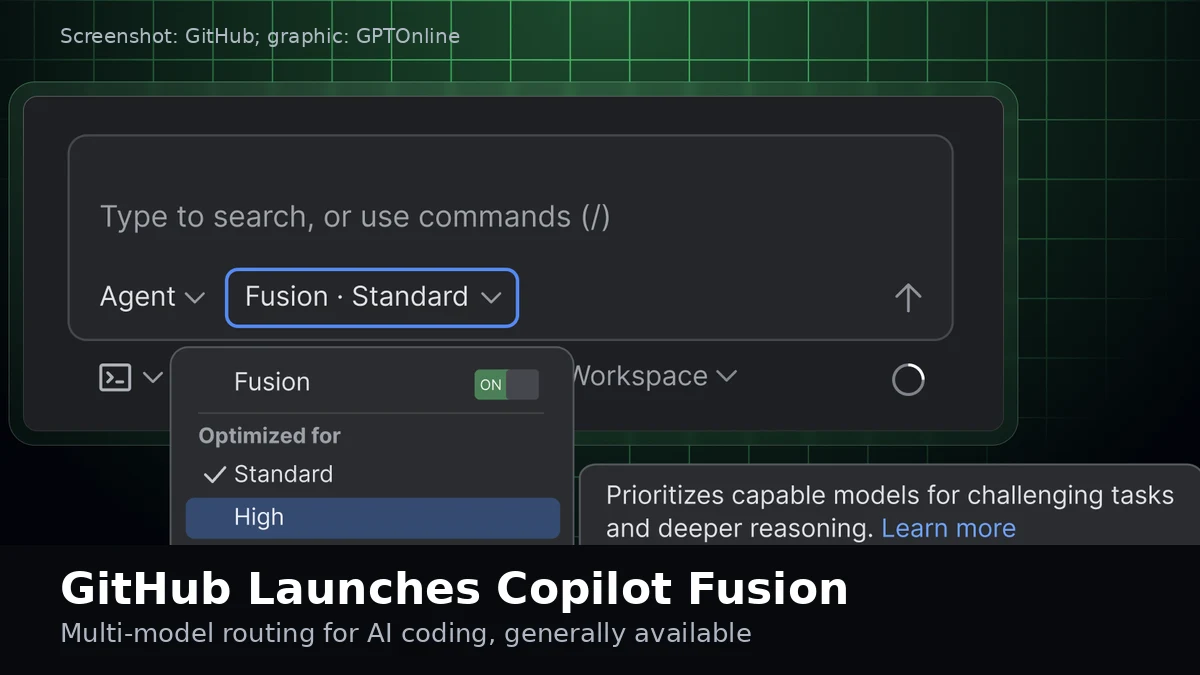
GitHub is taking the model picker out of developers’ hands. At its Universe 2026 conference on October 28, 2026, the Microsoft-owned company announced GitHub Copilot Fusion, a multi-model orchestration engine for AI coding that is now generally available. Instead of asking developers to choose which AI model should handle a task, Fusion evaluates the work across reasoning, code generation, debugging and tool use, then routes it to one or more models to balance quality, speed and cost.
Fusion is not a model itself, GitHub stresses, but a layer above the models. Developers select an effort level, Standard, High or Max, and Fusion handles model switching, cascading and critique workflows behind the scenes. The pitch is straightforward: frontier-level coding results at roughly half the cost of letting a single top-tier model do everything.
What Was Announced
The centerpiece of the Universe keynote is that Fusion is generally available as of October 28, replacing the current Auto model option in Copilot’s model picker, according to GitHub’s changelog. The rollout is gradual, reaching all Copilot users over the coming weeks, and GitHub is discounting Fusion use by 30 percent for the first 30 days.
Universe, held at San Francisco’s Fort Mason Center, also brought a cluster of related launches: a new GitHub Copilot app designed to take work from issue to merge in one surface; Copilot projects, which run agent work across multiple repositories in parallel managed sessions; and session continuity, which lets one cloud agent session follow a developer across the GitHub app, VS Code, the CLI and the web. GitHub also introduced Copilot code review Max, which it says posted the highest F1 score on ReviewBench for high-severity issues, while the lighter Lite and Balanced tiers handle routine reviews.
How Fusion Works
The three effort tiers define the trade-off. Standard prioritizes versatile models for everyday coding and selects one model per task. High reaches for more capable models on challenging tasks and deeper reasoning, accepting extra model calls when they are worth it. Max pulls in the most capable models for the most demanding work while still considering token efficiency. Enterprise administrators can also restrict which models Fusion is allowed to use, a control aimed at cost-conscious IT teams.
“Different tasks need different models. Developers shouldn’t have to manage every model choice to get the right result at the right price,” Jay Parikh, Microsoft’s EVP of CoreAI, wrote in the announcement post. “Copilot Fusion evaluates what a task needs across reasoning, code generation, debugging, and tool use, then chooses how to execute across one or more models.”
The launch arrives as token costs become a board-level concern. With more than 225 million developers on the platform, according to GitHub, soaring inference spending has pushed organizations to look for ways to cut costs without losing capability, a dynamic the Indian Express highlighted in its coverage of the announcement. Microsoft CEO Satya Nadella wrote on LinkedIn that Fusion delivers frontier-level quality 40 percent faster and at up to 77 percent lower cost.
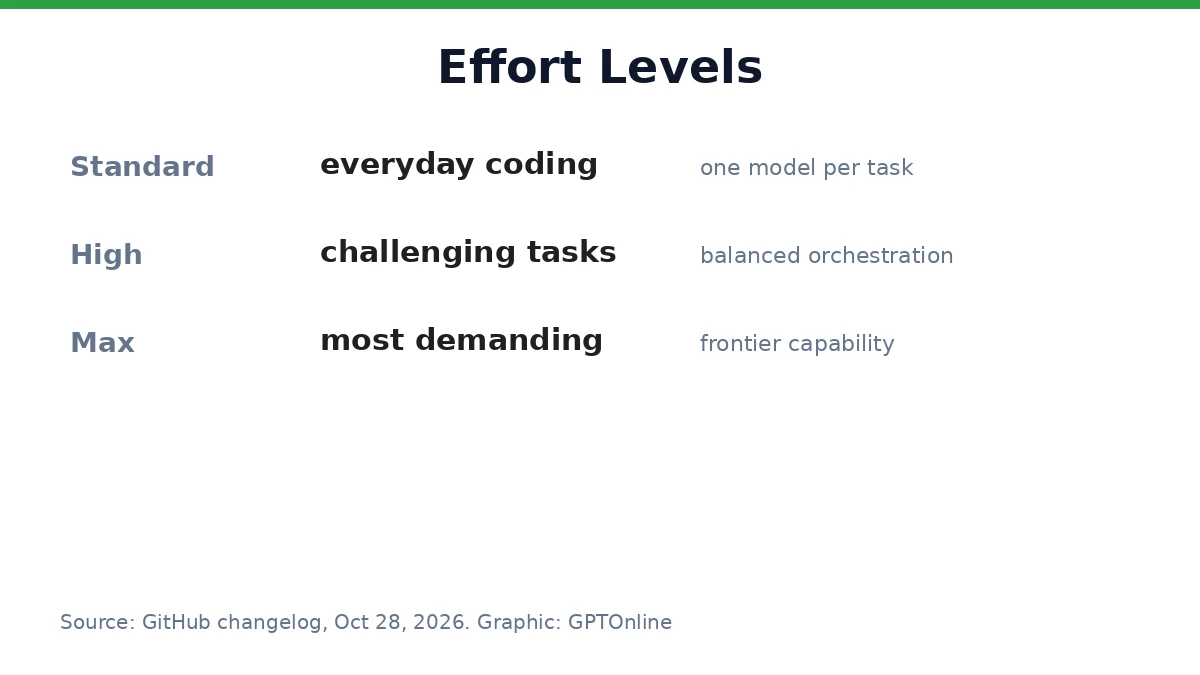
Copilot Fusion’s three effort levels. Source: GitHub changelog, Oct 28, 2026. Graphic: GPTOnline
Benchmarks and Pricing
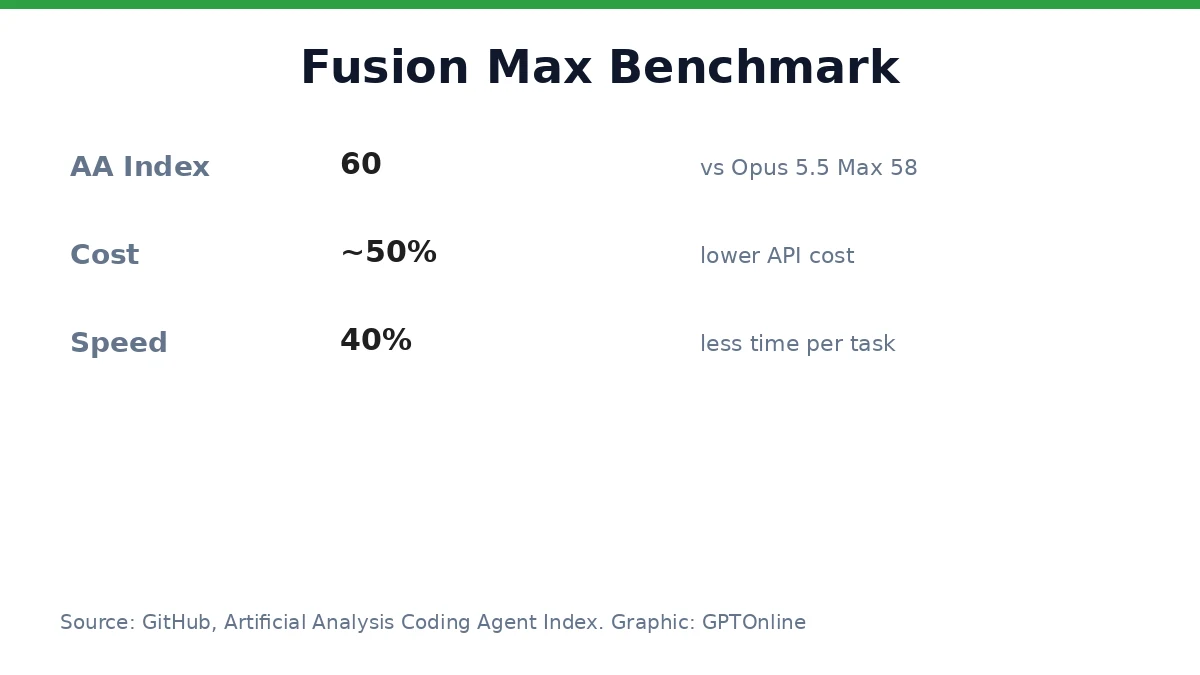
GitHub’s headline claim comes from the Artificial Analysis Coding Agent Index: Fusion Max scored 60, within two points of Claude Code powered by Opus 5.5 Max (58), while using about half the API cost and tokens and completing tasks 40 percent faster. As with all vendor-reported benchmarks, the figures reflect GitHub’s own evaluation setup, but the comparison deliberately frames Fusion as an efficiency play rather than a raw capability play.
On pricing, GitHub says Copilot Fusion use is discounted 30 percent for its first 30 days of general availability. Separately, GitHub announced that Enterprise customers can now use all Copilot features, including the Copilot app, code review and automations, without buying a separate subscription, paying instead for the AI credits they use.
The Bigger Picture at Universe
Fusion is part of a broader pitch GitHub made at Universe: the company wants to become what it calls “the most comprehensive software delivery system in the world,” with completed work rather than more code as the output that matters. To back that, GitHub detailed heavy infrastructure spending this year, adding 4 million CPU cores, 160 PB of high-speed storage and 50 Tb/s of network capacity, and said it expects to complete a multi-region Azure migration early next year, per reporting by Analytics India Magazine.
The company is also rebuilding its Git architecture to decouple compute and storage, a change aimed at handling the surge in agent-driven activity: GitHub says it saw 7.38 billion commits in September alone, roughly five times the previous month. As Blockchain.News summarized, the conference framed developers as moving from writing code line by line to orchestrating AI assistants and fleets of agents, with Fusion as the layer that keeps the model choices, and the bills, under control.
Sources
- GitHub, “GitHub Universe 2026: Evolving every layer of the stack,” GitHub Blog, October 28, 2026: github.blog/news-insights/company-news/github-universe-2026-evolving-every-layer-of-the-stack
- GitHub, “GitHub Copilot in JetBrains Universe releases,” GitHub Changelog, October 28, 2026: github.blog/changelog/2026-10-28-github-copilot-in-jetbrains-universe-releases
- Indian Express, “GitHub to developers: Copilot Fusion promises frontier-level AI coding at half the cost,” October 29, 2026: indianexpress.com
- Analytics India Magazine, “GitHub Expands Infra With 4 Mn Cores, Debuts Copilot Fusion for Multi-Model Routing,” October 28, 2026: analyticsindiamag.com
- Blockchain.News, “GitHub outlines agentic software delivery vision at Universe 2026,” October 28, 2026: blockchain.news