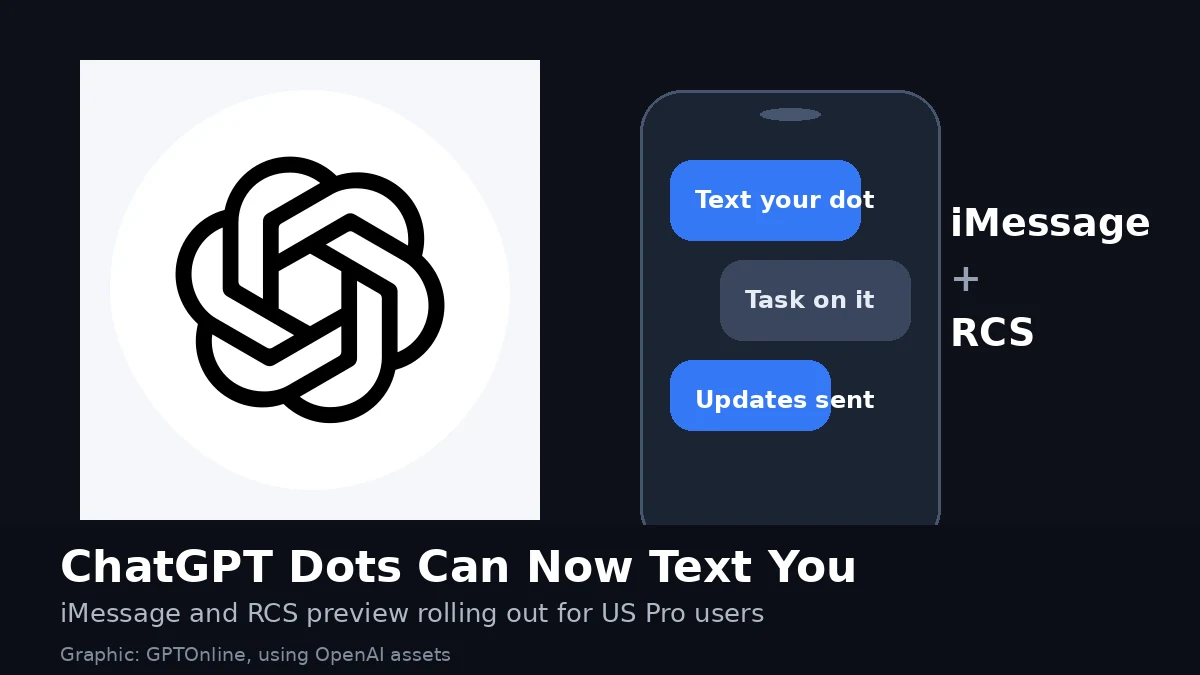
ChatGPT’s always-on agents are leaving the app. On October 28, 2026, OpenAI announced that ChatGPT dots, its personal AI agents launched at DevDay 2026, can now be texted directly over iMessage on iPhone and RCS on Android. The feature is rolling out as a preview for ChatGPT Pro users in the United States, OpenAI said in a post from its official @ChatGPT account on X.
“By popular request, you can now text your dot,” the company wrote. “Give it a task to take off your plate or something to keep an eye on, using text, photos, or even voice notes. It will text you proactively with relevant updates.”
The update fulfills a promise OpenAI made when it debuted dots late last month: that users would eventually be able to reach their agents by text. Until now, interacting with a dot required the main ChatGPT app on mobile, desktop or web.
How It Works
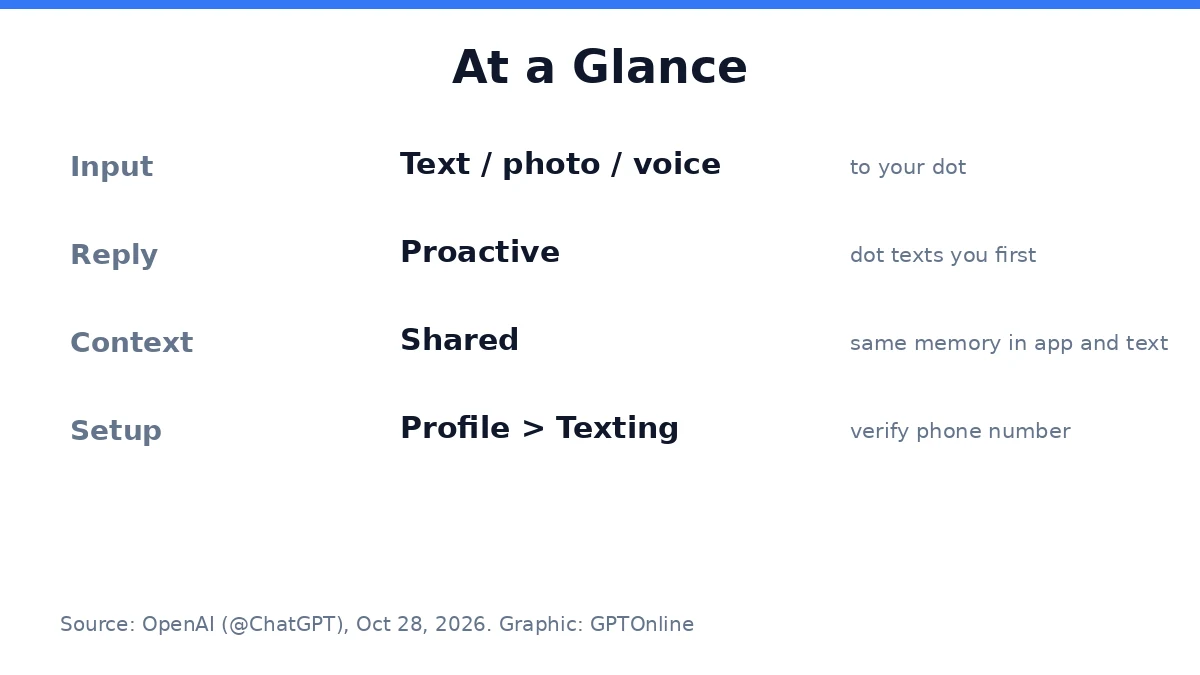
Setting up texting starts inside ChatGPT: users open their dot’s profile and select Texting, verify a phone number and enable iMessage or RCS on the phone, per reporting by Engadget and 9to5Mac. Once connected, users can send tasks by text, photo or voice memo, and the dot can text first with proactive updates on assigned work. The dot keeps the same memory, context and plugins it has in the app, so a conversation can move between the app and the text thread without repeating instructions.
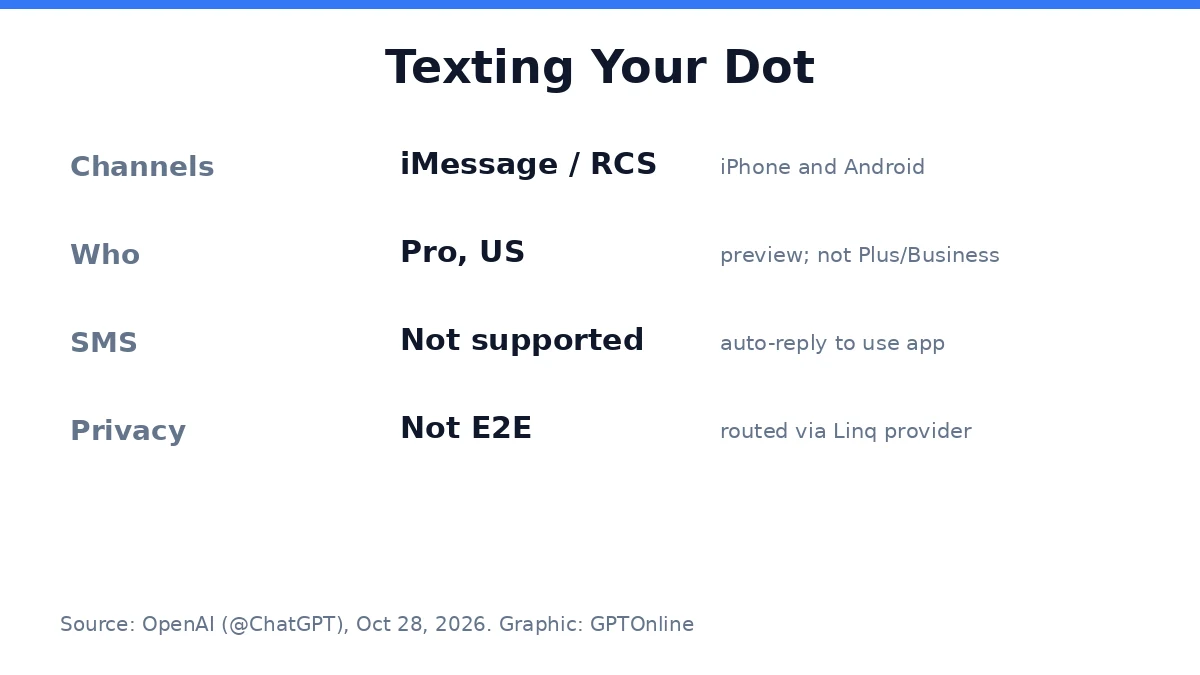
The scope is deliberately narrow. The rollout is a limited preview for US Pro users only, not available to Plus subscribers or Business and Enterprise workspaces. Plain SMS is not supported: texting over SMS triggers an automatic reply directing users to iMessage, RCS or the app instead. OpenAI stresses that the link is strictly one-to-one: “You’re the only one who can text your dot, and your dot can only text you,” and texting does not give the dot or OpenAI access to the rest of the user’s message threads.
The Privacy Caveat
The most important detail is in the fine print. OpenAI partnered with Linq, a third-party messaging provider, to route the texts, which means the conversation is not end-to-end encrypted between the user and the dot, even when sent over iMessage or RCS, as Windows Report noted. Linq keeps no message content after delivery, only metadata such as timestamps and delivery status, and OpenAI says it did extensive penetration testing, including with its own models and outside security firms, as part of the partnership. OpenAI’s own help page warns users to take care with sensitive information sent by text.
Note on the embedded announcement: the launch came via an official @ChatGPT post on X, whose direct URL could not be verified from outside the logged-in platform, so the post is quoted rather than embedded here.
Why It Matters
The move is a direct competitive shot in the personal-agent race. Anthropic launched Claude Duet, its own proactive agent app, just weeks earlier, and putting dots inside the phone’s default messaging app removes the biggest friction to daily use. If proactive agents become something users talk to like a contact, owning the text thread matters as much as model quality. For now, the rollout is small, US-only and Pro-only, but it is OpenAI’s clearest step yet toward making its agents live wherever the user already is.
Sources
- ChatGPT (@ChatGPT), official X post, October 28, 2026, quoted via 9to5Mac: 9to5mac.com/2026/10/28
- Engadget, “OpenAI Now Lets You Text Your Dot Agent,” October 29, 2026: engadget.com
- 9to5Mac, “OpenAI expanding ChatGPT dot access to iMessage and RCS,” October 28, 2026: 9to5mac.com
- AndroidPure, “ChatGPT Pro’s Dots Can Now Text You Over iMessage and RCS in the US,” October 29, 2026: androidpure.com
- Windows Report, “OpenAI now allows texting your ChatGPT dots, but messages aren’t end-to-end encrypted,” October 29, 2026: windowsreport.com