Updated October 15, 2026.
Leonardo.ai is a creative platform for generating and editing images, making AI videos, and exploring visual ideas. Its current tools also include a separate image-to-3D workflow. It can help an artist develop a direction or a team prototype an asset, but the result still needs review for quality, suitability, and rights before publication or production.
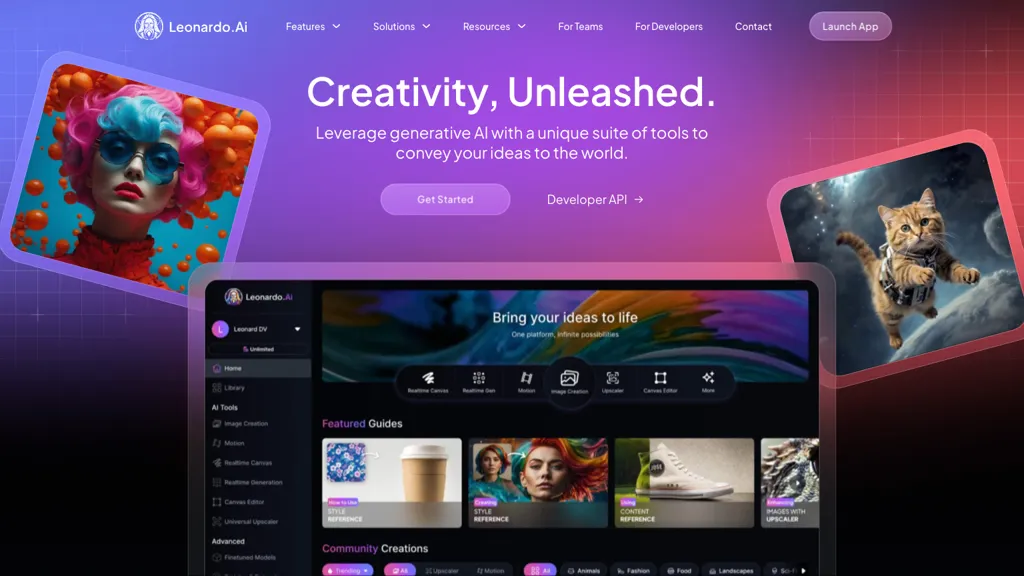
Image note: The retained featured image shows a historical Leonardo.ai homepage. The current interface and available features may differ.
What can Leonardo.ai do?
The platform combines its own models with models from other providers. Leonardo’s official model directory lists Lucid Origin, Lucid Realism, Phoenix, and Motion alongside third-party image and video options. Availability, controls, and costs vary by model; a feature supported by one model should not be assumed to work across the whole catalog.
- Generate and refine images: Start with a text description, choose a model and dimensions, and use reference images where supported. Outputs can be edited, upscaled, downloaded, or used as a starting point for video. See Leonardo’s image-generation guide.
- Explore visual directions: Flow State presents a stream of alternatives and lets you request variations on a promising image. It is useful for narrowing an initial idea before committing to detailed production work.
- Use guided workflows: Blueprints combine models, prompts, and settings behind a simpler input flow. Check each Blueprint’s description for its image or video outputs and its token cost.
- Develop a reusable visual style: Elements are Leonardo’s LoRA-based training tools for learning from a collection of images. They can help guide a recurring subject or aesthetic. Review each result rather than treating training as a guarantee of identical characters or perfect brand consistency.
For image-model selection, Leonardo describes Lucid Origin as a general-purpose option across visual styles, while Lucid Realism emphasizes cinematic imagery. These are provider descriptions, not comparative test results from this review.
Can it create game assets?
Yes, but the intended output matters. A character portrait, environment illustration, or prop concept is a 2D image. It can support art direction and may become part of a 2D project after editing; a picture of a three-dimensional object does not itself contain a usable mesh.
Leonardo now also documents 3D Generation powered by Hyper3D’s Rodin V2. This separate tool accepts up to five image references, generates a textured mesh, provides a 3D preview, and downloads a GLB file. Generations start at 400 tokens, with the cost changing by settings. That exceeds the free daily allowance, so Leonardo says a paid plan is needed in practice. The guide says this feature is currently unavailable in its mobile apps.
For a real game, budget time to inspect geometry, textures, scale, material behavior, and performance in the target engine. Check whether rigging, animation, collision shapes, optimization, or manual cleanup are still required. Those are production acceptance checks, not features this review verified. Neither a successful download nor an attractive preview establishes that an asset is ready to ship.
Plans, tokens, and ongoing costs
Leonardo offers a free tier and three paid individual plans. The following allowances were listed on its official pricing page when checked:
| Individual plan | Fast Tokens | Private generation |
|---|---|---|
| Free | 150 per day | No |
| Essential | 8,500 per month | Available |
| Premium | 25,000 per month | Available |
| Ultimate | 60,000 per month | Available |
Check the live web or app-store offer for the price, billing currency, renewal period, and applicable tax. The public web page excludes tax and offers monthly and yearly billing. This guide does not quote a consumer price because the public text checked did not explicitly identify its currency. Team plans and API billing are separate options.
According to the token FAQ, usage depends on the feature, model, references, size, and other settings. A token is not equivalent to one finished image. Check the displayed cost before generating, and budget for rejected attempts as well as successful outputs. Free tokens reset daily and do not accumulate.
Premium includes slower, token-free image generation on supported models once tokens are exhausted; Ultimate extends this to supported video models. This relaxed generation is restricted by model and demand. It should not be read as unlimited access to every tool or third-party model.
What rolls over?
The Rollover Bank can hold up to 25,500 tokens on Essential, 75,000 on Premium, or 180,000 on Ultimate. It requires an active paid plan. Downgrading can remove tokens above the new cap; cancellation ends the ability to retain the bank. Leonardo’s cancellation guide says the subscription stays active until its next renewal date, when unused subscription tokens expire.
Purchased top-up tokens are different: the pricing FAQ says they do not expire, but require an active subscription to use. For developers, the API pay-as-you-go guide describes a separate US-dollar balance charged by usage. Do not assume a consumer token allowance pays for API requests.
Commercial use, ownership, and copyright
Leonardo’s commercial-use guide permits commercial use of generated images for free and paid users, subject to its terms. That permission is distinct from exclusive ownership or a guarantee that an image is legally protectable.
Under the Terms of Service, sections 7 and 8:
- You retain your inputs and must have the rights and permissions needed to submit and process them.
- For paid subscribers, Leonardo assigns its rights in created content to the subscriber, subject to the terms and applicable law.
- For free subscribers, the terms assign output intellectual-property rights to Leonardo, where such rights exist.
- Outputs may resemble other users’ results. Leonardo disclaims warranties including fitness for a purpose and non-infringement, subject to consumer-law rights.
Review reference-image licenses, identifiable people, trademarks, and resemblance to existing work before using an output commercially. The service’s contractual permission cannot establish copyright protection or clear every third-party right for a particular asset.
Are prompts and images private?
Free creations are public by default and may appear in search results. Paying makes Private Mode available; check that it is enabled before generating confidential work. The privacy policy says public content may be analyzed for service improvement and model training, while private content is excluded from Leonardo’s model training.
Section 8.5 of the terms limits use of private content to performing obligations or exercising rights under the agreement; other uses, including model training, require express written consent. Public content carries a broad license to Leonardo.
Private Mode is not a promise of zero storage or processing. The privacy policy still describes service providers, safety checks, support, and legal disclosures. Use only material you are authorized to upload, and check your organization’s requirements before submitting confidential client work.
Mobile apps and access
Leonardo is available through its web app and official mobile apps. Its help center links to the Apple App Store and Google Play listings. Check the developer name, Leonardo Interactive Pty Ltd, rather than choosing an app solely because it contains “Leonardo” in its title. Feature availability can differ between web and mobile.
Example: a fictional game prop
Illustrative workflow only; this example was not tested. Imagine an indie team needs a lantern for a fictional woodland adventure.
- Write an original brief: “A small brass lantern with a leaf-shaped handle, front view, plain light-gray background, soft even lighting, no lettering.”
- Generate a few 2D directions using a small, fixed token budget. Compare silhouette and readability before spending more on detail.
- Record the selected model and settings, and keep only references the team owns or is licensed to use.
- If the project needs a mesh, evaluate the separate 3D workflow and inspect the downloaded asset in the team’s actual engine. If it needs an icon, focus instead on edges, contrast, transparency, and size.
- Approve the result against a written art brief and technical checklist. Keep a record of human edits and rights checks before release.
This makes Leonardo most useful as part of a deliberate creative workflow. Start with a modest task, inspect the output, and choose a paid plan only when its privacy, capacity, or specific tools solve a real need.
For another visual-generation option, see our Midjourney overview and compare the workflow, plan limits, and privacy requirements with your own project.
Review method: Official product pages, help documentation, pricing, and policies were checked on October 15, 2026. No account login, image or video generation, 3D export, purchase, or hands-on performance test was performed for this update.