Google DeepMind has unveiled Genie 4, its newest world model, and the headline feature is sound. Announced on October 27, 2026, the model generates music, ambient noise and interactive dialogue at the same time as the world itself, so the characters inside a simulation can talk back while you explore it. Alphabet and Google chief executive Sundar Pichai called it “our most realistic and interactive world model” in a post announcing the launch, as reported by The Times of India.
World models turn a text prompt or an image into a place you can walk around in, rather than a fixed video clip. Genie 4 pushes that idea further: it looks more photorealistic, it sounds like a real place, its people behave more like people, and you can rewrite the scene while it is running. Google DeepMind describes it as a model that “unlocks unprecedented realism and improves real-time interactive simulation.”
What Was Announced?
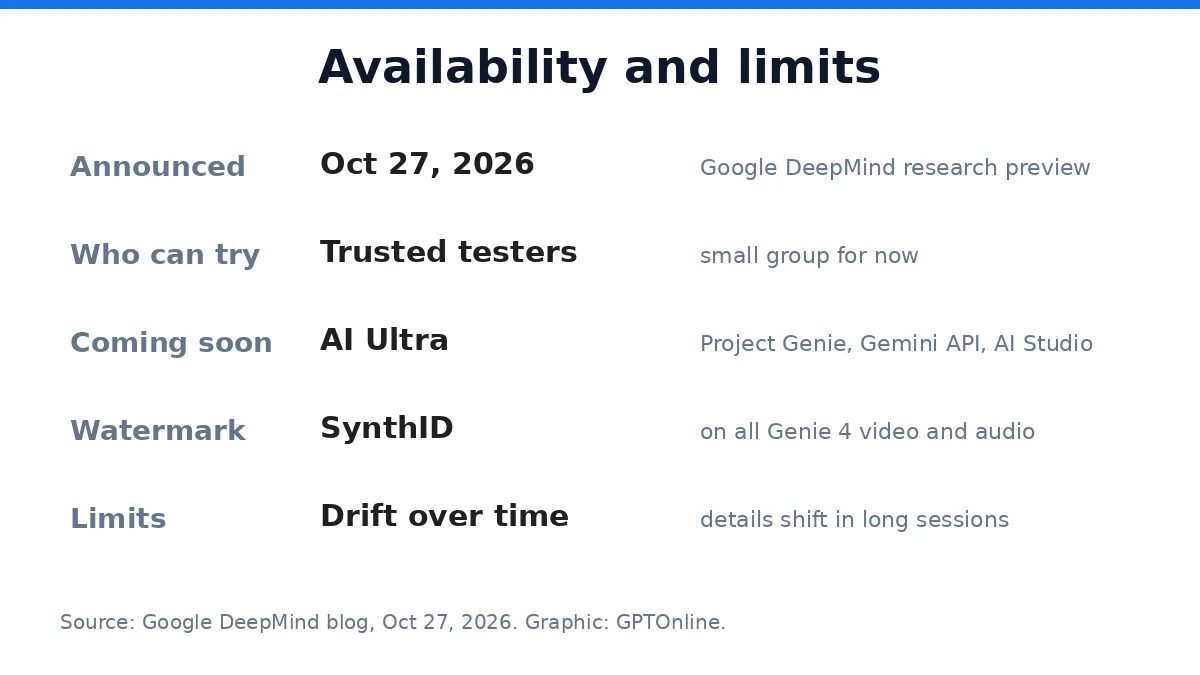
Genie 4 is a research preview, available first to a small group of trusted testers. Google DeepMind says it will reach consumers and developers next, starting with Google AI Ultra subscribers in Project Genie and early access partners of the Gemini API and Google AI Studio. A waitlist is open in Project Genie.
That staged rollout follows the pattern of its predecessor. TechCrunch notes that Genie 3 was previewed in August 2025. Genie 4 doubles the coherent scene length to up to two minutes, up from Genie 3’s one minute cap.
What Is New in Genie 4
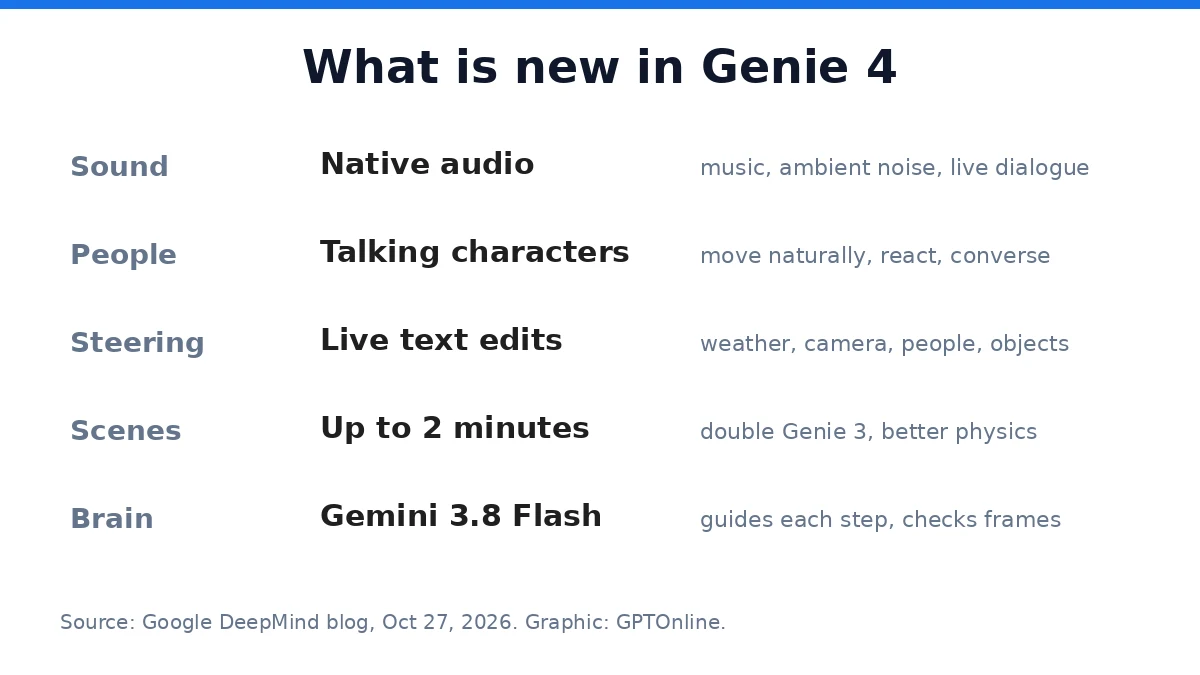
Google DeepMind lists four advances. The first is real-time steering. You can type changes while the world runs, such as new weather, a different camera angle or an extra person or object, and Gemini adapts your prompt to fit the scene. Between your inputs, Gemini also monitors and steers the scene to keep the world progressing in a coherent way.
The second is realism in physics and human action. Genie 4 simulates real-world physics such as aerodynamics and collisions, and DeepMind calls the human simulation the biggest jump of all. “The most dramatic leap is how Genie 4 simulates people, creating characters that move naturally, respond organically to their environments, and can be interactively steered in real-time,” the DeepMind team wrote.
The third is sound, and it is the first time a DeepMind world model has generated audio natively. “Every world carries the ambient sound of its own setting, from wind in the trees to waves crashing at the beach,” the blog post says. “The true frontier, however, is human speech. Genie 4 introduces interactive dialogue that adapts on the fly. Characters converse and react to your inputs or events in the world, all in real-time.”
The fourth is reasoning. Genie 4 brings Gemini models into the loop to plan multi-step events, so a scene can play out a chain of cause and effect instead of just reacting frame by frame.
Gemini Does the Directing
Genie 4 is built on the Gemini family. Gemini Omni anchors each simulation in real-world appearance and behavior, while other Gemini models provide the reasoning that keeps a scene coherent. Behind the scenes, Gemini 3.8 Flash works as a guiding agent: as Genie 4 renders the world, Gemini observes the scene, breaks broad goals into sequential steps, and reviews incoming frames to check that each step succeeded. When the world shifts or the user intervenes, Gemini adapts its plan in the moment.
DeepMind also showed the combination working with its robotics research. In one experiment, Gemini 4 Argon broke down a task into steps for Genie 4 to render: Apptronik’s Apollo humanoid playing a game of checkers. The steps appeared as text captions while the simulation rendered, pointing to a way of testing robot scenarios in imagined worlds before trying them in the real world.
Availability and Limits
For now, almost nobody can try Genie 4. It is a research preview for trusted testers, with the wider release to Google AI Ultra subscribers and Gemini API and AI Studio partners still to come. There is no public pricing yet, which fits a preview aimed at gathering feedback before a broader launch.
DeepMind is also clear about the limits. Genie 4 remains an early, experimental model. Visual details and object permanence can still shift or drift over time, especially as a simulation runs longer, after multiple complex prompt edits, or while navigating through a scene. Complex physical interactions, real-time audio accuracy, rendering legible text, spatial accuracy and long-term consistency are all active areas of research.
On safety, DeepMind says Genie 4 includes strict guardrails consistent with its policies across other models, and that it ran internal safety evaluations before the preview. All video and audio generated by Genie 4 will carry SynthID, Google’s imperceptible digital watermark, to mark the content as AI generated.
Why It Matters
Genie 4 lands in a world model market that is heating up fast. TechCrunch reports that Runway released its second world model, GWM Worlds 2, a couple of months ago, while Fei-Fei Li’s World Labs is being acquired by AMD, Amazon is in talks to buy Decart, and Rivian has acquired Third Dimension to bring simulation in house for self-driving testing. Google’s answer is to make its worlds sound alive and let Gemini direct them, a combination aimed as much at robotics training and film pre-visualization as at games.
The most telling detail may be the trusted tester feedback DeepMind cites. Filmmakers are testing Genie 4 as a rapid draft mode for pre-visualization, running multiple takes of a scene in real time. Photojournalists are exploring how a single archival photograph can become a grounded simulation of a historical space. If those workflows hold up outside the preview, world models stop being a demo category and start being a production tool.
Sources
- Google DeepMind: Genie 4, A new generation of world simulation (October 27, 2026)
- TechCrunch: Google’s Genie 4 world model adds audio, more realistic worlds, and real-time steering (October 27, 2026)
- Gizmodo: Google’s New AI World Model Can Generate Human Voices, Not Just Video (October 27, 2026)
- The Times of India: Google DeepMind launches Genie 4, CEO Sundar Pichai calls it “our most realistic and interactive world model” (October 27, 2026)