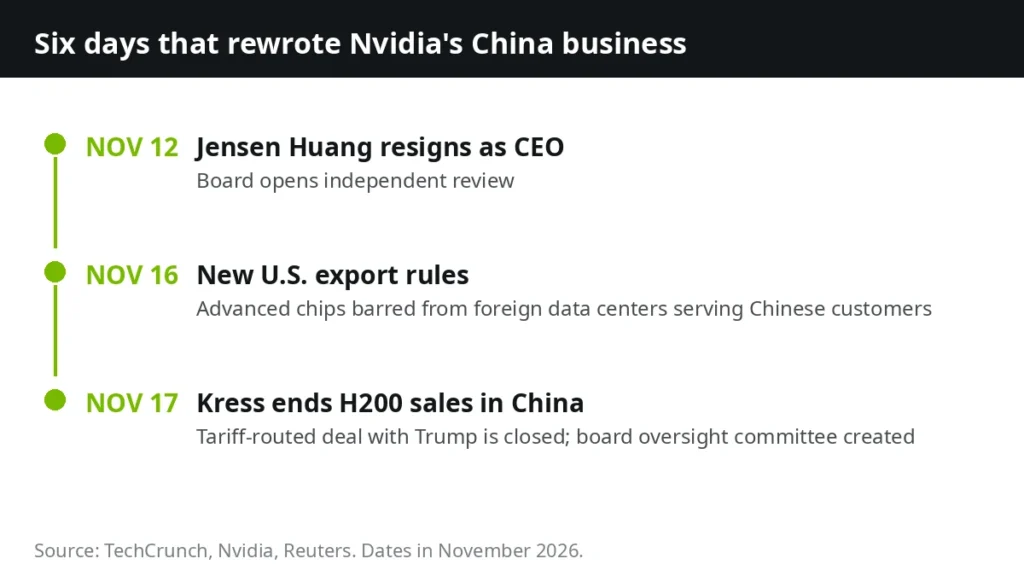
Nvidia will no longer sell its H200 chips in China, acting chief executive Colette Kress said on Tuesday, ending the company’s participation in a controversial arrangement that let advanced American chips reach Chinese buyers despite U.S. export controls. The announcement came on Nvidia’s first earnings call since co-founder Jensen Huang stepped down as chief executive last week, and it marks the sharpest break yet with Huang’s China strategy.
The decision closes a sales pathway that Huang himself negotiated with President Donald Trump. Under that deal, H200 chips bound for China were shipped through the United States, allowing the government to collect a 25% tariff on them. Kress’s announcement ends Nvidia’s role in the arrangement entirely, according to TechCrunch.
What Was Announced?
Speaking on the company’s fiscal third-quarter earnings call, Kress said Nvidia will stop selling H200 chips in China. The H200 is a Hopper-generation data center GPU widely used to train large AI models, and it was the most advanced Nvidia chip Washington had licensed for sale in China.
The disclosure came the same day Nvidia announced a new board-level committee to oversee national security policies, export control compliance and global trade risks. The committee was formed as the company faces an SEC investigation into whether its disclosures misled investors and a board-led review of Huang’s departure.
Nvidia also reported a blockbuster quarter on the same call, with revenue of $115.8 billion, up 103% year over year, as covered in GPTOnline’s earnings report. Kress argued that the China exit would not dent that momentum.
The Deal That Is Ending
The H200 arrangement angered China hawks in Washington who wanted to deny Chinese labs computing power and preserve the United States’ lead in AI. Huang long argued the opposite, that it was more important for the U.S. to compete in China than to concede the market. In April, he told podcaster Dwarkesh Patel that “to concede that market for the United States technology industry is a disservice to our country.”
Huang’s ouster was in part connected to an affair with the chief executive of a company under investigation for smuggling chips into China, according to TechCrunch. His departure has coincided with a rapid tightening of the rules around Nvidia’s China business.
Even before Kress’s announcement, the H200 pathway was already stalling. China had largely refused to accept delivery of the chips, preferring to build demand for its domestic chip industry even though major Chinese AI users want the still-superior Nvidia hardware, according to Jacob Feldgoise, a researcher at Georgetown’s Center for Security and Emerging Technology. About 600,000 licensed H200 chips were already stuck in Hong Kong as Beijing withheld import approval, Reuters reported earlier in November.
New Export Rules Raise the Stakes
On Monday, the U.S. issued new rules barring advanced American chips from foreign data centers that serve Chinese customers remotely. The rules close the workaround that had sustained much of the China trade, and they go beyond the H200 decision itself.
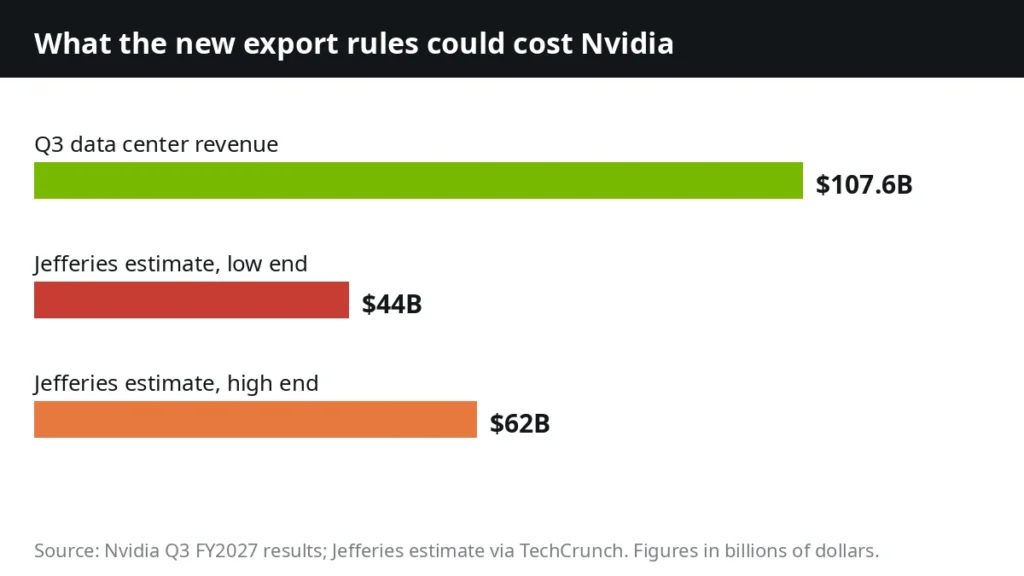
Investment bank Jefferies forecast that the new rules might trim between $44 billion and $62 billion from Nvidia’s data center revenue next year. Kress pushed back on that estimate, saying the backlog of demand for advanced chips such as Vera Rubin means the rules would have no impact on the company’s top-line revenue.
The longer-term exposure may be wider. Critics of Nvidia’s dependence on China claim that as much as 20% of its revenue comes from demand linked to the country, and TechCrunch noted that annual revenue at Nvidia’s Singapore subsidiary hit $104 billion in 2025, citing the Financial Times, before Nvidia stopped disclosing those figures. In the long term, the company may also lose potential customers in Singapore, Malaysia, Thailand and Indonesia as the rules bite.
Chinese labs, meanwhile, are already finding ways around the restrictions. All of China’s leading AI models show evidence of having been trained on Nvidia Grace Blackwell chips that are prohibited from being exported to China, according to TechCrunch. That training may have taken place at data centers outside China, but sales to those facilities will now be barred under the new rules.
“If large data centers suited for training AI models want to buy Nvidia chips, they will have to certify they aren’t serving any Chinese customers,” export control attorney Dan Fisher-Owens told TechCrunch. If they cannot provide that certification, the new rules may force them toward other chip options and further eat into Nvidia’s market share.
Why It Matters
The H200 exit ends the most politically charged chapter of Nvidia’s China business and signals how decisively the company’s new leadership is breaking with Huang. Where Huang fought to keep Nvidia competing inside China, Kress is accepting Washington’s direction and betting that demand for Vera Rubin and the rest of Nvidia’s lineup is strong enough to absorb the loss.
The gamble may pay off in the short term. Nvidia’s order book is full, and its data center revenue grew 110% last quarter. But the Jefferies estimate shows the scale of what is at stake if the export rules spread to more of the region’s data center demand, and the 600,000 chips already stranded in Hong Kong show how little of the China market was actually buying. For an industry that has treated Nvidia’s China sales as a permanent fixture, the era of the tariff-routed H200 is over.
Sources
- TechCrunch: Nvidia is abandoning China after Jensen Huang’s ouster
- GPTOnline: Nvidia Posts $115.8 Billion Quarter, Up 103%, in First Report Since Huang Exit
- GPTOnline: SEC Is Investigating Nvidia Over Whether Disclosures Misled Investors, WSJ Reports
- GPTOnline: About 600,000 Nvidia H200 Chips Are Stuck in Hong Kong as China Withholds Import Approval