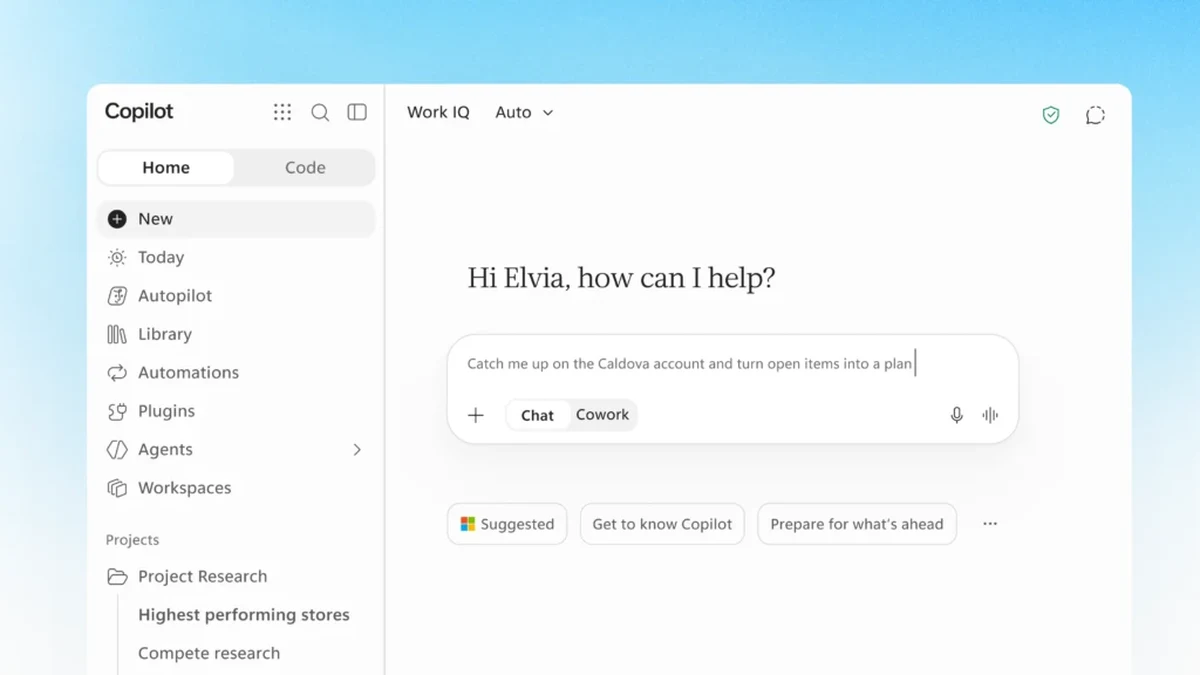
Microsoft has moved Word, Excel and PowerPoint inside Copilot, turning its AI assistant into the main place where office work happens. The company announced the change at its Ignite conference on Tuesday, November 17, calling the rebuilt Copilot the new operating system for work.
Office in Copilot is now generally available, Microsoft said in its official Ignite announcement. Users can create documents, spreadsheets and presentations directly inside the Copilot app, then keep editing the same files in the regular Office apps. The move inverts the traditional model: instead of opening an application first and calling on an AI assistant inside it, the agent leads and the Office apps act as components it calls on when needed.
What Was Announced?
The centerpiece is Office in Copilot. Microsoft says users can move from an idea to a finished document, editing and coauthoring with teammates without leaving Copilot. Every file inherits Microsoft 365 permissions, sensitivity labels and compliance controls from the start, so work created by the agent stays inside the same governance rules as work created in Word or Excel.
Microsoft also made Copilot Home generally available. Home brings Chat and Cowork together in a single starting point with one composer, and its Auto mode picks the model and effort level for each request, balancing quality, speed and cost. Employees can also choose a model from OpenAI or Anthropic themselves, where their organization allows it. A new Today view, a command center across mail, calendar, Teams meetings and tasks, is in private preview in the Copilot app and Outlook.
Underneath sits Work IQ, the context layer that lets agents understand a company’s people, relationships, emails, meetings and projects. Microsoft says Microsoft 365 now holds more than 19.5 exabytes of data, with 90 billion emails, 15 billion Teams messages and 10 billion new files added every week.

Microsoft CEO Satya Nadella. Photo: Richard Morgenstein, CC BY-SA 4.0, via Wikimedia Commons
Autopilot and Workspaces: Agents That Stay On
The other headline is Copilot Autopilot, a persistent, proactive agent for personal productivity. Unlike a chatbot that answers one question at a time, Autopilot is given ongoing responsibilities: it watches Teams channels and email, runs recurring work and manages projects, and can be mentioned in a chat the way a colleague would be. Microsoft says each Autopilot has its own Microsoft Entra Agent ID and a named manager, IT can limit its permissions or block it at any time, and its sign-ins and actions are logged under its own name.
Autopilot is beginning to roll out to customers in Microsoft’s Frontier early access program, not to everyone at once. Copilot Workspaces, shared spaces where people and agents build on each other’s work, are also available in Frontier. Microsoft describes the shift as turning AI interaction from single player to multiplayer, with people and agents driving toward a common goal with shared context.
Copilot Code, which builds dashboards and apps from plain language descriptions, will become generally available in the coming weeks. Copilot Managed Runtime, for securely hosting and managing apps inside a customer’s tenant, is generally available now.
Pricing and Availability
Microsoft announced no dollar prices for the new Copilot pieces. The company says Office in Copilot is already included in the Copilot subscription license. “This is the only AI tool where you can create a PowerPoint deck or Excel spreadsheet without spinning a meter,” the company wrote, meaning the work does not trigger a separate usage charge. Autopilot, by contrast, will use usage based billing through Copilot Credits, with final pricing still to come, according to Ars Technica’s report from the keynote.
Microsoft also leaned on cost comparisons to make its case, citing a GigaOm report that put Copilot 84% cheaper than Claude and 63% cheaper than ChatGPT for typical users at equivalent quality, and 68% and 35% cheaper for advanced users. Those are Microsoft’s chosen figures from a vendor commissioned study, not independent test results, and the company did not publish the underlying test details in the announcement.
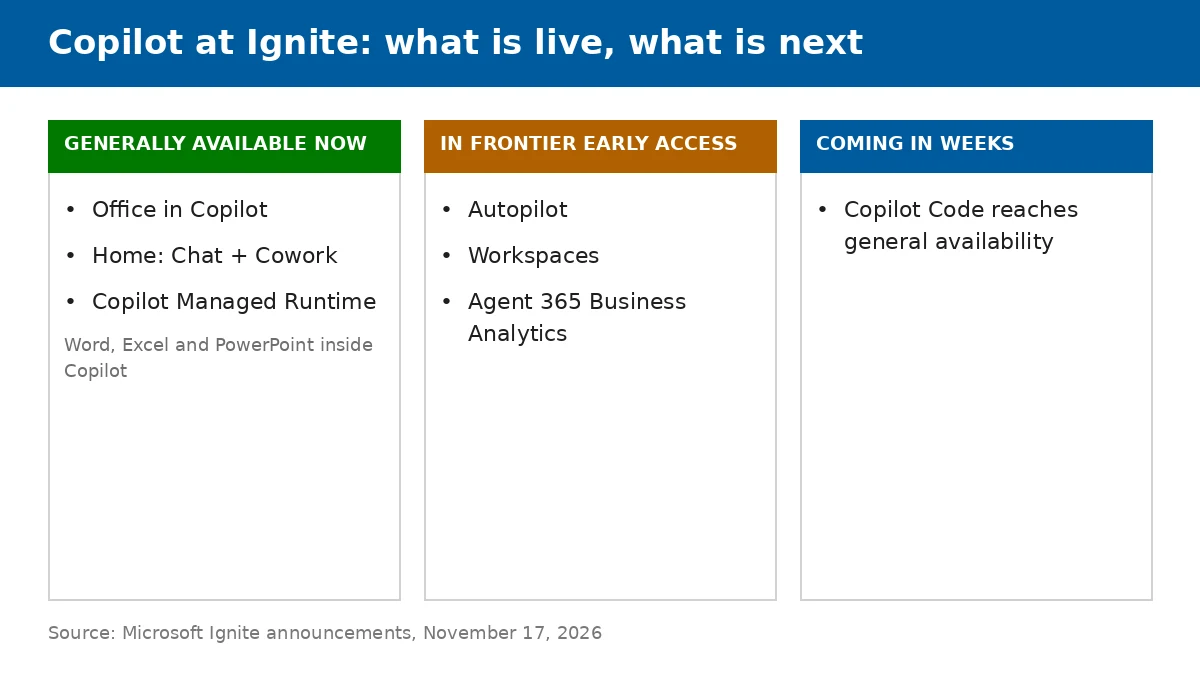
What is generally available now, what is in Frontier early access, and what is still to come. Graphic: GPTOnline, based on Microsoft’s Ignite announcements
Why It Matters
The announcement is Microsoft’s clearest answer yet to OpenAI and Anthropic in the race to own the workplace. Anthropic recently took Claude into the office with Sheets, whiteboards and meetings, and Microsoft’s own six MAI models unveiled at the same Ignite event showed it wants its own models in the mix too. Now Microsoft is betting that the winner is not the best model but the best home for work: the place where the files, the meetings and the permissions already live.
That bet comes with a trust problem Microsoft spent much of the keynote addressing. The company’s pitch is that agents can be autonomous in execution but bounded and supervised, with every action logged and human approval available before sensitive steps. It also announced an AI Transparency Initiative with more than 40 companies, including Adobe and Mastercard, to develop open industry standards for AI governance and security. Judson Althoff, chief executive of Microsoft’s commercial business, put the competitive claim bluntly: “anything you can do with Claude or ChatGPT, you can do better with Copilot, for less.”
Whether customers accept the inversion remains to be seen. Microsoft says nearly 80% of the Fortune 500 already use Copilot Cowork, and points to Eli Lilly, where more than 5,000 people use Cowork each month. The test now is whether workers who have spent decades opening Word first will start opening Copilot first instead.